Tuesday, January 31, 2006

The Christian Tradition Continues

The son of Crown Prince Frederik and Crown Princess Mary of Denmark was christened on January 21st. Born on October 15th 2005, his name was a secret, for reasons unknown, until his mother spoke them at the moment of his baptism - Christian Valdemar Henri John.

I had previously written about his name in my post The Naming of a Prince. I don't envy the parents who must have felt pressure to continue the tradition that alternates Christian and Frederik for future kings of Denmark. They said the name had been decided for some time and that it wasn't a difficult choice. But I disagree. What if they didn't like the name Christian? What if they had wanted to call him Frederik? Maybe these thoughts were running through their minds. We'll never know. In the end they decided to go with Christian, thus avoiding upsetting the order of things. But really, there are plenty of other perfectly good monikers available, just read the World of Royalty Blog, which mentions the various Danish names the couple could have chosen.

I have to say that I'm a bit disappointed by the choice of Christian. It's a nice name but it was no surprise. Not to mention a complete lack of originality. Of course I would have bended too but still, isn't part of the fun of choosing a name dashing the hopes of everyone around you? Especially people who make unsubtle suggestions. Sure people discussed the possibility of 'Gorm', highly unlikely but maybe it was on their list. Erik and Christopher would have been modern choices with precedent and Hans has a good ring to it in the year that celebrated the 200th birthday of Hans Christian Andersen. I'm not a fan of choosing a name that is currently fashionable, so 'Canute' would have made the prince stand out amongst his prep school peers. Don't feel so bad, his bodyguards would have protected him.

Hopefully the Prince and Princess will have more leeway in choosing the name of their second child. If it's a boy they could go with some of the names I've mentioned above. If it's a girl, how about Marilyn??

Just a suggestion.

© Marilyn Braun 2006

Wednesday, January 25, 2006

A meal fit for a Queen

Members of the public are being asked to choose what the Queen will eat for her birthday luncheon. Instead of contributing to the poll, I've decided to respectfully submit my own four course menu. I've read that the Queen and Prince Philip enjoy simple fare and I'm a big fan of the four basic food groups, in the parlance of Martha Stewart - it's a good thing. When you're the Queen's age, it's even more important to eat healthy. However, she shouldn't sacrifice taste, so here are my suggestions:

Appetizers

Weiners de cocktail & Poppers de japaleno (always good to have a vegetarian option)


Soup


Potage des pois fendu avec du jambon

I love split pea soup. Sure you could do potage de courge de butternut avec la sauge, but why not try something different?


Main Entree


Mini-pieuvres avec Dîner Kraft or Macaroni au fromage et aux légumes

Or more commonly known as macaroni and cheese. It's a classic standby, it's easy, it's tasty and according to the box it has some nutritional value. Serve it with tuna, add a sprig of parsley and voila, it becomes a $20.00 entree at an expensive restaurant.

Dessert

Bagatelle des fêtes au JELL-O

A staple of hospital and nursing homes, JELL-O is an easy standby and it doesn't have any calories. Add garniture fouettée Cool Whip, décongelée, mmmm, mmmm, mmmm, good!

Bon appétit!

© Marilyn Braun 2006

Friday, January 20, 2006

Royal Rumour has it...

Rumour has it that the Queen will step back, pare down on her duties and allow the Prince of Wales to act as Regent.

If true, I'm disappointed. I'm not a monarchist, but I'm comforted knowing that the Queen is still around. Like a grandparent I never visit, on a personal level, I care about her. She's the only queen I've ever known. She's on my stamps, my money, and on the various souvenirs I collect.

The Queen, of course, as earned the right to kick back and relax a bit. She'll be 80 in April. When her peers are retiring and spending winters in Florida, playing canasta, and making crafts with sea shells, she is doing investitures, reading important papers, travelling, and holding state dinners for 200+. Admirably she's still going strong.

Sure the Prince of Wales will do a great job, he's been apprenticing since he was 3 1/2 years old. Unlike Queen Victoria, who did not allow her heir, Edward VII, to access any papers, the Prince of Wales will be more prepared for his future role by QE2. It's reassuring, but it's not the same. What about the glamour and pagentry of monarchy? No one wears a tiara and priceless jewels like the Queen.

But should he really be handed the reins at the moment? With all of the furor surrounding his marriage to Camilla, shouldn't she let the dust settle? Won't this bring up all sorts of issues? His suitability as king? His name as sovereign? Camilla's title? His religious beliefs? There are all sorts of things for royal experts and the annoying Penny Junor to speculate on.

In her Coronation vows, I don't recall hearing anything about stepping back. Maybe it's in the interpretation. If we question her dedication, there are royal loopholes and disclaimers to prove us wrong. Legal experts will tell us we should have read the fine print.

It's nothing new for an heir to take on more duties when the monarch is unavailable or incapacitated. The Queen, when she was Princess Elizabeth did so, but it just seemed different then. With a young and beautiful queen there was something to look forward to. Can we say the same thing about the Prince of Wales?

I'm sure the Prince of Wales will make a great king; when the time comes. Until then I'm just not ready to see her go.

Let's hope it's just a rumour.

© Marilyn Braun 2006

Tuesday, January 17, 2006

Royal Review: Freddy and Fredericka by Mark Helprin

I have to say that I was looking forward to reading this book. One chapter in I started to have my doubts about that.

Freddy and Fredericka is about a fictional Prince and Princess of Wales, who bear a striking resemblance to the real Prince and Princess. There's the Queen (Queen Philippa), Prince Philip (Prince Paul), Diana (Princess Fredericka), Prince Charles (Prince Freddy), and Camilla (Lady Phoebe Boylingehotte). All of the main characters from the real soap opera are here.

The story begins with a falcon named Craig-Vyvyan which is supposed to predict the future monarch; if it flies from the arm of the heir, it means that they will be the next sovereign. After several attempts, the falcon has not flown for Freddy. At this point in the story one can only hope that it never does.

The character of Fredericka, fashionable, universally loved and lauded, is portrayed as an empty-headed, shallow, and manipulative, seemingly with no redeeming qualities. Although I'm sure the real Princess of Wales had her faults, this portrayal is taken to the extreme and it becomes annoying after a while. Freddy, more sympathetically portrayed, is misunderstood, contemplative, constantly upstaged by his glamourous wife, criticized by his father, and finds solace in talking to plants and Lady Boylingehotte. Can you already see where the story is going?

Of course we can read about that in royal biographies, so Helprin's tale takes a turn. When Freddy and Fredericka's antics make the monarchy look bad once too often, they are cast out into the real world, left to their own devices, to recapture the American colonies. The events that follow are completely plausible for two naked people forced to parachute into New Jersey in the middle of the night. They have no food, clothes, money, or ID. They also can't tell people who they are.

Adopting new identities, they make their way across America, finding food, clothing, and a new respect for each other. With surprising capability, they support themselves working as dishwashers, railway workers, cleaning toilets. They also become art thieves, dentists, and political speechwriters.

Some of the names used in the novel are too farfetched to be funny; Princess Fredericka's ancestral estate is called 'Feta', Prince Freddy's estate is 'Moocock'. Their new identities are a tongue twister: Mr and Mrs. Lachproof Bachquaquinnik Des Moofoomooach. My apologies to anyone with this as their real name.

Some of the arguments in semantics that the main character's get into, usually at inopportune moments, are funny, the misunderstandings while explaining themselves are hilarious. However there are times when some of the passages drag on. No doubt these are supposed to satire politicians and political situations but it just becomes an unnecessary distraction to the main story of Freddy and Fredericka.

Stripped of their royal personages, wealth and priviledge, we see them as real people, human, flawed. As they discover each other and question their royal positions, one can't help but feel compassion towards them. This makes the book a page turner and I found myself rooting for the characters to reach their destiny, whatever their choice ended up being.

Will they stay in America and reclaim the colonies? Will they return to Britain and their royal positions?

I highly recommend reading this book to find out.

© Marilyn Braun 2006
Wednesday, January 11, 2006

Royal Trivia Time!

Did you know...

  • The Queen became one of the first Heads of State to send an e-mail on March 26, 1976 during a visit to the Royal Signals and Radar Establishment, a military unit based at Malvern, Worcestershire.

  • The Queen has 30 god-children

  • The Queen became the first member of the Royal Family to be awarded a gold disc from the recording industry. Around 100,000 copies of the CD of the 'Party at the Palace', produced by EMI, were sold within the first week of release.

  • Prince Philip is the first member of the royal family to use a helicopter

  • The first Royal Walkabout bt the Queen and Prince Philip took place during a visit to Australia and New Zealand in 1970.

© Marilyn Braun 2006

Monday, January 09, 2006

Royal Profile: George Lascelles, 7th Earl of Harewood

The Rt. Honourable Sir George Henry Hubert Lascelles, KBE, 7th Earl of Harewood, Viscount Lascelles and Baron Harewood was born on February 7, 1923 at Harewood House, the family manor in Yorkshire. He was the first son of Henry, the 6th Earl of Harewood and Princess Mary, later the Princess Royal. He was the first grandchild of King George V and Queen Mary and is a first cousin of Queen Elizabeth II. Until he succeeded to the title of Earl of Harewood in 1947, he was known by the courtesy title of Viscount Lascelles. He has a younger brother, Gerald (1924-1998).

He was educated at Eton and King's College, Cambridge and later commissioned into the Grenadier Guards, attaining the rank of Captain. During World War II he fought in Italy, was wounded and captured by the Germans and imprisioned in Colditz from 1944 to May 1945. After the war, in 1945-6 he served as 'aide de-camp' to the governor-general of Canada at the time, the Earl of Athlone (husband of Princess Alice, Countess of Athlone). During the monarch's absence abroad, he was appointed a Counsellor of State in 1947; the first person without a royal title to do so. He was appointed again during Queen Elizabeth's major post Coronation Commonwealth tour in 1953-54.

In 1949 he married Marion Stein, and the couple had three sons: David, the current Viscount Lascelles (b 1950), James (b 1953), and Jeremy (b 1955). The marriage was dissolved in 1966; making the earl the first member of the immediate family to divorce. Two years prior to this, he had a son, Mark Lascelles (b 1964) by Patricia Tuckwell, whom he married in 1967. Marion Stein later went on to marry politician Jeremy Thorpe, who caused a scandal in 1976 when he was accused of having a homosexual relationship with another man.

He has devoted most of his career to the opera, for which he is a recognized expert and has written major books on the subject. He was editor of Opera Magazine and worked for the Royal Opera House, Covent Garden as Director. He has been Chairman of the Board of the English Opera, Artistic Director of the Leeds Festival and the Edinburgh International Festival. Artistic Adviser to the New Philharmonica Orchestra and Managing Director of the English National Opera North. In 1985 he retired to devote more time to running Harewood House.

The Queen created him a Knight Commander of the British Empire in 1986. He received the Australian Order of Merit in 1959. His memoirs, The Tongs and the Bones, was published in 1981.

Update: The Earl of Harewood died on July 11th, 2011. He is survived by his wife Patricia and his four sons.

© Marilyn Braun 2006

Friday, December 23, 2005

The Royal Christmas Broadcast

Through one of the marvels of modern science, I am enabled, this Christmas Day, to speak to all my peoples throughout the Empire. I take it as a good omen that Wireless should have reached its present perfection at a time when the Empire has been linked in closer union. For it offers us immense possibilities to make that union closer still.

On Christmas day 1932, King George V made the first royal Christmas broadcast. His speech was short, no more than 251 words, and lasted two-and-a-half minutes, but it started a tradition that has continued to this day. The text of this Christmas speech was written by poet and writer Rudyard Kipling and it was broadcast live by radio from his study at Sandringham. The time chosen was 3 pm - the best time for reaching most of the countries in the Empire by short waves from the transmitters in Britain.

Although he had reigned since 1910, it wasn't until the summer of 1932 that he was convinced to do a Christmas broadcast using the 'untried medium of radio'. King George V continued to broadcast until the end of his reign. His voice noticeably weaker, his last speech came in 1935, a month before his death.

There was no Christmas broadcast in 1936 as King Edward VIII abdicated just before Christmas. His successor, King George VI delivered his first Christmas message in 1937,  thanking the nation for their support during the first year of his reign. George VI had stammered most of his life and he would always find making the broadcast to be an ordeal. There would be no broadcast in 1938, as it had yet to become a regular tradition. However the Second World War would change that.

In 1939, three months after war had been declared, he made a speech that was to have a profound effect. Wearing his uniform of Admiral of the Fleet, he reassured his people in the uncertain times ahead. During the Second World War these broadcasts played a large part in boosting morale and reinforcing belief in the common cause. All of his broadcasts were live except for his last one, in 1951. Suffering from lung cancer, the message was pre-recorded as he was only able to manage the recording in intervals. Despite this, his optimistic words were to touch his listeners, who were unaware of the seriousness of his illness.

He died in February 1952, and his heir, the present Queen, made her first broadcast on Christmas day of that year. Using the same desk and chair as her father and grandfather, she broadcast her radio message live from Sandringham. This message would be recorded and re-broadcast all over the world for the benefit of those who could not get a good reception that day. In 1953, while on her Commonwealth tour, she made her speech from Auckland, New Zealand; the first and only time that it would be done outside of the United Kingdom.

In 1957, on the 25th anniversary of her grandfather's first broadcast, the Queen's Christmas message was televised for the first time. From 1960 onwards, the broadcasts were recorded in advance so that tapes of the speech would be sent across the Commonwealth for transmissions at convenient times.

The Queen has given a broadcast every year of her reign except one. In 1969, when the documentary film 'Royal Family' was shown, it was decided not to broadcast a Christmas message. Instead she released a written message. Listeners missed the broadcast and wrote to the BBC to complain. A message had been broadcast without break ever since.

The broadcast has kept up with modern technology. In 1932, King George V had the 'wireless', in 1957, the Queen broadcast live on television, and in 1998 the broadcast appeared on the Internet for the first time. Today, the message is recorded a few days before Christmas and lasts up to 10 minutes.

Since 1932, the Christmas broadcast has become a chronicle of global, national and personal events, reflecting current issues and concerns. Lending a personal touch, the Queen talks about her hopes for the year ahead and what Christmas means to her and many of her listeners.

This year will be the Queen's 52nd Christmas broadcast. We can look forward to this tradition continuing for many years to come.

For a complete archive of the Queen's Christmas broadcasts click here.
 
© Marilyn Braun 2005

Monday, December 19, 2005

The Queen's To-Do list for Christmas

√ Record Christmas speech

√ Send Christmas cards

√ Wrap 550 employee gifts

√ Buy more wrapping paper, tape and stamps

√ Re-gift fruitcake

√ Put dustcovers over the furniture at BP

√ Pack for Sandringham

√ Put lights up at Sandringham

√ Buy kris kringle gift for Princess Michael

√ Choose menu for dinner

√ Make sure there are enough Christmas crackers this year

√ Rent It's a Wonderful Life

√ Roast chestnuts over an open fire

√ Hang stockings with care

√ Buy Mistletoe

√ Decorate Christmas tree

√ I'm NOT Martha Stewart! Buy mince pies, trifle, and Christmas pudding this year

√ Make sure camera has plenty of film

Phew!


© Marilyn Braun 2005

Friday, December 16, 2005

Dear Lilibet...

It's coming up to the end of the year and I just thought I would check in and see how things are with you.

You've had an eventful year, what with Charles getting married again, Andy costing the taxpayers too much money, Harry and the sicknote incident, and now William with the whole boots thing. Not to mention Princess Michael and her jam. No matter how you raise them they still surprise you don't they? At least you didn't have to worry about Anne and Edward this year. By the way, Beatrice looked just stunning on the cover of Tatler. Let's hope she doesn't take after her mother.

I don't blame you one bit for not going to the wedding. If I were in your shoes I wouldn't have gone either. It was a splendid service afterwards, even if I did have to watch it on tv like everyone else. No hard feelings though.

I went to Calgary earlier this year, actually just two weeks after you had left. You're not avoiding me are you? ;o) It would have been lovely to see you and Philip. Next time you're in Toronto, you must stop by. Our flight was fine and almost uneventful. We were worried about the baby but she was a trouper. Coming back was another story! Can you believe she's just turned one! Time just flies doesn't it? Did you get the photos I've sent you?

We arrived in Edmonton and made our way around to Jasper and Banff. You recommended the Banff Springs hotel, so we thought we would stay there. Unfortunately we couldn't get a discount, even after mentioning your name as you had suggested. Oh how embarrassing! I told security that you would hear about this.

Anyways, we drove on and went to the Icefields, Athabasca Falls, the Hot Springs, as well as the Royal Turrell Dinosour museum in Drumheller. It seems that you and Phil have opened a lot of places; just plaques everywhere! You must have so many memories and gift shop souvenirs.

We stopped off at Lake Louise; what a beautiful tribute to a family member. But did the province have to be named after her too? I would have been happy with a school, a parkway or even a hospital. I would have even settled for a street sign. Obviously a lake wasn't good enough for her.

Well dear, I'm looking forward to your Christmas message this year. They just keep getting better and better.

All my love to you and your family.

Marilyn

© Marilyn Braun 2005

Wednesday, December 14, 2005

Camilla and the Specter of Diana

Like Laurel and Harvey, Abbott and Costello, Siskel and Ebert, Camilla and Diana's names seem to be intertwined. Whether it's about fashion or exclusion from state prayers, when discussing Camilla, Diana's name invariably comes up. And it's not likely to end anytime soon. Their names will go down in history as a cautionary tale of what not to do when you marry into the royal family. Future generations take note. But other than being blonde, well-to-do, divorced, born under the sign of Cancer, mother's of two children, and married to the same man, what do they really have in common?

More than you would think. According to the recent issue of Majesty magazine, they are related through an illegitimate line from King Charles II and his brother, James, Duke of York. It has even been said that Charles is related to both women; albeit through a legitimate line.

Although blood is supposed to be thicker than water, there are limits. Especially when a distant cousin has an affair with a cousin's husband, who also happens to be a cousin. In this situation family ties are bound to get strained. Tongues wag and relations take sides. Things could have gotten nasty. Then Diana died, and everyone was saved from awkward moments at family gatherings.

But although Diana is gone, she is not forgotten.

We only need to look at the coverage of Charles and Camilla's recent American tour. Although I consider myself to be an avid royal watcher, I have no idea what Charles and Camilla did or where they went. I was too busy reading the comparisons between Charles and Diana's 1985 tour and the 2005 one. The media packed Diana's bags and brought her along. It was inevitable that this would happen, but reporting it for the entire tour? didn't the newspapers have anything better to write about?

In the current issue of Vanity Fair, there's an article titled 'Charles and Camilla, Together at Last', which makes it to the third page before it mentions Diana. True, the path to marital bliss cannot be told without mentioning how inconvenient Diana was. But do we really need to rehash every part of the drama? There's nothing new in this article. No explosive revelations. Nothing we haven't heard royal experts heatedly discuss on Larry King.

Few remain neutral when discussing Camilla and Diana. Although the Camilla campaign has won much of the public over, for the unconverted, the consensus is to blame Camilla for everything that went wrong in Diana's marriage, and her resulting death. If the monarchy eventually implodes, that will be Camilla's fault too.

It seems that Camilla will always live under the specter of Diana. In the absence of accomplishments on Camilla's part, it's more interesting to compare the two. After all, has Camilla walked through a mine field? shook hands with an Aids patient? had everyone from her childhood nanny to her spiritual advisor write a book about her? caused a massive outpouring of global grief at her death? We'll have to wait and see. For now Diana takes the lead in those categories.

So many of the comparisons between Camilla and Diana are negative towards Camilla. But like Diana, I'm sure that Camilla has her own remarkable qualities. Her ability to be down to earth is not unlike Diana's common touch. Like Diana, she has renewed interest in the monarchy. She may never make the same impact or be as universally lauded, but does she need to? If we can leave the past behind and focus on all of the positive that Camilla can bring to her role, then in time Camilla may have a chance to make her own mark. Then those comparisons can be put to good use.

And that may not be such a bad thing afterall.

© Marilyn Braun 2005

Friday, December 09, 2005

Prayers for Camilla

Just when we thought that Camilla has finally been accepted, she gets snubbed again! This time, she's being excluded from the state prayers. The Queen, Prince Philip and the Prince of Wales are included. When Diana was still in the fold, she was included too. In hindsight, we should have been praying for Diana more. So why not give Camilla the same theologial sanction?

Of course, this is not intended as a snub, she is, after all, included in the prayers for the rest of the royal family. But the problem is, she's not just any member of the family, she's the wife of the Prince of Wales and she should be treated with all of the respect that position entails.

If anyone deserves prayers it's Camilla. Prayers for the baptism of fire people have put her through. Prayers for the cruel comments levelled at her. Prayers for all of the comparisons she's had to endure. Prayers for having to defer to her 'She who must be obeyed' mother-in-law.

Don't you feel as though we've been fooled all along? That all of the supposed signals of her acceptance: marrying Prince Charles, Harry and William 'loving her to bits', appearing on the royal Christmas card, being loaned a priceless tiara, and getting 'pass the salt' proximity to the Queen at the Norwegian banquet in October, mean nothing?

Hasn't the Queen and her courtiers learned from previous experience? Diana? the civil ceremony snub? If they're not going to give her respect outright then why not just make a show of it? Leave her in the prayers once and then no one will notice. I know I don't pay attention.

Let us pray the Queen will start.

© Marilyn Braun 2005

Wednesday, December 07, 2005

The Naming of a Prince

When my daughter was born in November 2004, within minutes of her birth, the first question the nurses asked was "What's her name?"

Despite having to withstand the pressure of 'suggestions' from family members, although we had some ideas, we hadn't really settled on anything and she remained, alternately, the Baby/Her/She/It for about 2 weeks until the deadline for registering her birth came up. Had we not been forced to decide, she would probably have been known as 'It' for a while. No doubt, she will thank us later.

Imagining the pressure we faced after 2 weeks, I can only speculate on what the Crown Prince Frederik and Princess Mary of Denmark are enduring since their son was born on October 15th. They have over 400 years of tradition weighing down on them, so it's not a decision to be taken lightly. But as per Danish tradition, his name will not be announced until his christening on January 21st.

In the British royal family, at one point it was the norm to release the names one month afterwards. Prince Charles broke with this tradition; Prince William was named within a week of his birth, and Prince Harry within 19 hours. Although protocol is observed, most European royal families don't seem to have this custom. The names of recent royal babies in the Netherlands, Norway and Belgium have been announced within a few days. So why the wait?

There is quite a bit of discussion on what his name will be. If they continue with tradition, it's likely that it will be Christian as most King's of Denmark have alternated between Frederik and Christian as their given name. Possessing an ability to divine the future, Wikipedia.org has created his page using that name. However, maybe the Crown couple will choose something different. But naming an heir is a serious affair, so it's wise that they take their time. With their second child they will have far more leeway, but don't expect any creative names that celebrity parent's tend to saddle their children with. We won't be seeing Prince Moxie Crimefighter* anytime soon.

If any event, the length of time it takes for a royal baby to be announced, gives us more time to speculate. And in the absence of any real controversy, and with nothing better to do, isn't that fun?

© Marilyn Braun 2005


* Moxie Crimefighter is an actual name of a celebrity child

Tuesday, December 06, 2005

Reminders of Grace

Since the tragic death of Princess Grace of Monaco in 1982, her family has never been the same. Her husband, the late Prince Ranier never remarried. Princess Caroline has been de facto First Lady of Monaco for 23 years. Her youngest daughter, Princess Stephanie, lives under the shadow of rumors and questions regarding the accident. Out of her children, her death has probably affected Prince Albert and Monaco's future, the most.

Prince Albert has stated on several occassions, the difficulty of finding a spouse who can live up to the inevitable comparisons to his mother. And there is a tremendous amount to live up to. Elegant, serene, beautiful, Grace Kelly was the best thing to ever happen to Monaco; she put the country, smaller than New York's Central Park, on the map. It's also hard to compete with someone whose grave is Monaco's major tourist attraction.

Until the 2002 changes to the constitution allowed for Prince Albert's sisters and their children to inherit the throne in the event he remained a bachelor, there was concern about when he would get married, to whom, and when he would produce the requisite heir to save Monaco from losing its independant nation status to France. To the relief of everyone, the law was changed. The discussions about Prince Albert's love life haven't.

Every woman that Prince Albert has ever openly dated, stood next to, or talked briefly with, have been compared to his mother. The stunning supermodel Claudia Schiffer, with her blonde hair and blue eyes, came close to matching Princess Grace's loveliness. Should she have married him, she too would have kept people talking about Monaco. Alas it was not meant to be.

Princess Caroline and Princess Stephanie, although glamourous and beautiful, cannot be compared to their mother physically or tempermentally. It must be difficult to live up to a mother who publicly never put a foot wrong. Which is really too bad. Thus the pressure on Prince Albert to find a replacement.

In the absence of a wife for Albert, her grandchildren have now come into play. Her eldest granddaughter, Charlotte Casiraghi, has been compared to having the elegance and stylishness of her grandmother; despite looking absolutely nothing like her. The Princess'genetics continue with Andrea and Pierre Casiraghi, both of whom look like they've stepped out of a Calvin Klein ad. As of yet, Princess Stephanie's children are too young to know whether they can fill the void.

Princess Grace's death was more than just a tragic accident. Monaco lost a special, irreplaceable jewel in the process.

Time will tell if they can ever replace it.

© Marilyn Braun 2005

Friday, December 02, 2005

Discovering Royalty

My interest in British royalty started when I was a teenager, and other than Monaco and America's royal family - the Kennedy's, I didn't take much notice of other monarchies. Some I didn't even know existed.

Unbeknownst to me, they were out there.

It wasn't until a few years ago, surfing on the web, that I located sites about royalty. Up to that point I felt quite alone. No one else seemed to share my interest and with the exception of royal weddings and births, there wasn't much out there in the way of news. Boy was I wrong! There was lots of information out there, and a lot of people who shared my interest. Now, I have a quite a few sources for information and news, which I mentioned in my Recommended Royalty sites article.

You may feel the same way, wanting more information but not knowing where to get it. That's why, in my links section, I have listed official sites where you can learn more, as well as some other sites of interest, such as Althorp and Burke's Peerage. In my References section I have listed a new site about English Monarchs which will provide you with a tremendous amount of information on the history of Kings and Queen's of England. Alt.Talk.Royalty has an amazing list of FAQ's on royalty. If you want information on Russian royalty, the Alexander Palace Time Machine is the place to go. Several of the links I've listed include message boards where you can discuss royalty with other people.

My blog mainly covers British royalty and it's the monarchy I'm most familiar with. But there's more to royalty than Charles and Camilla. I've discovered other monarchies and I've started to follow them as well - Denmark, Sweden, Norway, Belgium, Spain, the Netherlands and Japan. So I've decided to branch out and from time to time I will write articles about them too. Occasionally I have written about them in my Royal Glamour Girls and A Cinderella Story articles, but for the most part I've stayed with the main theme of the blog.

So, stay tuned for articles on non-British royalty.

© Marilyn Braun 2005

Wednesday, November 30, 2005

My Royal Collection

When Charles and Camilla's wedding date was changed from April 8, 2005 to April 9, 2005, I decided to see if I could get a mug/tankard with the original date. I ordered this item on the official Royal Collection shop, and waited. Finally my order arrived and when I opened it up, voila! I had a tankard with the old date. I was completely overjoyed by this. But included in this delivery, was a letter from the Royal Collection shop apologizing for sending one with the old date and to let them know whether I wanted one with April 9th.

"Are you kidding?"

"No way!" I said, to no one in particular. My husband looked at me curiously, as he is wont to do on a more frequent basis.

Now, I must admit, usually, if I buy something for my collection, I want it to be perfect - no scratches, dents, anything. If it's possible I will return it because it mars my enjoyment. But in this case, I made an exception. Think of the collectors value of such an item! At the time columnists negated buying these souvenirs in the hope that they would increase in value. However, on eBay I located 2 tankards for US$111.82. Recently, some items with the wrong date were auctioned off, raising £5,000 for charity. So, I have no regrets with my purchase.

I mainly collect books, but from time to time I will buy a plate, stamps, coins, and mugs/tankards. I'm so into collecting that I even made fun of it in the article Royal Support Group. If I find a book, provided its still readable, I will buy it regardless of its condition. Occasionally it will be incribed, which I think is equivalent to defacing public property. Sometimes an incription will be charming - Christmas 1905, but for the most part it won't. I shake my fist at such people. Didn't Aunt Tina, who gave the book to Charlie for Christmas 1973 realize the potential value of such an item?

My collection can't be compared to the Royal Collection at Buckingham palace, but for me these items are priceless. The oldest book in my collection is from 1897 and I have books from every reign up to the present Queen. I don't collect these to sell them. They never lose their value to me and they have no price tag.

So, wrong date or not, I'm hanging on to my commemorative mug.

© Marilyn Braun 2005

Monday, November 28, 2005

Royal Profile: Victoria, Marchioness of Milford Haven

Princess Victoria Alberta Elisabeth Mathilde Marie of Hesse, was born at Windsor Castle on April 5, 1863, the eldest daughter of Grand Duke Ludwig IV of Hesse and by Rhine and Princess Alice, the second daughter of Queen Victoria. She was one of seven children, her siblings included Alix, the ill-fated Tsarina Alexandra of Russia, and Ella, Grand Duchess Elizaveta Feoderovna of Russia, both of whom were murdered; they were later cannonized by the Russian Orthodox Church.

In 1866, the family moved to the Neu Palais in Darmstadt. She spoke German first, reading it well by the age of six, and English by the age of seven. She was smart and an avid reader, taking the Oxford exams for younger girls. In her life she was to weather many tragedies: her youngest brother, Friedrich died in 1873. In December 1878, diphtheria claimed the lives of her mother and her youngest sister, Marie. In 1937, a plane crash would claim the lives of five members of her family.

In 1884, she married her first cousin, once removed, Prince Louis of Battenberg (son of Princess Battenberg). The couple had four children, Princess Alice, (mother of Prince Philip, Duke of Edinburgh), Princess Louise (later Queen Louise of Sweden), Prince George (2nd Marquess of Milford Haven), and Prince Louis (later Earl Mountbatten of Burma).

In 1917, the family renounced its German name and titles and anglicized the family name to Mountbatten. Her husband gave up his title of Prince Louis and became the Marquess of Milford Haven. Thus Princess Victoria became Marchioness of Milford Haven.

Victoria was admired for her 'lack of vanity, her firm handshake, her direct, sometimes abrupt manner which gave an almost masculine impression.' Her interests included painting, archaeology and philosphy, and she was well known for her socialist, egalitarian beliefs. After her husband's death in 1921, she lived in Kensington Palace until her death on September 24, 1950 at the age of eighty-seven.

She is buried at Wippingham Churchyard on the Isle of Wight.

© Marilyn Braun 2005

Tuesday, November 22, 2005

Royal Profile: Princess Battenberg

Julie (or Julia) von Hauke, Princess Battenberg, was born on November 12, 1825 in Warsaw, Poland. Although she was greatly admired, her marriage to Prince Alexander of Hesse-Darmstadt, was considered to be one of the great scandals in the 19th century.

She was the daughter of John Maurice von Hauke, and Sophie la Fontaine. Her father was German and a professional military man, fighting in Napoleon's army. He then switched sides and fought for the Russians. In recognition of this, Tsar Nicholas I, made him a Count, as as well as Deputy Minister of War of Congress Poland.

In 1830, at the age of 5, she was orphaned and made a ward of the Tsar. When she was older she served as a lady-in-waiting to the wife of Tsar Alexander II. In the course of her court duties at St. Petersburg she met Prince Alexander of Hesse-Darmstadt; brother to the Tsarina.

Countess Julie von Hauke and Prince Alexander fell in love, but they faced opposition. At the time, it was considered unthinkable for a member of a ruling house to marry a mere countess and the Tsar forbade the couple to marry. Without seeking the permission of the Tsar, they eloped and married on October 28, 1851. As Julie was of insufficient rank to her husband, their marriage was regarded as morganatic.*

While her husband retained the title of prince, her brother-in-law, Grand Duke Ludwig III, granted Julie,a week after her marriage, the title, style, and surname, Illustrous Highness, Countess of Battenberg. In 1858, she was elevated to Her Serene Highness, Princess of Battenberg (a 'non-royal' title). As a result of this elevation, their children were also elevated to the title of His/Her Serene Highness Prince/Princess Battenberg, although they would have no claim to the ducal throne of Hesse-Darmstadt. The couple had five children, each of whom inherited their mother's surname of Battenberg. Thus the house of Battenberg was founded.

Although Prince Alexander was considered to be the black sheep of the Grand Ducal Hesse family, three of his descendants became consorts to European sovereigns in the 20th century: Queen Victoria Eugenie of Spain, Queen Louise of Sweden, and Prince Philip, Duke of Edinburgh.

The family eventually settled in Darmstadt, raising their family, primarily at Heiligenberg Castle, near Jugenheim, in southern Hesse. Julie spoke German, Russian, Polish and French. She read Dante in Italian and Shakespeare in English. It was also said that Bismark was afraid of her. She converted from Roman Catholicism to Lutheranism in 1875.

Julie died at Schloss Heiligenberg in Germany, on September 19, 1895 at the age of 70.

© Marilyn Braun 2005

* A morganatic marriage is a match between a person of 'high rank' and one of 'low rank'. The 'low rank' partner does not take the title of the higher ranking spouse, nor do their children.

Monday, November 21, 2005

Royal Wedding Dresses

As I mentioned in my article on Royal weddings, the dress is the centerpiece of the day. I covered some history regarding the dress, however I did not go into details regarding some of the specific dreses. There have been some lovely bridal gowns. Royal wedding gowns have set trends, influenced bridal fashion. Much speculation goes into the making of these dresses, with the various designers having to take extreme measures to protect it, from white washing the windows, guarding it, locking the seamstress in a room to work on it, to burning any extra scraps of material. The dresses of Diana, Princess of Wales and Sarah, Duchess of York, have been reported in great detail, so this article covers some of the lesser known ones. These are just a few of the spectacular dresses worn in the last century:

The Queen Mother's dress - 1923 - At the time, her dress was described as 'the simplest ever made for a royal wedding to date'. It was made of chiffon moire, dyed to match the colour of the point de Flanders lace veil lent by Queen Mary. It was made by the court dressmakers, Mme Handley Seymour. Almost medieval in its style, the dress had two trains, the first one attached at the waist, and extended 10 inches beyond the hem and spread 80 inches wide. The second one, made of tulle, which was fastened from the shoulders. Vogue described it as 'a medieval Italian gown". The veil was secured by a simple wreath of white heather, myrtle leaves, with knots of white roses - the emblem of the County of York - appropriate for the new Duchess of York.


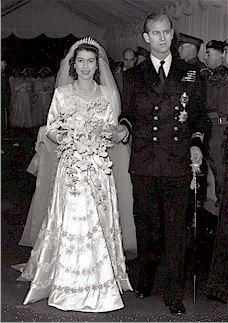
Princess Elizabeth's dress - 1947. At the time the dress was made the war had just ended, but coupon rationing was still in effect. Concerned that the Princess would not have enough to make her dress, women across the country sent their coupons in; which was illegal. This dress was made by Norman Hartnell, whose design house was to make the majority of the Queen's clothing. Although he had been given less than three months to make the dress, it did not disappoint. Hartnell found his inspiration for the dress in an image of Primavera by Bottacelli. The dress was made of satin, in the princess style and the silk came from China, since using Japanese and Italian silkworms would have been unpratriotic so soon after the war. At the shoulder there were three covered loops to attach the 15 foot full court train to the shoulders. This dress had exquisite embroidery, which embodied some royal or patriotic significance.


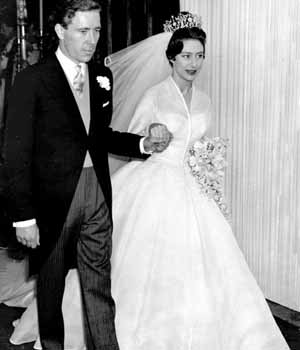
Princess Margaret's dress - 1960- was very different from any dress that had been created before and it was stunning in it's simplicity. It was also designed by Norman Hartnell. It was made of silk organza and instead of a separate court train, the dress itself was trained. Later on, in 1999, when her son, David Linley married Serena Stanhope, her new daughter-in-law paid her a compliment by choosing a dress similar to the one worn in 1960.

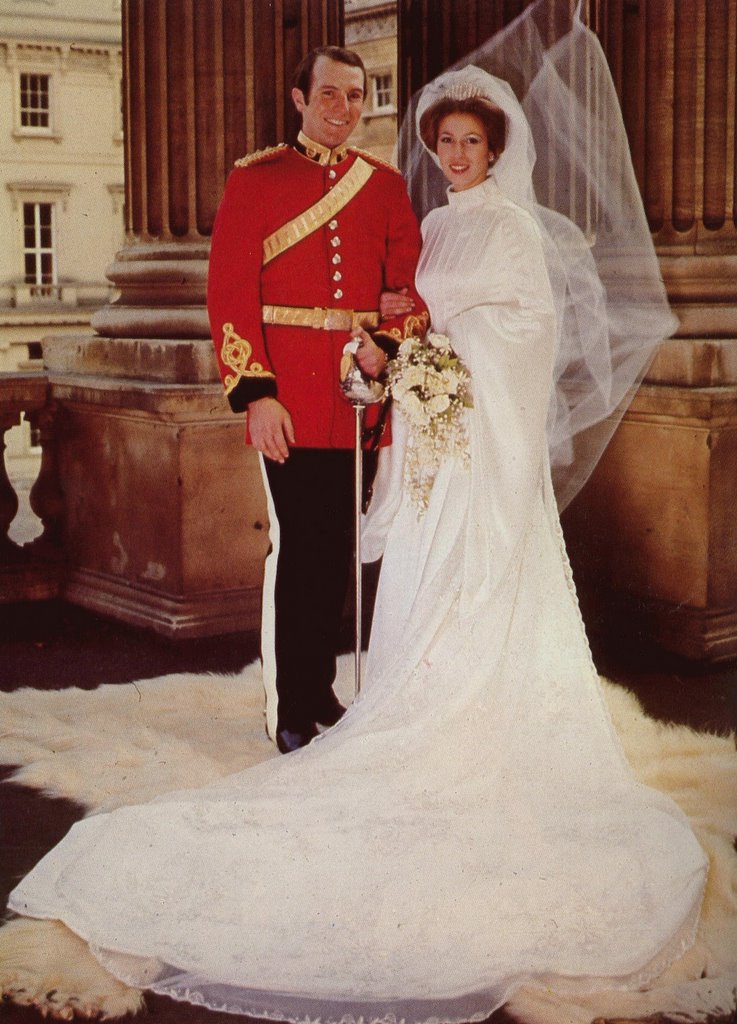
Princess Anne - 1973 - Her dress was in a medieval, Tudor style, made of white silk, highnecked and pintucked to show off her tiny waist. Princess Anne conceived the design herself, wanting to get away from more traditional gowns that would have been expected of her. The dress was made by Maureen Baker, chief designer for Susan Small and remained a closely guarded secret until the wedding. The 15 girls who worked on the dress were each given one small piece to make and had no idea what the finished dress would look like. The main feature of the dress was the huge trumpet sleeves, tucked into the elbow and flared out over fine chiffon. Sleeves were a big feature of the seventies, but comparing this dress to current bridal fashion, these sleeves give the dress a somewhat dated look. The neckline and shoulders were embroidered with pearls, and pearls of silver thread picked out a design of flowers on the long, pure silk gauze train.


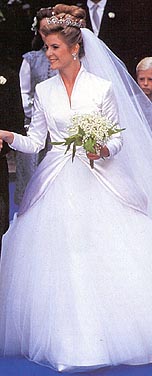
Avoiding comparison with other royal brides, Sophie Rhys-Jones wore a sleek panelled long dress-coat. and an ivory silk train. It was made from hand-dyed silk organza and hand-dyed silk crepe, embroidered with a total of 325,000 cut-glass and pearl beads. It was designed by Samantha Shaw, previously unknown up to that point. The dress has a medieval feel and it is V-necked and corseted. The veil was also sewn with beads, and was longer than the train itself.

Camilla is the only royal bride, at least in recent history, to wear two dresses on her wedding day. Both dressses were designed by Robinson Valentine.

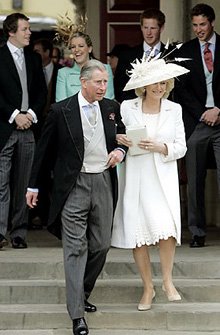
Her first dress for the civil ceremony was an elegant, oyster silk embroidered coat, over a chiffon dress of the same color, embroidered, stylish and very age appropriate. Unlike other royal brides, Camilla wore a hat to her ceremony.


To the blessing, she wore a full length porcelain blue silk dress with a hand painted designs, and embroidered with gold thread work. Her headdress consisted of gold leafed feathers tipped with Swarovski Diamonds


© Marilyn Braun 2005


Thank you for enjoying this article. If you use the information for research purposes, a link to credit the work I've put into writing it would be appreciated.

Friday, November 18, 2005

Royal Engagement Rings

"Diamonds are a girl's best friend", and so the song goes. But royal engagement rings are somewhat different. Despite some fabulous diamonds in the royal collection, the traditional diamond is not necessarily the rock of choice for royal engagement rings.

Symbolizing love and purity, sapphire is probably the most popular stone chosen by royal brides and this choice is somewhat of a tradition in the family. Princess Marina, Duchess of Kent, Princess Alice, Duchess of Gloucester, and Princess Alexandra of Kent who wears an oval star sapphire ring inherited from her mother. Princess Anne, the present Duchess of Kent and Princess Michael of Kent, also had sapphire rings for their engagements. When the Queen Mother became engaged in 1923, she was originally given a sapphire ring, which, in her only interview, she told reporters that it was her favourite stone. In the 1950's she switched to a large pearl ring surrounded by diamonds, similar to a ring worn by Queen Mary until her death.

The Queen wears many priceless jewels, but her favorite is her diamond engagement ring. The diamonds on her ring came from a tiara that had belonged to Prince Philip's mother. Prince Philip was involved in the design and the platinum ring was set with eleven diamonds, a 3 carat solitaire and five smaller stones set on each shoulder. When the engagement was announced, the ring was too big and had to be re sized 2 days before the official photo call. A bit of trivia: it is said that if the Queen is annoyed about anything she will start to twist the ring round and round.

Diana's ring was a large, striking oval sapphire surrounded by fourteen brilliant cut diamonds, set in 18 carat white gold. It has been reported that Diana was offered a tray of rings and she chose this one because it was the biggest. This particular ring inspired copies the world over and at the time the it was estimated to have cost £28,500. She is shown wearing the ring on the day her divorce became final. Prince Harry inherited the ring after his mother's death. At the time of her death it was valued at £250,000.

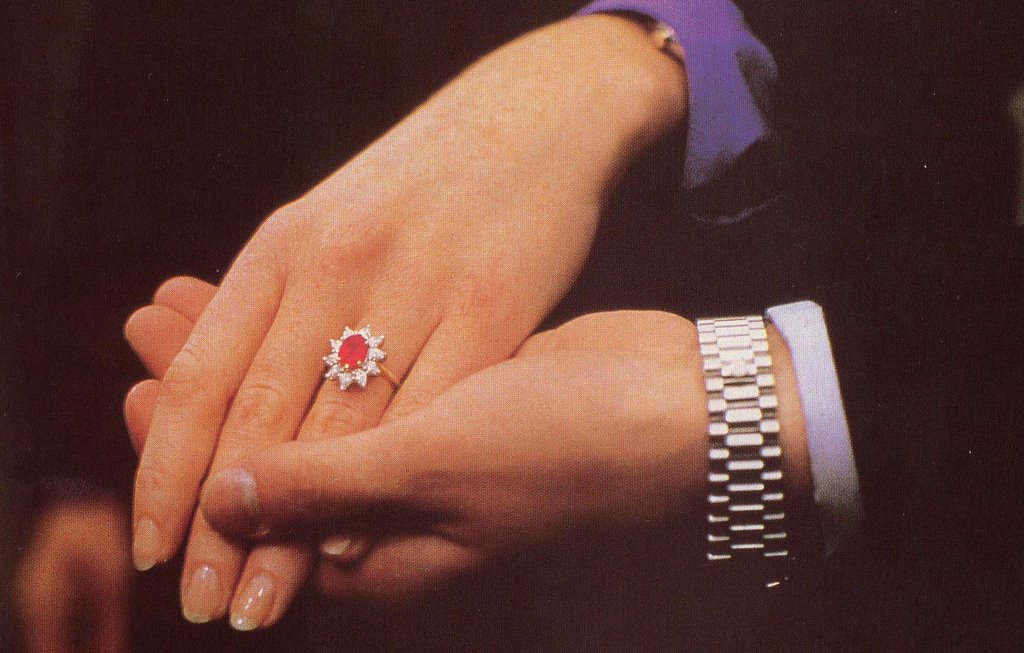
Sarah's ring has an oval Burma ruby, surrounded by a cluster of 10 drop diamonds. The stone was chosen to compliment her red hair. Prince Andrew had originally wanted an emerald ring, but Sarah didn't, so the couple chose a ruby instead. Prince Andrew helped to design it. It is set in eighteen carat yellow and has a white gold band and at the time it was valued at £25,000. In photographs, she can still occasionally be seen wearing the ring. The ruby stone is not chosen for rings very often, because, like opals, in the past the royal family has had superstitions regarding them. Queen Alexandra had a very strong aversion to opals, believing that the brought bad luck. The only other bride to have chosen a ruby engagement ring, in recent history, is the late Princess Margaret.

Sophie's ring features a 2.05-carat oval diamond, flanked by two smaller heart shaped gems, set in 18 carat white gold. Made by the Crown Jewellers, Aspry and estimated at £105,000, it is said to be the most expensive royal engagement ring in history.

Second to the provenance of diamonds in Queen Elizabeth II's engagement ring, Camilla's probably has the most history and sentimental value. The ring is considered to be a family heirloom, and there are estimated values of £100,000. It is in an art deco style, set in platinum, and composed of a emerald cut central diamond flanked by three diamond baguettes on either side. It originally belonged to the Queen Mother, who was given the ring in in 1926 upon the birth of the present Queen.

© Marilyn Braun

Thank you for enjoying this article. If you use the information for research purposes, a link to credit the work I've put into writing it would be appreciated.

Wednesday, November 16, 2005

For Sale: Royal Memorabilia

With the vast array of royal memorabilia for sale on eBay: books, magazines, lunches with Paul Burrell, and Range Rovers, I've decided to sell my own piece of royal history. This is a special item, not available in any store or on eBay as of yet. So my friends, right out of the royal horse's mouth, I'm offering it here.

You, lucky reader, you could own Prince Philip's dentures! You heard it here first. You may be wondering, why am I parting with such a personal item? Well, I still have my original teeth, they don't fit in my mother's mouth, and...well..I've decided to cash in.

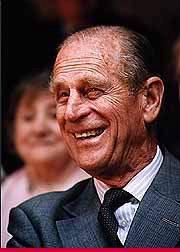
We're all self conscious about some part of our body and Prince Philip is no exception, as the photo shows. Good dental care is very important. But, had he looked after his teeth in the first place, I wouldn't be able to offer you this special item. A wonderful and unique piece to cherish and pass down from generation to generation.

However, you may have your doubts, wondering what use could you possibly have for this item? Too many to count! Such an amazing conversation piece! The holidays are coming up, what a fantastic stocking stuffer! Not to mention, replete with royal dna, you could even make your own Prince Philip. How can you not buy it?

There's some wear and tear but otherwise they're in good condition. I've included a picture of Prince Philip wearing them to prove to you, that these are in fact his real dentures. What a nice smile and they look so real. Buy now and it could be yours!

For confidentiality reasons I can't disclose how I came to own this item or where it came from. But, I'm sure you still have your doubts, you're wondering, can these possibly be Prince Philip's REAL dentures? Why wouldn't he keep them for himself? Shouldn't he have a backup pair? If I were in your shoes I would have questions too, so to remove all doubt from your mind, here's a Certificate of Authenticity:


Act now and I'll even throw in a box of Polident!

This deal won't last long! Buy today!

Serious inquiries only.

© Marilyn Braun