Tuesday, November 22, 2005

Royal Profile: Princess Battenberg

Julie (or Julia) von Hauke, Princess Battenberg, was born on November 12, 1825 in Warsaw, Poland. Although she was greatly admired, her marriage to Prince Alexander of Hesse-Darmstadt, was considered to be one of the great scandals in the 19th century.

She was the daughter of John Maurice von Hauke, and Sophie la Fontaine. Her father was German and a professional military man, fighting in Napoleon's army. He then switched sides and fought for the Russians. In recognition of this, Tsar Nicholas I, made him a Count, as as well as Deputy Minister of War of Congress Poland.

In 1830, at the age of 5, she was orphaned and made a ward of the Tsar. When she was older she served as a lady-in-waiting to the wife of Tsar Alexander II. In the course of her court duties at St. Petersburg she met Prince Alexander of Hesse-Darmstadt; brother to the Tsarina.

Countess Julie von Hauke and Prince Alexander fell in love, but they faced opposition. At the time, it was considered unthinkable for a member of a ruling house to marry a mere countess and the Tsar forbade the couple to marry. Without seeking the permission of the Tsar, they eloped and married on October 28, 1851. As Julie was of insufficient rank to her husband, their marriage was regarded as morganatic.*

While her husband retained the title of prince, her brother-in-law, Grand Duke Ludwig III, granted Julie,a week after her marriage, the title, style, and surname, Illustrous Highness, Countess of Battenberg. In 1858, she was elevated to Her Serene Highness, Princess of Battenberg (a 'non-royal' title). As a result of this elevation, their children were also elevated to the title of His/Her Serene Highness Prince/Princess Battenberg, although they would have no claim to the ducal throne of Hesse-Darmstadt. The couple had five children, each of whom inherited their mother's surname of Battenberg. Thus the house of Battenberg was founded.

Although Prince Alexander was considered to be the black sheep of the Grand Ducal Hesse family, three of his descendants became consorts to European sovereigns in the 20th century: Queen Victoria Eugenie of Spain, Queen Louise of Sweden, and Prince Philip, Duke of Edinburgh.

The family eventually settled in Darmstadt, raising their family, primarily at Heiligenberg Castle, near Jugenheim, in southern Hesse. Julie spoke German, Russian, Polish and French. She read Dante in Italian and Shakespeare in English. It was also said that Bismark was afraid of her. She converted from Roman Catholicism to Lutheranism in 1875.

Julie died at Schloss Heiligenberg in Germany, on September 19, 1895 at the age of 70.

© Marilyn Braun 2005

* A morganatic marriage is a match between a person of 'high rank' and one of 'low rank'. The 'low rank' partner does not take the title of the higher ranking spouse, nor do their children.

Monday, November 21, 2005

Royal Wedding Dresses

As I mentioned in my article on Royal weddings, the dress is the centerpiece of the day. I covered some history regarding the dress, however I did not go into details regarding some of the specific dreses. There have been some lovely bridal gowns. Royal wedding gowns have set trends, influenced bridal fashion. Much speculation goes into the making of these dresses, with the various designers having to take extreme measures to protect it, from white washing the windows, guarding it, locking the seamstress in a room to work on it, to burning any extra scraps of material. The dresses of Diana, Princess of Wales and Sarah, Duchess of York, have been reported in great detail, so this article covers some of the lesser known ones. These are just a few of the spectacular dresses worn in the last century:

The Queen Mother's dress - 1923 - At the time, her dress was described as 'the simplest ever made for a royal wedding to date'. It was made of chiffon moire, dyed to match the colour of the point de Flanders lace veil lent by Queen Mary. It was made by the court dressmakers, Mme Handley Seymour. Almost medieval in its style, the dress had two trains, the first one attached at the waist, and extended 10 inches beyond the hem and spread 80 inches wide. The second one, made of tulle, which was fastened from the shoulders. Vogue described it as 'a medieval Italian gown". The veil was secured by a simple wreath of white heather, myrtle leaves, with knots of white roses - the emblem of the County of York - appropriate for the new Duchess of York.


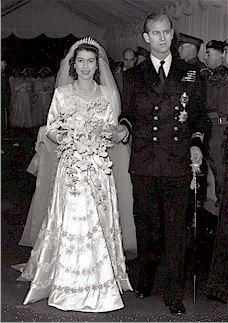
Princess Elizabeth's dress - 1947. At the time the dress was made the war had just ended, but coupon rationing was still in effect. Concerned that the Princess would not have enough to make her dress, women across the country sent their coupons in; which was illegal. This dress was made by Norman Hartnell, whose design house was to make the majority of the Queen's clothing. Although he had been given less than three months to make the dress, it did not disappoint. Hartnell found his inspiration for the dress in an image of Primavera by Bottacelli. The dress was made of satin, in the princess style and the silk came from China, since using Japanese and Italian silkworms would have been unpratriotic so soon after the war. At the shoulder there were three covered loops to attach the 15 foot full court train to the shoulders. This dress had exquisite embroidery, which embodied some royal or patriotic significance.


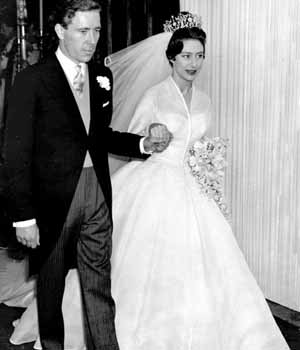
Princess Margaret's dress - 1960- was very different from any dress that had been created before and it was stunning in it's simplicity. It was also designed by Norman Hartnell. It was made of silk organza and instead of a separate court train, the dress itself was trained. Later on, in 1999, when her son, David Linley married Serena Stanhope, her new daughter-in-law paid her a compliment by choosing a dress similar to the one worn in 1960.

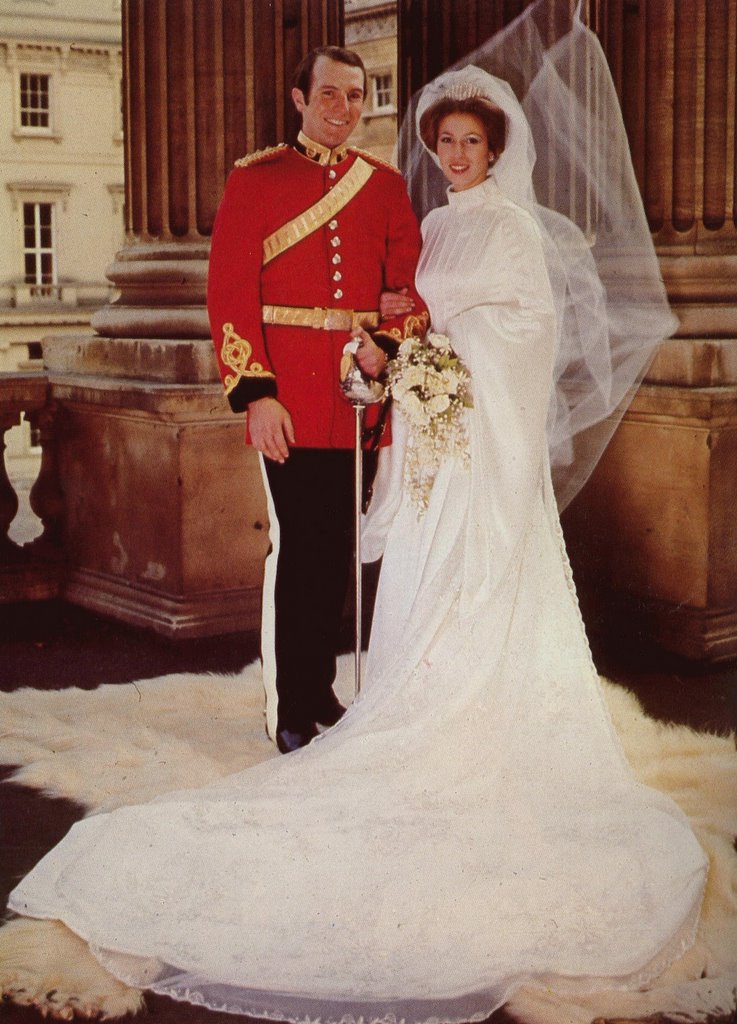
Princess Anne - 1973 - Her dress was in a medieval, Tudor style, made of white silk, highnecked and pintucked to show off her tiny waist. Princess Anne conceived the design herself, wanting to get away from more traditional gowns that would have been expected of her. The dress was made by Maureen Baker, chief designer for Susan Small and remained a closely guarded secret until the wedding. The 15 girls who worked on the dress were each given one small piece to make and had no idea what the finished dress would look like. The main feature of the dress was the huge trumpet sleeves, tucked into the elbow and flared out over fine chiffon. Sleeves were a big feature of the seventies, but comparing this dress to current bridal fashion, these sleeves give the dress a somewhat dated look. The neckline and shoulders were embroidered with pearls, and pearls of silver thread picked out a design of flowers on the long, pure silk gauze train.


Avoiding comparison with other royal brides, Sophie Rhys-Jones wore a sleek panelled long dress-coat. and an ivory silk train. It was made from hand-dyed silk organza and hand-dyed silk crepe, embroidered with a total of 325,000 cut-glass and pearl beads. It was designed by Samantha Shaw, previously unknown up to that point. The dress has a medieval feel and it is V-necked and corseted. The veil was also sewn with beads, and was longer than the train itself.

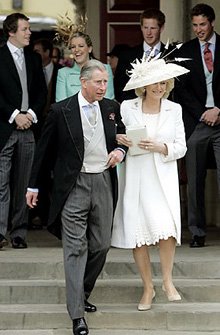
Camilla is the only royal bride, at least in recent history, to wear two dresses on her wedding day. Both dressses were designed by Robinson Valentine.

Her first dress for the civil ceremony was an elegant, oyster silk embroidered coat, over a chiffon dress of the same color, embroidered, stylish and very age appropriate. Unlike other royal brides, Camilla wore a hat to her ceremony.


To the blessing, she wore a full length porcelain blue silk dress with a hand painted designs, and embroidered with gold thread work. Her headdress consisted of gold leafed feathers tipped with Swarovski Diamonds


© Marilyn Braun 2005


Thank you for enjoying this article. If you use the information for research purposes, a link to credit the work I've put into writing it would be appreciated.

Friday, November 18, 2005

Royal Engagement Rings

"Diamonds are a girl's best friend", and so the song goes. But royal engagement rings are somewhat different. Despite some fabulous diamonds in the royal collection, the traditional diamond is not necessarily the rock of choice for royal engagement rings.

Symbolizing love and purity, sapphire is probably the most popular stone chosen by royal brides and this choice is somewhat of a tradition in the family. Princess Marina, Duchess of Kent, Princess Alice, Duchess of Gloucester, and Princess Alexandra of Kent who wears an oval star sapphire ring inherited from her mother. Princess Anne, the present Duchess of Kent and Princess Michael of Kent, also had sapphire rings for their engagements. When the Queen Mother became engaged in 1923, she was originally given a sapphire ring, which, in her only interview, she told reporters that it was her favourite stone. In the 1950's she switched to a large pearl ring surrounded by diamonds, similar to a ring worn by Queen Mary until her death.

The Queen wears many priceless jewels, but her favorite is her diamond engagement ring. The diamonds on her ring came from a tiara that had belonged to Prince Philip's mother. Prince Philip was involved in the design and the platinum ring was set with eleven diamonds, a 3 carat solitaire and five smaller stones set on each shoulder. When the engagement was announced, the ring was too big and had to be re sized 2 days before the official photo call. A bit of trivia: it is said that if the Queen is annoyed about anything she will start to twist the ring round and round.

Diana's ring was a large, striking oval sapphire surrounded by fourteen brilliant cut diamonds, set in 18 carat white gold. It has been reported that Diana was offered a tray of rings and she chose this one because it was the biggest. This particular ring inspired copies the world over and at the time the it was estimated to have cost £28,500. She is shown wearing the ring on the day her divorce became final. Prince Harry inherited the ring after his mother's death. At the time of her death it was valued at £250,000.

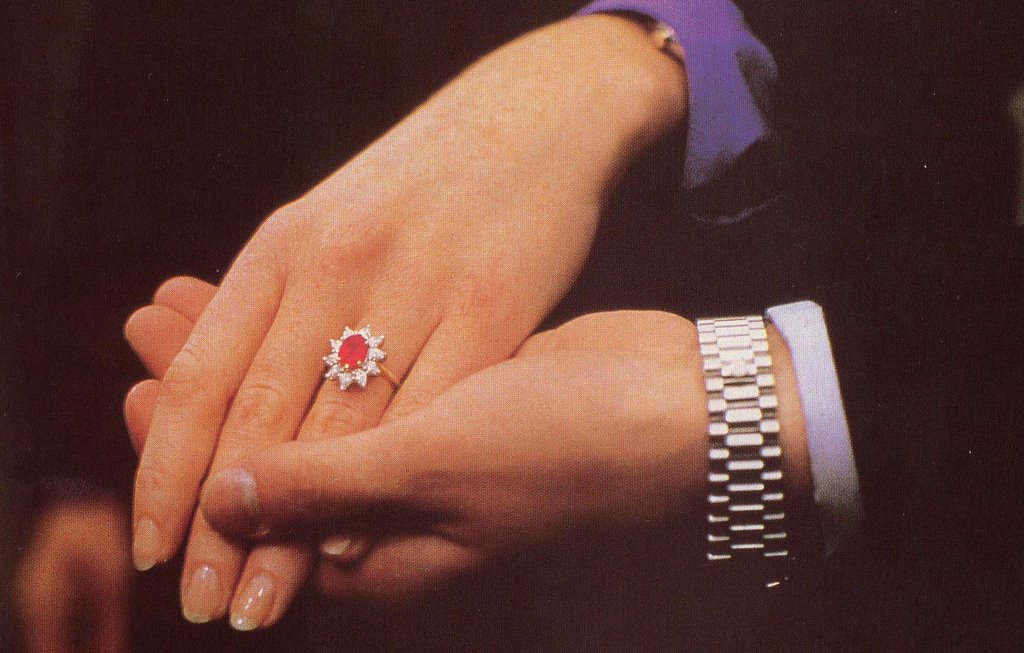
Sarah's ring has an oval Burma ruby, surrounded by a cluster of 10 drop diamonds. The stone was chosen to compliment her red hair. Prince Andrew had originally wanted an emerald ring, but Sarah didn't, so the couple chose a ruby instead. Prince Andrew helped to design it. It is set in eighteen carat yellow and has a white gold band and at the time it was valued at £25,000. In photographs, she can still occasionally be seen wearing the ring. The ruby stone is not chosen for rings very often, because, like opals, in the past the royal family has had superstitions regarding them. Queen Alexandra had a very strong aversion to opals, believing that the brought bad luck. The only other bride to have chosen a ruby engagement ring, in recent history, is the late Princess Margaret.

Sophie's ring features a 2.05-carat oval diamond, flanked by two smaller heart shaped gems, set in 18 carat white gold. Made by the Crown Jewellers, Aspry and estimated at £105,000, it is said to be the most expensive royal engagement ring in history.

Second to the provenance of diamonds in Queen Elizabeth II's engagement ring, Camilla's probably has the most history and sentimental value. The ring is considered to be a family heirloom, and there are estimated values of £100,000. It is in an art deco style, set in platinum, and composed of a emerald cut central diamond flanked by three diamond baguettes on either side. It originally belonged to the Queen Mother, who was given the ring in in 1926 upon the birth of the present Queen.

© Marilyn Braun

Thank you for enjoying this article. If you use the information for research purposes, a link to credit the work I've put into writing it would be appreciated.

Wednesday, November 16, 2005

For Sale: Royal Memorabilia

With the vast array of royal memorabilia for sale on eBay: books, magazines, lunches with Paul Burrell, and Range Rovers, I've decided to sell my own piece of royal history. This is a special item, not available in any store or on eBay as of yet. So my friends, right out of the royal horse's mouth, I'm offering it here.

You, lucky reader, you could own Prince Philip's dentures! You heard it here first. You may be wondering, why am I parting with such a personal item? Well, I still have my original teeth, they don't fit in my mother's mouth, and...well..I've decided to cash in.

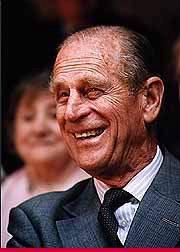
We're all self conscious about some part of our body and Prince Philip is no exception, as the photo shows. Good dental care is very important. But, had he looked after his teeth in the first place, I wouldn't be able to offer you this special item. A wonderful and unique piece to cherish and pass down from generation to generation.

However, you may have your doubts, wondering what use could you possibly have for this item? Too many to count! Such an amazing conversation piece! The holidays are coming up, what a fantastic stocking stuffer! Not to mention, replete with royal dna, you could even make your own Prince Philip. How can you not buy it?

There's some wear and tear but otherwise they're in good condition. I've included a picture of Prince Philip wearing them to prove to you, that these are in fact his real dentures. What a nice smile and they look so real. Buy now and it could be yours!

For confidentiality reasons I can't disclose how I came to own this item or where it came from. But, I'm sure you still have your doubts, you're wondering, can these possibly be Prince Philip's REAL dentures? Why wouldn't he keep them for himself? Shouldn't he have a backup pair? If I were in your shoes I would have questions too, so to remove all doubt from your mind, here's a Certificate of Authenticity:


Act now and I'll even throw in a box of Polident!

This deal won't last long! Buy today!

Serious inquiries only.

© Marilyn Braun

Tuesday, November 15, 2005

Royal Profile: Patrick Lichfield

Patrick Lichfield was probably best known as a cousin of the Queen and the photographer who took the portraits for the wedding of Charles and Diana in 1981. However, there was more to Patrick Lichfield than his proximity to the royal family.

Thomas Patrick John Anson, 5th Earl of Lichfield, was born on the 25th of April 1939. His parents were William, Viscount Anson and Princess Georg of Denmark, the former Anne Bowes-Lyon, daughter of John Bowes-Lyon, the late Queen Mother's brother. Although he bore the title of the Earl of Lichfield, a title inherited from his grandfather, when he was working he preferred to be called plain 'Patrick'.

Educated at Harrow and Sandhurst, he served as a lieutenant in the Grenadier Guards before becoming a photographer. Early in his career, he found an increasing demand for editorial work in national newspapers and various magazines, including Life during the Vietnam war, although not in the war zone. His biggest break came when the legendary Diana Vreeland gave him a 5-year contract with Vogue magazine. He worked in numerous advertising campaigns including, from 1978, the prestigious Unipart calendar.

He took up photography at the age of six, taking his first picture of the Queen when he was playing in a cricket match against Eton. Unfortunately, these pictures will never be published as the headmaster confiscated his camera shortly afterwards. Undeterred, his first official royal sitting was with the Duke and Duchess of Windsor in 1967, thus beginning a working relationship with the royal family.

His royal portfolio ranged from the 1971 group photograph of 26 members of the royal family, the Silver Wedding portrait of the Queen and Prince Philip, to an intimate photograph of Prince Charles with his young cousin Lady Sarah Armstrong-Jones at Balmoral. His most recent commission was a portrait of the Queen for her Golden Jubilee in 2002. He published numerous books on photography and his work has been exhibited worldwide. He was awarded Fellowships from the British Institute of Professional Photographers and The Royal Photographic Society.

Before his photographic career took off he came close to springboard diving for Britain, but missed out on a place on the Olympic team. He loved swimming and in the 1980's he became a qualified underwater diver, spending much of his free time doing so on the Carribean island of Mustique where he had a home. His other hobbies included sky-diving, cricket, and riding motorcycle.

Patrick Lichfield married Lady Leonora Mary Grosvenor, who was the eldest daughter of the 5th Duke of Westminster. They were divorced in 1986. The marriage produced three children, Lady Rose (born 1976), Thomas, Viscount Anson (born 1978), and Lady Eloise (born 1981).

On November 10th, 2005 he suffered a stroke and was taken to the John Radcliffe Hospital in Oxford, where he died the following morning.

© Marilyn Braun

Thursday, November 10, 2005

Ask Marilyn

I LOVE to write about royalty!

I also LOVE to answer questions on royalty! Not as much as writing articles on royalty, but it's pretty close.

So, I've decided to change the format of my webpage to a question and answer theme. If you have a question on royalty, I will do my best to answer it.

So go ahead Ask Marilyn

Monday, November 07, 2005

Queens Regnant

Definition: A queen regnant is a female ruler who reigns in her own right. Unlike a queen consort who is the spouse of the reigning king, with no official role of her own, a queen regnant rules with all monarchical powers that a king would have, regardless of gender.
Currently there are three European queens regnant: Queen Elizabeth II of Great Britain, Queen Margarethe II of Denmark, and Queen Beatrix of the Netherlands. Prior to their accession, these women were regarded as Heiress Presumptive, (the presumption being that a male might be born to replace them). The history of queens regnant in each country is very different. Denmark has had one Queen Regnant prior to Margarethe II; she was Queen Margarethe I (1387-1412) although she acted as regent until her son came of age. England has had six queens regnant. In the Netherlands, Queen's ruled the 20th century and when Beatrix's son, Willem-Alexander, succeeds he will be the first male monarch in over a century.

Despite having an illustrious history of female monarchs, the United Kingdom, like Denmark, still follows male primogeniture. However, the Netherlands, Sweden, Norway and Belgium have changed their succession laws to allow the firstborn to succeed regardless of gender.

Queen Elizabeth II of the United Kingdom

Of the three queens regnant, Elizabeth II has reigned the longest. She is the oldest queen, but at the age of 25 she was the youngest to come to the throne. At the time of her birth, she was third in line and her chances of becoming queen were remote. It wasn't until her uncle King Edward VIII abdicated in 1936, that she became heiress presumptive. She had one younger sister, the late Princess Margaret. In 1947 she married Prince Philip, Duke of Edinburgh and they have four children: Prince Charles, the Prince of Wales (born 1948), the Princess Royal (born 1950), Prince Andrew, Duke of York (born 1960), and Prince Edward, the Earl of Wessex, (born 1964).


Queen Margarethe II of Denmark

Although she was the eldest child of the Crown Prince and Princess of Denmark, when Queen Margarethe was born, women did not have rights to inherit the throne at all. Her uncle was next in line until a 1953 referendum made Princess Margarethe heiress presumptive. When her father died in 1972, she became the first Queen regnant under the new Act of succession. Queen Margarethe is considered to be the most intellectual monarch - studying at no fewer than five universities. She is also extremely accomplished as an artist and writer. Queen Margarethe is regarded as Europe's most modern and progressive monarchs; openly granting interviews and making herself easily accessible to her subjects. The Queen has two younger sisters, Princess Benedikte and Queen Anne-Marie of Greece. In 1967 she married French diplomat, Count Henri deLaborde de Monpezat (Prince Henrik upon marriage). They have two sons: Crown Prince Frederik (born 1968), and Prince Joachim (born 1969).

Queen Beatrix of the Netherlands

Queen Beatrix is the fourth successive female sovereign in the Netherlands. She was the first of four daughters born to Queen Julianna and Prince Bernhard. She has three younger sisters - Princess Irene, Princess Margriet, and Princess Christina.

Like Queen Margarethe, Queen Beatrix is academically well educated, studying international and European law and international relations. She earned a law degree in 1961.

Unlike Queen Elizabeth II and Queen Margarethe II who succeeded upon the deaths of their fathers, Beatrix succeeded upon the abdication of her mother, Queen Juliana, in 1980. At 42 she was the oldest of the three to ascend the throne. In the Netherlands, abdication has become something of a tradition, although it is unknown whether she will choose to do so in favour of her eldest son.

In 1966, she married a German diplomat, Claus von Amsberg (upon marriage he became Prince Claus). They had three sons: Crown Prince Willem-Alexander (born 1967), Prince Johan Frisco (born 1968), and Prince Constantijn (born 1969). Prince Claus died in 2002.

The future

With the changes in succession laws, allowing for the first born to succeed regardless of gender, in the future we will see queens regnant on the thrones of Belgium (Princess Elisabeth), Norway (Princess Ingrid Alexandra), the Netherlands (Princess Catharina-Amalia), and Sweden (Crown Princess Victoria). If the succession rules are changed we might even see Princess Aiko as Empress of the Chrysanthemum throne, and the newborn Infanta Leonor as the first Queen of Spain in over 150 years.

God save the Queens


© Marilyn Braun

For more information check out the Official British, Danish and Dutch sites.

Monday, October 31, 2005

Question - How can I please everyone?

Charles from England writes:

I'm completely misunderstood by everyone, it seems that no matter what I do it's judged mercilessly. I can't seem to please anyone. I try and put the Great back into Great Britain and no one seems to notice. What else do I need to do? I married and had heirs - oh the things I do for England! I carry out engagements, cut ribbons, eat organically, pay attention to my children...why ME? I didn't ask to be born into this position. I just want to be happy, how do I please everyone?

Dear Charles,

Well, thank you for writing in. Whilst I cannot pretend to understand your position, I will try to. If my hours of watching Dr. Phil have taught me, you cannot please everyone, it's a losing battle. However, just because it's a losing battle, doesn't mean you shouldn't make an effort. Have you tried hard enough? People can tell if you don't have your heart in it. Remember, if you make a valid attempt, you will never live your life with regrets.

To help you out, I've compiled a list of 25 ways* that you can please everyone:

  1. Say nothing
  2. Smile all of the time
  3. Time permitting, listen to what everyone says
  4. Do what your parents tell you to do
  5. Take the advice of everyone
  6. If advice conflicts, do a half and half split
  7. Always revere Diana's memory
  8. Publicly appear weighed down with guilt and regret
  9. Keep your opinions to yourself and don't make speeches that criticize people
  10. Make your own jam
  11. Practice what you preach
  12. Stay married and don't have an affair
  13. Sacrifice your personal happiness cheerfully
  14. Be happy but not too happy
  15. Answer all of your critics - by letter, email or phone
  16. Believe what everyone says about you and adapt your behavior accordingly
  17. Don't answer open ended questions
  18. Send thank you notes to all of your critics
  19. Be unfailingly polite, gracious, and generous
  20. Work hard but pay your own way
  21. Be nice to everyone - you never know where there's a microphone
  22. Show modesty and gratitude about your position
  23. Stay below to radar
  24. Keep Harry on a short leash
  25. Abdicate and let William take over

© Marilyn Braun


* Authors note: these are only guidelines, it's unlikely he will please everyone by using them. Don't tell Charles that. You might please me by using them but I'm not everyone. I like to think I am but I'm not. Read my blog regularly and share my blog link with everyone, this will please me too. I make no guarantees, nor do I assume any legal responsibility if you use them. Results may vary. May contains traces of peanuts. Dry clean only. Use caution if you have heart problems, or are pregnant. Keep out of reach of children. Pleasing eveyrone might be bad for your mental health. Consult your therapist for advice on your specific situation.

Thursday, October 27, 2005

Camilla's tiara: The Delhi Durbar

Embed from Getty Images Well, the Queen opened her vaults and picked out a tiara to lend to Camilla, and what a tiara! The Delhi Durbar tiara has been seen only a handful of times: the Queen Mother wore it in 1947 during a tour of South Africa, and in 1998, it was displayed at Christie's in aid of charity.

The circlet was made by Garrards, especially for Queen Mary during the Delhi Durbar on December 12,1911 - hence its name. Durbar is Hindi, for a 'ceremonial gathering to pay homage'. The gathering was to install King George V and Queen Mary as Emperor and Empress of India. King George V admired this piece and referred to it as "May's best tiara".

It was originally worn with detachable emerald drops and at the Durbar, Queen Mary wore it over a crimson velvet cap. According to the book Tiara's A History of Splendor by Geoffrey Munn, it is designed as a:

'graduated frieze of lyres and forget-me-not leaves and flowers, emblematic of harmony and love, it once supported not only the Cambridge emeralds but also the third and fourth cleavings of the famous Cullinan diamond. The cushion shaped stone of 62 carats was secured by a wire at the highest point of the jewel and the drop-shaped stone weighing 92 carats hung in the oval aperture below.'

The Cullinan III and IV diamonds are known as the Lesser Stars of Africa, they are the most valuable items owned by the Queen, who refers to them as 'Granny's Chips'. These diamonds are no longer in the Delhi Durbar, but are now set in a brooch, whch is rarely worn by the Queen. Queen Mary's Delhi Durbar crown latterly belonged to the Queen Mother, but upon her death it went into the private collection of the Queen.

© Marilyn Braun

Thank you for enjoying this article. If you use the information for research purposes, a link to credit the work I've put into writing it would be appreciated.

References:

Tiaras - A History of Splendor by Geoffrey C. Munn
Tiaras Past and Present by Geoffrey C. Munn
Queens' Jewels by Vincent Meylan
The Royal Jewels by Suzy Menkes
The Queen's Jewels by Leslie Field

Photo of the Delhi Durbar tiara from: Tiaras - A History of Splendor by Geoffrey C. Munn

Wednesday, October 26, 2005

Camilla's night to shine

I must be psychic. Didn't I predict that Camilla would be wearing a tiara soon? Yes, I think I did.

So, as I've mentioned, the Norwegian royals are coming to town and the big question seems to be - What tiara will Camilla wear? Royal watchers will see this as the ultimate sign that Camilla has been accepted into the family. Imagine the minute speculation if she doesn't show up in one. If Crown Princess Mette-Marit of Norway (unwed mother whose son was fathered by a convicted drug dealer) wears a tiara, what does that say about Camilla?

Of course, she can't wear something that belonged to Diana or any of the other ones I wrote about in Jewels fit for a Queen. The Queen has so many tiaras I'm sure she can find one in the vaults that doesn't have any type of sentimental value with the public. Sometimes the vault isn't even opened: Sarah, Duchess of York didn't get a tiara of her own, and it doesn't seem that Sophie did either. However, Camilla is the wife of the heir to the throne, future Queen/Princess Consort (whichever one she chooses to be known by) and she must look the part.

Personally I think wearing jewellery that has been previously owned is bad luck. I feel that a piece of jewellery is one of the closest things to a persons body and retains the karma the previous owner. I also think it's pretty cheap to not go out and buy a piece especially for me. If I were Camilla, I would mention this to Charles, and convince him to buy something unique and special. So, instead of concentrating on the provence of the tiara, people can focus on how good she looks.

Of course she could also go with the minimalist approach; a woman who doesn't need jewels to shine. In 1962 the Shah and Empress of Iran made a State visit to the Kennedy White House. At a state dinner held in their honor, the Empress wore a gold embroidered dress glittering with sequins and several millions of dollars worth of jewellery. Instead of trying to match the empress, Jacqueline Kennedy wore a sunburst diamond clip in her hair. This minimalist approach was widely praised, but can Camilla pull it off? Going this route, she runs the risk of upstaging the other bedecked royals, something Diana learned to her detriment. If she wears too many jewels she will look like she's trying too hard. Poor Camilla, she just can't win.

Regardless of what she wears, Camilla doesn't need a tiara to prove that she's a member of the royal family; she became one the moment she married Prince Charles and no piece of jewellery can ever diminish that.

Shine on Camilla, shine on.

© Marilyn Braun

Tuesday, October 25, 2005

Prince William's stripes

Congratulations to Prince William for earning a place at Sandhurst Military Academy.

Ok, no one else seems to be saying this, but I can't help but feel that he would have gotten into Sandhurst either way. Sure I was impressed with the way he looked in his fatigues and bib, suitably gritting his teeth for the cameras, but do we honestly believe that he would have been turned away?

Now, I admit that Prince William is in the position where he can't win, where he will always have to prove himself to people skeptical of whether he really earned his stripes, or presidencies of Football Associations. True, we can't fault him for an accident of birth that made him an heir to the throne. From the moment he was born he automatically won a place on stamps, commemorative china, and his name on hospitals and street signs. We should all be so lucky.

Maybe he did genuinely prove himself, but somehow I doubt his years at university prepared him for the Sandhurst physical endurance tests. Maybe some strings were pulled, or threats made, after all, it can't hurt when your grandmother is head of the armed services; it's good to have connections. There would have been nothing to lose by denying Harry a spot but William, as a future King, is different. Would Sandhurst really want to interfere with royal military tradition? Or William's future credibility as head of the armed services?

Prince Harry wants a career as a soldier, it's in his blood and it's expected of him. William has always been seen as the intellectual prince. Of course he seems to have legitimately gotten into St. Andrew's University and earned a degree on his own merits. But unlike the military, there would have been no problem had he not gotten into university. A degree is not a requirement to become King, nor does it guarantee a job. As many liberal arts graduates have discovered, a degree in geography is a qualification to work the night shift at a convenience store. Even if it were a requirement, had he not earned one, the honorary degrees, Doctorates, and Chancellorships conferred upon him will more than make up for it.

Good luck to Prince William as he enters this next phase of his life. However, if the going gets too tough, there's always honorary colonelships awaiting him.

© Marilyn Braun

Monday, October 24, 2005

Royal Profile: King Olav V of Norway

You may be wondering why I'm writing a profile on a Norwegian monarch. In fact, there are strong ties between the British and Norwegian royal families; British by birth, King Olav V and the Queen were cousins. In anticipation of the King and Queen of Norway's visit to the United Kingdom I thought it appropriate to focus on him.

Prince Alexander Edward Christian Frederik was born at Appleton House on the Sandringham Estate on July 2, 1903. He was the only child of Prince Carl of Denmark (later King Haakon VII of Norway) and Princess Maud (later Queen Maud of Norway), the third daughter of King Edward VII.

In 1905 when his father was elected King of Norway, the two year old Alexander was given the more Norwegian sounding name Olav. As an only child, he was brought up in a loving environment and he was especially close to his mother, who nicknamed him "my little Hamlet". At first he was privately educated, but later went to a secondary school in Oslo: the first prince to attend an ordinary state school. He attended the Norwegian Military Academy and in 1924 enrolled in Oxford University, where he read law and economics. Like his mother, he excelled in sports; becoming a champion ski-jumper and winning a gold medal at the 1928 Summer Olympics where he represented his country in yachting.

On March 21, 1929 he married his cousin, Princess Martha of Sweden and they had three children: Princess Ragnhild, born in 1930, Princess Astrid, born in 1932 and Prince Harald (the present King Harald V) in 1937. When his wife died in 1954, he never remarried.

After the German occupation of Norway in 1940, the King and Prince Olav found refuge in Britain. For the duration of the war the Crown Princess and her children were exiled to Washington D.C. Prince Olav was highly respected for his knowledge and leadership skills and in 1944 he was appointed Norwegian Chief of Defence. In this position he led the Norwegian disarmament of German occupying forces. Olav returned to Norway in 1945.

In 1955, he was appointed Regent when his father became incapacitated and on September 21,1957 he succeeded to the throne upon the death of his father. By a 1908 amendment in the Norwegian constitution, it was no longer a requirement for the sovereign to be crowned. Instead, King Olav was blessed in Nidaros Cathedral on June 22, 1958. He was extremely popular amongst his subjects; driving his own cars, and paying for his tickets when he used public transportation. He was nicknamed "Folkekonge" (The people's king).

King Olav, who had been Europe's oldest reigning monarch, died on January 17, 1991 at Kongsseteren, the Royal Lodge. He is buried in the Chapel of Akershus Castle in Oslo.

© Marilyn Braun

Friday, October 21, 2005

Royal Reality

Whenever I write an article I usually ask my husband to read them, not necessarily for constructive criticism, but more for reassurance that at least someone is reading my blog. Having read the recent articles, he tactfully commented that the royal profiles, were, uh, lacking some pizzazz. He said that I should write something negative about my subjects, controversial, something most people wouldn't know about them.

Me: Are you saying that the royals are boring?

At that moment I knew I was asking a rhetorical question

Yes, the royals are boring

For non-royal watchers this is rather obvious. When was the last time they really did something interesting? We've only had a handful of royals that have some type of glamour - Prince Edward, the future King Edward VIII, then Duke of Windsor - who abdicated for the woman he loved. Princess Margaret, choosing duty over love. In present times, there was Diana and squigy-gate, Charles and Camilla-gate, and toe-sucking, freebie Fergie; the ultimate royal entertainer!

In this day and age of reality television, we're looking for the quick fix. People demeaning themselves for our entertainment. The royals use television as a medium for christmas broadcasts, exclusive interviews, flattering profiles, and occasional retaliation. In 1987 The Duke and Duchess of York, Princess Anne and Prince Edward did take part in an early reality tv show 'It's a royal knockabout', a 'slapstick' game show with members of the royal family, dressed in medieval costume, acting as team captains for a charity of their choice. But that was fairly tame in comparision to today. We would never see the royals on Fear Factor. Can you imagine the Queen repelling off a 10 story building for $50,000?

So, how can the royals be more interesting? Personally, I think they need to get with the times, appeal to a younger demographic, get in touch with their subjects. What better way to do this than via their own reality series. Here are some ideas I've come up with:

Newlyweds: Follow those romantic middle-aged lovebirds Charles and Camilla as they adapt to the monotony of married life.

Royal Bootcamp: A reality show that follows Prince Harry through the trials and challenges of his military career. He could endear himself to the audience by tearing up when he's called Prince Sicknote.

Survivorman - Leave Princess Michael in the woods for seven days, sans food and water, with a harmonica and camera and see whether she comes back.

The Apprentice - Tune in to see the Queen tell Prince Charles "You're fired!"

The Bachelor - Prince William chooses from a bevy of lovely aristocratic ladies, vying for the opportunity to be a future mistress

The Simple Life: Strip Princess Beatrice and Zara Philips of their cell phones and manolo blahniks, send them to rural Saskatchewan, and see what happens

© Marilyn Braun

Wednesday, October 19, 2005

More Royal Trivia

Did you know:

  • Prince Philip, Duke of Edinburgh, was the first member of the royal family to be interviewed on television, this occured in May 1961

  • In 1929, The Queen, (then Princess Elizabeth), made the cover of Time magazine for 'setting the babe fashion for yellow'

  • The Queen has never given an interview

  • Princess Beatrice's birthday - 8.8.88 - is considered to be extremely lucky in the Chinese calendar

  • The Duke of Edinburgh and the Queen are both great-great-grandchildren of Queen Victoria

  • Windsor Castle is the largest and oldest inhabited castle in the world

© Marilyn Braun

Monday, October 17, 2005

Wanted: A job writing about royalty

I LOVE writing about royalty (picture me jumping on a couch like Tom Cruise) and I would die happy, at an extremely old age, if I could do it for a living. So I'm pulling an Oprah, with her book clubs and capturing of criminals, to appeal to you for help in finding a job. Of course I can't offer you a $100,000, but I can offer you my undying appreciation and, if I haven't let success go to my head, a small dedication in my first book.

To date I have written almost 60 articles and I feel that it's appropriate to do this now that I've developed a portfolio. I have some articles which I feel are better than others, satirical work such as Buckingham Palace: Royal Eyesore, Royal Glamour Girls , and Rest in Peace Diana, but only for now. I've also written more factual articles on Royal Weddings and Queen's House: Dynasty and Surname and I'm branching out with more biographical pieces, such as: Royal Profile - Princess Patricia of Connaught.

When I started this blog in March, I had no idea what direction it would take or what I was going to write. I also didn't know how much I would enjoy researching and writing these articles. Believe it or not, I wanted the blog to have a purpose and I hope is that you enjoy the articles. I'm happy if you come away with a smile, find a link that interests you, or read the royal profiles and say to yourself "I had no idea that person existed". I'm even happier if you visit on a regular basis.

I would genuinely love to make a career out of writing so if you can suggest ways to do this or if you or someone you know has connections in publishing or any other type of media - spread the word and my blog link! Any suggestions are appreciated and I can be contacted via email on my profile.

Thank you

Marilyn :o)

Friday, October 14, 2005

Royal Profile: Princess Marina, Duchess of Kent

Princess Marina, Duchess of Kent, was born on December 13, 1906 in Athens, the youngest daughter of Prince Nicholas and Princess Helene of Greece. Like her first cousin Prince Philip, Duke of Edinburgh, she was brought up outside of Greece after her family was forced into exile.

Her family moved to Paris where she attended finishing school and studied painting. She was an accomplished linguist and a skillful dressmaker. She was also widely reknowned for her style and beauty.

On November 29, 1934 she married Prince George, Duke of Kent in Westminster Abbey. Princess Marina belonged to the Greek Orthodox Church and following the service at Westminster Abbey, a second ceremony with Greek Orthodox rites was held in the private chapel in Buckingham Palace. The couple made their home at Number 3 Belgrave Square, and at Coppins, Iver in Buckinghamshire, a home that the Duke inherited from his aunt, Princess Victoria Alexandra. The couple had three children, Prince Edward, the present Duke of Kent born in 1935, Princess Alexandra born in 1936, and Prince Michael of Kent born in 1942.

Seven weeks after the birth of their youngest son, the Duke was killed in a flying accident. No financial provisions had been made and during wartime, the Duchess was not granted funds from the civil list. This resulted in many of the Duke's valuable pictures and objects being sold. After her husband's death she assumed many of his duties, including the presidencies of several organizations and the chancellorship of the University of Kent. Her interests included music, the theatre and ballet, and she enjoyed reading, painting and tennis.

When her son Prince Edward married in 1961, to distinguish her from her daughter-in-law, she adopted her former title and became known as HRH Princess Marina, Duchess of Kent. She moved to Kensington Palace and lived there until her death on August 27, 1968. She is buried beside her husband in the Frogmore Burial Ground.

© Marilyn Braun

Thursday, October 13, 2005

Why I love the Internet

Dear Reader,

If you’re a regular visitor or just pass through, you may have noticed that I haven’t posted in a while. Not because I don’t have ideas, I have plenty that I can’t finish. Not because I haven’t felt like it, because I have. Due to technical difficulties, I have not been able to keep the blog current. I nearly called in a favour from someone who surfs the Internet regularly at work; desperate times call for pseudo desperate measures. Luckily I never had to resort to such subterfuge.

Despite offending modems, I love the Internet. It has provided me with recipes I’ve passed off as my own, given me valuable parenting advice, and generated thank you cards when I haven’t been able to think of anything unique to say. I’ve been able to communicate with friends, relatives and co-workers instead of having to speak to them in person and I’ve passed many long hours at work under the guise of making travel arrangements for managers.

As I haven’t had access in over a week, I have no idea what’s going on in the world of royalty. I would have heard if something happened with the British, but for the other monarchies, I’m clueless. Someone important could have died, maybe Princess Mary of Denmark had her baby, or Máxima of the Netherlands ran off with a servant and I would be the last to know. I’m probably missing out on timely material, right now as we speak.

We never really know the value of someone until we no longer have it. Until now I've had to wing the parenting thing, with mixed results. Now that I'm powered up and running I have no excuse for not paying my bills, or not posting articles. So check back soon.

Thanks for visiting

Marilyn

Monday, October 03, 2005

My Favourite Royal

Ever since Diana's death I've felt a void inside of me, which no other royal can fill. Unlike other royals, stories about her on the news, in magazines, or on the Internet, used to stop me dead in my tracks. If there were a new book on her I would shove the elderly or small children out of the way to get to it. I can't say that anymore and it's disappoints me.

The royals are no longer completely interesting to me, no longer glamorous. To get my Diana fix I've had to settle for revelations by James Hewitt, or the outright money grubbing by Paul Burrell. Has it come to this? Am I really so desperate? I laugh and scoff like the rest of you, but deep down inside I pay attention. Of course I have my standards, I don't buy tabloids; the headlines teased me for too long and it finally broke my heart when I realized none of them were true.

It would be an understatement to say I have an interest in royalty. I stayed up all night to watch the wedding of Andrew and Fergie, and I bought every newspaper and magazine I could find after Diana's death. When the Queen dies, I've warned my husband that no matter what time of day it is or where we are I will go out, once again, and buy every publication. I admit I didn't do this when the Queen Mother or Princess Margaret died, and I probably wouldn't go out of my way for Prince Charles, but I would do it for the Queen.

I guess if I were asked who my favourite royal is now, I would have to say its Camilla. Strange isn't it? The void filled by Diana's nemesis. Is there irony in that? Camilla is interesting in a way that Charles and William's bald spots, or the question of Harry's paternity isn't. Now that she's in the fold, I find myself longing to know more about her. Should a sanctioned book come out I would probably let the infirm pass by before I grabbed it. I might even wait until it comes out on paperback.

Now that Charles and Camilla are married there's no longer the promise of something interesting and I find myself looking to older books. Books which freeze frame the blossoming Princess Elizabeth as she came of age, her wedding to Prince Philip, and the Coronation which heralded a new Elizabethan age. Was there anyone more dashing than Prince Philip as a young man? Anyone lovelier than the 26-year-old Queen? 60 years on their devotion to one another is still going strong.

Princesses Mary of Denmark, Mette-Marit of Norway, Maxima of the Netherlands, Mathilde of Belgium, and Letizia of Spain assure me that glamour exists. But all hope is not lost with the British; there's Prince William's girlfriend Kate Middleton. I genuinely find myself pulling for her, hoping that she can tough out the publicity to become the next royal bride. She will never replace Diana but she’ll look good trying.

So should William and Kate become engaged, or the Queen dies get out of the way or I'll run over you.

© Marilyn Braun

Friday, September 30, 2005

Royal Profile: Princess Victoria Alexandra

Princess Victoria Alexandra Olga Mary, fourth child and second daughter of the Prince and Princess of Wales (later King Edward VII and Queen Alexandra) was born at Marlborough House on July 6, 1868. To distinguish her from the many relatives who bore the name Victoria, she was nicknamed 'Toria'.

On the insistence of their father, the children had a more relaxed, happy and carefree upbringing; however, it greatly lacked in discipline. Queen Victoria found the children to be "such ill-bred, ill-trained children, that I can't fancy them at all." Of the five unruly, mischievous Wales children, Victoria was considered to be the most intelligent. She was reported as very sharp, quick, merry, amusing, and at times exceedingly naughty. Their mother, Princess Alexandra wanted to keep them as children for as long as possible and they were isolated from other people, which resulted in the children forming a very tight unit. Victoria and her sisters, Princesses Louise and Maud (later Queen of Norway), were dressed alike and were known as the 'whispering Wales girls'.

As a baby with her parents & siblings in 1868
Victoria was a hypochondriac, had a sharp tongue and her childhood of running wild with her siblings lead her to have an inflated sense of her own importance. She never married, remaining as a companion to her mother, with whom she lived until Queen Alexandra's death in 1925. Although she played the dutiful daughter, the sacrifice to her happiness lead her to be extremely bitter. She had two romances but in those days, neither of her commoner suitors would have been acceptable as a spouse. When Princess May of Teck (later Queen Mary) married her favourite brother, George, she classified her sister-in-law as boring and took to apologizing to those who ended up sitting next to her at dinner. Envying her happy marriage, Toria made life difficult for Mary at every possible opportunity, claiming back items of furniture and jewellery she claimed belonged to her.

After her mother's death, she then set up her own household at Coppins, Iver, in Buckinghamshire, where she devoted herself to her main recreations of music, gardening and photography - an interest she inherited from her parents.

She was extremely close to her brother, King George V and they had daily telephone calls. "Every morning I rang up my sister at half past nine, just to have a chat. Of course we are not always too polite. One morning her telephone rang at the usual time, and she took up the receiver and said 'Hullo, you old fool' and the voice of the operator broke in, 'Beg your pardon, Your Royal Highness, His Majesty is not yet on the line.' "

When she died in December 1935 he was devastated. The loss of this favourite sister proved a blow from which he never recovered and he died just over a month later.

© Marilyn Braun 2005

Wednesday, September 28, 2005

Royal Births

Doesn't everyone (who isn't the new parent who has to get up several times a night to tend to the newborn) love a baby? Aren't they (when they're not crying, fussing, tired, smelly) adorable? When a royal birth occurs, we get the best of the situation without actually having to get involved. Sure, some of us might knit a sweater or crochet a blanket for the royal arrival that will eventually be given away to charity, but for most royal watchers it will just be a reason to buy Majesty magazine or Hello. We might even go on to Internet boards and discuss the names, ask questions about line of succession, titles, but it will usually end there.

We get to see just enough photos of them without actually having to find a way to lie to the new parent about how pretty/handsome their baby looks. Valuable tip: since most babies are downright ugly, I've found saying "he/she/it's so clean!" is a good non-committal response. Thankfully most royal parents demand privacy for their newborn so we don't get inundated with photos we don't care about.

Some of us might heave a sigh of relief at not having to buy a shower, Christmas, birthday, gifts for the baby who will no doubt have everything they could possibly ever wish for. Or the pressure of choosing names those royal watchers will judge mercilessly - we have close relatives for that. However, even royal parents don't escape this, in Queen Victoria's time she had an edict; all girls and boys have Victoria or Albert amongst their given names. The future George VI was born on December 14 - the anniversary of the death of Prince Albert, Queen Victoria's beloved consort. To mollify the Queen, the parents named him Albert and he was christened Albert Frederick Arthur George. His maternal grandmother did not like the name Albert and prophetically announced that she hoped the last name "may supplant the less favoured one". It eventually did when the prince unexpectedly became King George VI. When Prince Albert's second daughter, Princess Margaret, was born, he wanted to name her 'Ann Margaret' but King George V vetoed this and eventually she was called Margaret Rose.

Yes, the birth of a baby is truly a magical event.

Most royal births have taken place at home and it would have been unthinkable to do otherwise. In Queen Victoria's time, almost all of her children were born at Buckingham Palace. Quite a few of her grandchildren were born there or at Windsor Castle. The old Queen actually liked to be present at the birth's whenever possible. When her granddaughter, Princess Victoria of Hesse gave birth to Princess Alice (mother of the present Duke of Edinburgh), the Queen made certain the baby was born in the same room and bed that Princess Victoria herself had been born. She motivated the labouring mother by telling her the reasons why she disliked the room they were in. When Princess Alexandra (later Queen Alexandra) delivered prematurely, the Queen thought that the princess was doing this deliberately to avoid her presence.

However, until Prince Charles was born in 1948, most royal mothers could not avoid the tradition of the birth being witnessed by a minister of the Crown. This custom had it's origins in the famous 'warming pan' plot of 1688, when it was believed that Mary of Modena, Queen Consort of James II, had had another woman's baby smuggled into her bed to pass off as the legitimate heir. Since then, to prevent any uncertainties of legitimacy, a government minister was present, albeit in an adjoining room. For the birth of the future Edward VIII in 1894, Queen Victoria decided that only one Cabinet minister would be required, and from then on the Home Secretary was called upon to attend. The birth of Princess Alexandra of Kent in 1936, was the last occasion where the Home Secretary was present; King George VI having directed that a minister need not be required to attend the birth of those not in direct line of succession.

King George V and Queen Mary's children were born at York Cottage on the Sandringham estate, with the exception of their first child, Prince Edward (later Edward VIII) who was born at White Lodge, Richmond Park. The present Queen was born in her maternal grandparents home, 17 Bruton Street, thus making her the only future monarch to be born in a location that had a door number. The building was eventually torn down but there is a plaque on the present building, marking it as the birthplace of the Queen. Princess Margaret had more illustrious surroundings for her birth, Glamis Castle, where according to legend, King Duncan was murdered by Macbeth in 1040. Three of the present Queen's children were born at Buckingham Palace, except for Princess Anne, who was born at Clarence House.

It is now the norm for British royal babies to be born in a hospital. Princess Beatrice and Princess Eugenie were born at the Portland Hospital. St. Mary's Paddington has been the location of several royal births; the first one in 1974 was Alexander, Earl of Ulster (son of the present Duke and Duchess of Gloucester). Most notably, Prince William's birth took place at St Mary's and he was the first direct heir to the throne to be born in a hospital. Diana was seen as a trailblazer by deciding on a hospital birth, despite at least five previous royal babies having been born at the same hospital. Although Diana had the best of modern medical technology and pain relief available, there are advantages to having a baby within the confines of a palace - privacy. Having to face the world media 21 hours after the birth must have been an exhausting moment for her. No new mother ever looks her best and she was no exception. The second time around she looked as though she could carry out a days worth of engagements after handing the baby off to a nanny.

An heir usually warrants a 41 guns salute and a gold-framed birth announcement on the gates of Buckingham Palace, everyone else normally gets a wood frame - although it's probably a good wood frame, not one from Walmart. For those of us who can't make the trip to London, there's the Internet or the quick, two-sentence blurb on CNN. For most of us, we have to make do with an announcement in the local newspaper.

Thankfully most heirs have been male so we don't have to re-ignite the debate or go through the trouble of changing the succession laws. Those poor, poor, people in Japan, Denmark and Spain! But that's another article in itself.

© Marilyn Braun