We know that Kate Middleton is being lauded for her sense of style. But what about Prince William? Sure, he's good looking and when the occasion calls for it, he cleans up well in a bespoke suit, but is he really a style icon? Let's review the evidence.
Most recently we've watched Prince William pass out of the Royal Military Academy, Sandhurst. He was impressive in his uniform. But the question on the minds royal watchers and fashionista's alike: Did that black uniform do him justice? The answer is a resounding yes!Admirably showing off his toned waist, he decided to accessorize with a rifle, red sash and the Sovereign's banner.
Yes, black seems to be his color. He looked especially smart in his silk university graduation gown. But he doesn't shy away from brighter colors. Like his father before him, he has shown that from an early age, he can wear such classics as the 160 year old royal christening gown.
Although William looked great in his uniform, not everyone can pull this look off. William's height works to his advantage, but like the rest of us, he works with what he's got. However, that shiny token medal on his uniform can't detract from the thinning spot on the back of his head. He effortlessly drew attention away from this by wearing the mandatory hat. But let's face it, he can't do that forever. Luckily last year's trend continues and thanks to Howie Mandel, bald is still beautiful.
Despite this, he plays up his assets: flawless skin, good muscle definition and blue eyes; the color of two deep pools of Tide laundry detergent. You'll feel cleaner just staring into them. From his first appearance leaving the hospital as a blanket clad bundle in his mother's arms, to last summer's chili pepper swim shorts, William's outfits are always climate appropriate. Wearing military fatigues, his face covered in mud, he exudes an air of elegance.
One must be tempted to ask: where does he get his sense of style? It's inevitable that he will be compared to his father - who, in 1952, at the age of four, was voted one of the 'World's Ten Best Dressed Men'. It runs in the family. In 1929, his grandmother made the cover of Time Magazine by 'setting the babe fashion for yellow'. William himself used to set trends as a child, wearing his silk baby rompers and toddler snowsuit. More recently he made the Vanity Fair 2006 International Best Dressed list.
But while William may be in good company, he still stands out in a crowd. Unlike the rest of us, William is lucky, he has the fashion accessory everyone is talking about: Kate Middleton. Indeed, fashion wise he has yet to put a foot wrong. Things can only go up from here.
Verdict: Prince William is the style icon to watch for 2007.
© Marilyn Braun 2007

Tuesday, January 30, 2007


Wednesday, January 24, 2007
Beautiful Kate?
A recent post on a message board that I frequent, asked the question: Why does everyone call Kate Middleton beautiful? Food for thought and I was about to reply on the site. Instead I decided to post my reply here.
There have been many comparisons made between Prince William's girlfriend Kate Middleton and his mother Diana. Regardless of who Prince William dates, this is inevitable. If this keeps William up at night, we'll never know. Should he worry about it, he's in good company. Prince Albert of Monaco, no doubt holds the same concern; his future wife will be compared to his mother, the late (and in her youth, impossibly beautiful) Princess Grace of Monaco. Whether this would be the case for William's wife or not, it's a tough act to follow.
The comparisons are mainly in looks and style. In all reality, Kate looks nothing like Diana. And neither is prettier than the other. Sophie is actually closer in appearance to Diana, yet the comparisons died quickly when it turned out she didn't have the same fashion sense or high profile to warrant it.
Since Diana died, my theory, is that the royal family needs a new 'star' and for the media, someone to sell newspapers. Not a star that will steal the thunder of the more senior royals, but someone who will bring glamour and interest back. Something the royals are severely lacking at the moment. Apologies to Princess Beatrice and Zara Philips.
Kate is being built up in the media. Sold to us, if you will. The anti-Diana, mentally stable, she's the one person that can save the monarchy. It's a lot to live up to. Ask Prince William, he should know all about it. If things don't work out for Kate, no need to worry, William's next girlfriend will save the day.
I tend to agree that Kate is pretty but not drop dead-gorgeous. At least not yet. She seems to have become more polished since entering the public eye. At this rate, the longer she remains Prince William's girlfriend (or should she become his wife), she'll be shinier than the Crown Jewels. But the same could be said for the other European crown princesses. Would we have looked twice at Mette-Marit of Norway were it not for her marriage to Prince Haakon? Or even Maxima of the Netherlands or Mary of Denmark? Out of all of them, I think Mathilde of Belgium is the most beautiful. Feel free to disagree with me on that.
When Diana came on the scene, people were surprised that Charles could be involved with someone so plain and unremarkable. Especially when he was previously dating stunning blondes. At the time we knew nothing about Camilla. Indeed, one early book describes Diana as 'handsome'. Other books, like Diana - A Portrait, mention her 'star quality', that special something that she always had. Looking at pictures of her before her marriage, I honestly don't see it. I think that Diana became beautiful because she was built up in the media, so then she started to believe it. Because of this, Diana had an image to maintain. Yes, she may have been vain but marrying someone with almost unlimited resources would make anyone become high maintenance.
So, whatever your thoughts on Kate Middleton or whether she becomes a member of the royal family, one thing is certain - to quote Benjamin Franklin:
Beauty, like supreme dominion, is but supported by opinion
© Marilyn Braun 2007
This article was inspired by a post on the World of Royalty message board.
There have been many comparisons made between Prince William's girlfriend Kate Middleton and his mother Diana. Regardless of who Prince William dates, this is inevitable. If this keeps William up at night, we'll never know. Should he worry about it, he's in good company. Prince Albert of Monaco, no doubt holds the same concern; his future wife will be compared to his mother, the late (and in her youth, impossibly beautiful) Princess Grace of Monaco. Whether this would be the case for William's wife or not, it's a tough act to follow.
The comparisons are mainly in looks and style. In all reality, Kate looks nothing like Diana. And neither is prettier than the other. Sophie is actually closer in appearance to Diana, yet the comparisons died quickly when it turned out she didn't have the same fashion sense or high profile to warrant it.
Since Diana died, my theory, is that the royal family needs a new 'star' and for the media, someone to sell newspapers. Not a star that will steal the thunder of the more senior royals, but someone who will bring glamour and interest back. Something the royals are severely lacking at the moment. Apologies to Princess Beatrice and Zara Philips.
Kate is being built up in the media. Sold to us, if you will. The anti-Diana, mentally stable, she's the one person that can save the monarchy. It's a lot to live up to. Ask Prince William, he should know all about it. If things don't work out for Kate, no need to worry, William's next girlfriend will save the day.
I tend to agree that Kate is pretty but not drop dead-gorgeous. At least not yet. She seems to have become more polished since entering the public eye. At this rate, the longer she remains Prince William's girlfriend (or should she become his wife), she'll be shinier than the Crown Jewels. But the same could be said for the other European crown princesses. Would we have looked twice at Mette-Marit of Norway were it not for her marriage to Prince Haakon? Or even Maxima of the Netherlands or Mary of Denmark? Out of all of them, I think Mathilde of Belgium is the most beautiful. Feel free to disagree with me on that.
When Diana came on the scene, people were surprised that Charles could be involved with someone so plain and unremarkable. Especially when he was previously dating stunning blondes. At the time we knew nothing about Camilla. Indeed, one early book describes Diana as 'handsome'. Other books, like Diana - A Portrait, mention her 'star quality', that special something that she always had. Looking at pictures of her before her marriage, I honestly don't see it. I think that Diana became beautiful because she was built up in the media, so then she started to believe it. Because of this, Diana had an image to maintain. Yes, she may have been vain but marrying someone with almost unlimited resources would make anyone become high maintenance.
So, whatever your thoughts on Kate Middleton or whether she becomes a member of the royal family, one thing is certain - to quote Benjamin Franklin:
Beauty, like supreme dominion, is but supported by opinion
© Marilyn Braun 2007
This article was inspired by a post on the World of Royalty message board.
Thursday, January 18, 2007
Saying what's already been said
I have several drafts in the inbox where I weigh in about Kate Middleton and Prince William. I haven't been able to finish any of these drafts because sometimes I wonder whether I have anything new to add to the subject. Finding something to say that hasn't already been said about this issue is difficult. What angle should I take when there isn't one left?
The subject seems to have been beaten to death, with no end in sight. In the absence of an engagement ring, plenty of speculation and 'insider' reports take its place. The ghost of Diana makes its ubiquitous appeance. One can only wonder what the principal players in this media frenzy think. The royal family is no doubt used to this. But unlike his father with the young Lady Diana Spencer, Prince William seems to be protective of Kate Middleton. Or so the reports would have us believe. Has William ordered police protection for Kate? A chivalrous royal suitor rescuing his damsel in distress makes for a better story. William on his polo pony and Kate, a present day Cinderella, running the gaunlet of rabid press. Hounded while doing the most menial of tasks, arguments about Kate's privacy add a newsworthy dimension.
One thing is certain, both sides have to handle the situation carefully. Learning lessons from Diana's death, regardless of Kate's status, the royal family can't be seen to be insensitive. Kate, should she want to become the next royal bride, needs to be discreet while playing the waiting game. Should an announcement be forthcoming, we can only hope it will be worth it. Angle: Love conquers all.
But what does Kate think? Does she want to be a princess? What if things don't pan out? Book deals and appearances on Oprah follow. It could work out either way for her. Just look at Fergie.
Maybe I'll ponder these things while I'm thinking of something to write about.
© Marilyn Braun 2007
The subject seems to have been beaten to death, with no end in sight. In the absence of an engagement ring, plenty of speculation and 'insider' reports take its place. The ghost of Diana makes its ubiquitous appeance. One can only wonder what the principal players in this media frenzy think. The royal family is no doubt used to this. But unlike his father with the young Lady Diana Spencer, Prince William seems to be protective of Kate Middleton. Or so the reports would have us believe. Has William ordered police protection for Kate? A chivalrous royal suitor rescuing his damsel in distress makes for a better story. William on his polo pony and Kate, a present day Cinderella, running the gaunlet of rabid press. Hounded while doing the most menial of tasks, arguments about Kate's privacy add a newsworthy dimension.
One thing is certain, both sides have to handle the situation carefully. Learning lessons from Diana's death, regardless of Kate's status, the royal family can't be seen to be insensitive. Kate, should she want to become the next royal bride, needs to be discreet while playing the waiting game. Should an announcement be forthcoming, we can only hope it will be worth it. Angle: Love conquers all.
But what does Kate think? Does she want to be a princess? What if things don't pan out? Book deals and appearances on Oprah follow. It could work out either way for her. Just look at Fergie.
Maybe I'll ponder these things while I'm thinking of something to write about.
© Marilyn Braun 2007
Wednesday, January 03, 2007
Royal Profile: Edwina, Countess Mountbatten of Burma
 Rumoured to be a descendant of Pocohontas, she led a fashionable and priviledged life as one of London's leading socialites. But it wasn't until the Second World War that she became a woman of substance.
Edwina Cynthia Annette Ashley was born on November 28, 1901 at Broadlands, Romsey, Hampshire and named after her godfather, King Edward VII. She was the daughter of Amalia Mary Maud Cassel and Wilfred William Ashley, (later created Baron Mount Temple), the grandson of the 7th Earl of Shaftesbury. She was also the granddaughter and co-heiress, with her younger sister Mary, of Sir Ernest Cassel the millionaire financier, friend and confidant of King Edward VII.
Her mother died when she was ten years old and she and her sister spent much of their time with their grandfather. She was sent to school in Eastborne and later to domestic science school in Suffolk. When she left school her grandfather, who adored her, arranged that she should come to live with him, and at the age of eighteen she became his hostess at his mansion London, Brook House.
She met Louis "Dickie" Mountbatten (son of Victoria, Marchioness of Milford Haven) in June 1921 and on February 14, 1922 Dickie proposed. They were married on July 18, 1922 at St. Margaret's Westminister, with the Prince of Wales as best man. For a wedding present, Edwina gave her new husband a 1919 Rolls Royce. They lived first at Brook House, Park Lane, London, the old home of Sir Ernest Cassel. After the death of her father in 1939, she inherited Broadlands near Romsey, Hamshire, which then became the family home of the Mountbatten's.
Early in their married life, the couple lived a rather glamourous lifestyle, with friends in the entertainment business such as Douglas Fairbanks, Mary Pickford and Charlie Chaplin who wrote and directed a film as a wedding present called 'Nice and Easy'. This film starred Dickie, Edwina, Fairbanks, Pickford and Chaplin, who appeared in two roles - his normal self and as the little tramp.
Two years to the day of Dickie's proposal, on February 14, 1924 their first daughter Patricia was born at Brook House. Their second daughter, Pamela was born April 19, 1929 in more eventful circumstances when Edwina unexpectedly went into labour while in a hotel in Barcelona, Spain.
With the advent of the Second World War, Edwina joined the war effort via the St. John's Ambulance Brigade, touring shelters and designing and implementing a first aid course for civilians. In 1943 when her husband was appointed the Supreme Allied Commander South East Asia, she continued her efforts by visiting hospitals and camps throughout South East Asia. In 1947 her husband was appointed Viceroy of India. Once India and Pakistan gained independance in August 1947, Louis and Edwina or 'Lady Louis' as she was affectionately known, remained in India as Governor General, continuing their work with the poor and disadvantaged. In recognition of her efforts, Edwina was made Dame Grand Cross of the Order of the British Empire (GBE) in 1943, a Dame of the Royal Victorian Order (DCVO) in 1946 and was awarded the Imperial Order of the Crown of India (CI) in 1947.
Four days after the marriage of her second daughter, she went away on tour of the Far East on behalf of Save the Children Fund and as Superintendent-in-Chief of St. John. She died in her sleep on the 21st of February 1960 in Jesselton, North Borneo. At her request she was buried at sea off the coast of Portsmouth.
© Marilyn Braun 2007
Sunday, December 17, 2006
Ruler of rulers
 It's a boy!!!!!
On Monday December 11, 2006 at 8:48 pm my son Eric Michael was born. He weighed 9lbs 7oz and was 22.5 inches long. Eric is actually the first boy born into both sides of the family in several years. On my side, a boy hasn't been born into the family in over 60 years. My husband was the last boy born into his side of the family in 30 years. Regardless we are very happy to have a healthy baby.
Depending on which source you check, the name Eric is Scandanavian and means "Ruler of rulers" or "Ever ruling". I've liked this name for quite a while so the regal meaning is just an added bonus for me.
Right now I'm busy with the baby and with a toddler who is adjusting to the baby, so I may not be able to post for a while. I do have articles in the works but it's hard to type with a bottle in one hand and a newborn in the other - I'm just not that talented! But I will be back, hopefully in the New Year.
In the interim, I hope you will enjoy this article on Royal Christmas Broadcasts.
Seasons Greetings to you and your family.
Thanks for visiting!
Marilyn :o)
Tuesday, November 28, 2006
The Great Royal Reveal
I'll be the first to admit that I don't really like surprises. I have an unerring ability, through no real effort of my own, to find out what my birthday and Christmas gifts will be. I also, quite by accident, found out the sex of my first born. My seeming desire to spoil surprises for myself includes wanting, deliberately this time, to find out the sex of my second child. Yes, I only have to wait a few more weeks, but in the interim I could have been deciding on names, color schemes and buying the right clothes. Unfortunately, I was foiled as the ultrasound technician, who for whatever reason, did not write down the sex.
Anyways, I was very happy when I read that the Crown Prince of Spain would reveal the sex of his second child prior to its birth. Today we've learned that the couple's second child is a girl, thus continuing the possibility that their first daughter, the adorable Infanta Leonor, could become the next Queen of Spain. No longer do we have to wait on tender hooks until May 2007, when this second child is due to arrive, to find out whether the laws might be changed to allow for female succession. Who would want to deny Leonor the right to the throne based on her sex? Many people, as we've seen in Japan with the recent birth of a male heir to the throne to displace the daughter and only child of the Crown Prince and Princess.
Wouldn't it be wonderful to know, in advance, what the sex of each expected royal child? Especially when so much is riding on it? We could have been knitting blue booties and baby blankets to send to Japan months ago. The traditionalists could have kicked back and relaxed. Princess Masako could have prepared herself for the onslaught of unfair comparisons to her sister-in-law for producing a male heir instead of her own. No such surprise awaited the arrival of the first born heirs to the Norwegian, Dutch and Belgian thrones. As they've already changed their laws, we could concentrate on the new arrivals (all girls), being healthy instead of on their sex.
Ultrasound technology for gynecological use has been around since the late 1950's, early 1960's. In 1971 we could have known the sex of Princess Märtha Louise, eldest child of the then, Crown Prince and Princess of Norway, who was displaced in the line of succession by the birth of her younger brother, the present Crown Prince Haakon of Norway. Or in 1977 when the now Crown Princess Victoria of Sweden, the first born child of the King and Queen of Sweden was born. Could the laws have been changed way back then? We'll never know. But today we could be looking at Crown Princess Märtha Louise and Victoria could have had her right to the throne acknowledged early on instead of having to displace her younger brother when the law was eventually changed in 1980. Diana, Princess of Wales knew the sex of Prince William, probably one of the most anticipated royal arrivals until the births of Prince Christian of Denmark and the new Prince Hisahito of Japan. Had Diana announced she was expecting a boy in advance, we could have all breathed a sigh of relief at maintaining the status quo or made plans for change.
Regardless of the sex of her siblings, my personal preference would be for Leonor to maintain her right to the throne and to not be displaced because she's a girl. Women have shown they are just as capable of being great leaders as men and no law can change that fact.
© Marilyn Braun 2006
Anyways, I was very happy when I read that the Crown Prince of Spain would reveal the sex of his second child prior to its birth. Today we've learned that the couple's second child is a girl, thus continuing the possibility that their first daughter, the adorable Infanta Leonor, could become the next Queen of Spain. No longer do we have to wait on tender hooks until May 2007, when this second child is due to arrive, to find out whether the laws might be changed to allow for female succession. Who would want to deny Leonor the right to the throne based on her sex? Many people, as we've seen in Japan with the recent birth of a male heir to the throne to displace the daughter and only child of the Crown Prince and Princess.
Wouldn't it be wonderful to know, in advance, what the sex of each expected royal child? Especially when so much is riding on it? We could have been knitting blue booties and baby blankets to send to Japan months ago. The traditionalists could have kicked back and relaxed. Princess Masako could have prepared herself for the onslaught of unfair comparisons to her sister-in-law for producing a male heir instead of her own. No such surprise awaited the arrival of the first born heirs to the Norwegian, Dutch and Belgian thrones. As they've already changed their laws, we could concentrate on the new arrivals (all girls), being healthy instead of on their sex.
Ultrasound technology for gynecological use has been around since the late 1950's, early 1960's. In 1971 we could have known the sex of Princess Märtha Louise, eldest child of the then, Crown Prince and Princess of Norway, who was displaced in the line of succession by the birth of her younger brother, the present Crown Prince Haakon of Norway. Or in 1977 when the now Crown Princess Victoria of Sweden, the first born child of the King and Queen of Sweden was born. Could the laws have been changed way back then? We'll never know. But today we could be looking at Crown Princess Märtha Louise and Victoria could have had her right to the throne acknowledged early on instead of having to displace her younger brother when the law was eventually changed in 1980. Diana, Princess of Wales knew the sex of Prince William, probably one of the most anticipated royal arrivals until the births of Prince Christian of Denmark and the new Prince Hisahito of Japan. Had Diana announced she was expecting a boy in advance, we could have all breathed a sigh of relief at maintaining the status quo or made plans for change.
Regardless of the sex of her siblings, my personal preference would be for Leonor to maintain her right to the throne and to not be displaced because she's a girl. Women have shown they are just as capable of being great leaders as men and no law can change that fact.
© Marilyn Braun 2006
Saturday, November 25, 2006
Royal Profile: Princess Louise, Duchess of Argyll
 Princess Louise was born on March 18, 1848 at Buckingham Palace, the sixth child and fourth daughter of Queen Victoria and Prince Albert. She was named Louise Caroline Alberta by her father. Louise after her father's mother. Caroline, after Prince Albert's step-grandmother, the dowager duchess of Gotha. And Alberta after himself. During her early childhood she was called "Loo-Loo".
Of Queen Victoria's five daughters she was considered the prettiest, the wittiest, and the best-dressed. She was also the most independent-minded and tempermental.
She was educated by governess at Windsor Castle in arithmetic, history, geography, grammar, as well as the art of court etiquette. She did well in French but not in German. She was considered to be the most artistic of the Queen's daughters and her mother, recognizing her undeniable talent, reluctantly allowed her to attend the Kensington National Art Training School in 1868, becoming the first monarch's daughter to be publicly educated. She eventually became an accomplished sculptor, writer and artist, designing a marble sculpture of her mother which stands at Kensington Palace overlooking the Round Pond and a monument in St. Paul's Cathedral to the fallen of the Boer War of 1899-1902.
Despite her talent, in her mother's eyes, her first duty was to marry. Instead of a foreign princeling, Queen Victoria looked to aristocratic circles. A non-royal match was considered rather novel at the time and had not occurred in the royal family in over 350 years. She married John Douglas Sutherland Campbell, Marquess of Lorne and heir to the Dukedom of Argyll on March 21, 1871 in St. George's Chapel, Windsor. He was known as Ian when he was younger but was called Lorne, after the courtesy title be bore, and he belonged to one of the oldest and most prominent families in the kingdom. The public looked forward to the wedding, Louise being called "The Maiden All for Lorne," and a London perfumer created a scent for the occasion called "Love-Lorne." The couple spent part of their honeymoon at Claremont House near Windsor and then took a tour of the Continent. She became Duchess of Argyll when her husband succeeded to the dukedom in 1900. The couple would have no children.
In 1878 Lorne was offered the governor-generalship of Canada. In addition to their official duties, the couple hosted sledding, sleighing, skating parties at Rideau Hall, and went canoeing and salmon-fishing expeditions. Princess Louise set up her own art studio at Rideau Hall, and encouraged the foundation of the Canadian Academy of Arts in 1880. During her husband's tenure as Governor General of Canada, regiments such as Princess Louise's Dragoon Guards, Quebec's Louise Embankment, Lake Louise in Banff National Park, and the province of Alberta were named after her.
Always interested in women's rights she founded the Ladies' Work Society, where women learned crafts of needlework, embroidery, thus enabling them to earn wages. She also sponsored an "Education Parliament" which became the Girls' Public School Day Company, where middle-class parents were given financial assistance to educate their daughters.
Her husband died in 1914 and she lived at Kensington Palace until her death on December 3, 1939 at the age of ninety-one. She was cremated and her ashes are buried in the Frogmore burial grounds.
© Marilyn Braun 2006
Wednesday, November 22, 2006
More interesting royal trivia
Did you know...
- Prince Philip, the Duke of Edinburgh, is worshipped as a divine figure by the Iounhanan tribe on the island of Tanna in Vanuatu, in the South Pacific. He has never visited the island but upon hearing of his status, he sent a signed picture which is minded by an official guardian. As well, the Duke of Edinburgh Stone is an integral part of the tribe's daily life.
- The first member of the Royal Family to ride in a motor car was Queen Victoria's son, the Prince of Wales (later Edward VII)
- The longest serving royal consort is Queen Charlotte, the wife of King George III, from their marriage on 9 September 1761 until her death at the age of 74 on 17 November 1818, almost 57 years in total. The longest serving husband of a reigning queen is the Duke of Edinburgh.
- The only monarch to be born and die at Buckingham Palace was King Edward VII. He was born at the palace in 1841 and died there in 1910.
- The Queen does not own the Royal Palaces, works of art from the Royal Collection or the Crown Jewels. These are held by Her Majesty as Sovereign and must be passed to her successor in due course.
© Marilyn Braun 2006
Monday, November 20, 2006
Royal Profile: Cecil Beaton
When Cecil Beaton visited a clairvoyant in 1926, she told him that he would have a lot to do with royalty. At the time he could not have realized just how prophetic that statement would be.
Cecil Walter Hardy Beaton was born in London on January 14, 1904, the grandson of a blacksmith, and the eldest son of a prosperous timber merchant. He had three siblings: Reginald (Reggie) born 1905, Nancy (born 1909) and Barbara (Baba) born 1912. When he was 11, his grandmother bought him his first camera, which he taught himself the basics of photography, using his mother and sisters as his first models. When he became more proficient he sent his photographs off to London society magazines, writing under a pen name but recommending the work of 'Beaton'.
Raised in Hampstead, he attended Heath Mount School, London where he felt like an outsider much of the time. It wasn't until he attended Harrow School that he hit his stride and involved himself in the theatre, designing sets, sewing costumes and performing. Although not academically inclined, to please his parents he attended St. Thomas' College, Cambridge, studying history, art and architecture. He continued to work on his photography in his homemade studio, sending photographs to the major fashion magazines. Through his university contacts he was commissioned to photograph the Duchess of Amalfi. The photograph, bought and printed by Vogue, gave him his first ever published work.
In 1925 he left Cambridge without a degree and his father gave him a job in his office as a clerk. He lasted eight days. Bringing along his camera, he spent his time attending society parties, taking photographs of the elite and London glitterati. These photographs formed his first exhibition in 1927. Shortly afterwards he set up his own studio, establishing himself as London's definative society photographer. As his success grew he set his sights on the glamour of Hollywood, eventually photographing Marlene Dietrich, Tallulah Bankhead, Marlon Brando, Marilyn Monroe, Audrey Hepburn and Greta Garbo, amongst others.
During the Second World War he worked for the British government and military as official photographer and his images of the devastation were later published in the book Winged Squadrons (1942). In addition to his flourishing photographic career, he wrote several books, worked as an illustrator and set designer for various theatrical productions; winning four Tony awards. For his work in film, he won two Academy Awards for costume design for Gigi in 1958 and My Fair Lady in 1964. His black and white costumes for My Fair Lady were inspired by the 1910 Black Ascot following the death of King Edward VII.
He would photograph the royal family for fifty years, starting in 1930 with Princess Louise, daughter of Queen Victoria. In his royal photographs he was greatly inspired by painters Franz Xaver Winterhalter and Thomas Gainsborough and used blow-ups of their paintings as backdrops for some of his most successful and romantic portraits of Queen Elizabeth and the young Princesses Elizabeth and Margaret. These portraits did much to restore the image of the monarchy after the Abdication in 1936, particularly transforming the image of Elizabeth, Duchess of York from minor royal into regal personage when she became Queen. Some of his most notable photographs included the wedding of the Duke and Duchess of Windsor in 1937, the Coronation of Queen Elizabeth II in 1953, as well as the first official photos of the infants Prince Charles, Princess Anne, Prince Andrew and Prince Edward. Beaton was also influenced by photographers Marcus Adams and Bertram Park and in the 1950's and 1960's his photographs took on a more informal style, inspired by Irving Penn and Richard Avedon.
In 1957 he was became a Commander, Order of the British Empire, in 1960 he was made a Chevalier, Legion of Honor, and he was knighted in 1972. He suffered a stroke in 1974, and although one side of his body would be permanently paralyzed, he taught himself to write and draw with his left hand and had his cameras adapted. However his health would remain damaged and he died in Broadchalke, Wiltshire, 18 January 1980.
© Marilyn Braun 2006
Cecil Walter Hardy Beaton was born in London on January 14, 1904, the grandson of a blacksmith, and the eldest son of a prosperous timber merchant. He had three siblings: Reginald (Reggie) born 1905, Nancy (born 1909) and Barbara (Baba) born 1912. When he was 11, his grandmother bought him his first camera, which he taught himself the basics of photography, using his mother and sisters as his first models. When he became more proficient he sent his photographs off to London society magazines, writing under a pen name but recommending the work of 'Beaton'.
Raised in Hampstead, he attended Heath Mount School, London where he felt like an outsider much of the time. It wasn't until he attended Harrow School that he hit his stride and involved himself in the theatre, designing sets, sewing costumes and performing. Although not academically inclined, to please his parents he attended St. Thomas' College, Cambridge, studying history, art and architecture. He continued to work on his photography in his homemade studio, sending photographs to the major fashion magazines. Through his university contacts he was commissioned to photograph the Duchess of Amalfi. The photograph, bought and printed by Vogue, gave him his first ever published work.
In 1925 he left Cambridge without a degree and his father gave him a job in his office as a clerk. He lasted eight days. Bringing along his camera, he spent his time attending society parties, taking photographs of the elite and London glitterati. These photographs formed his first exhibition in 1927. Shortly afterwards he set up his own studio, establishing himself as London's definative society photographer. As his success grew he set his sights on the glamour of Hollywood, eventually photographing Marlene Dietrich, Tallulah Bankhead, Marlon Brando, Marilyn Monroe, Audrey Hepburn and Greta Garbo, amongst others.
During the Second World War he worked for the British government and military as official photographer and his images of the devastation were later published in the book Winged Squadrons (1942). In addition to his flourishing photographic career, he wrote several books, worked as an illustrator and set designer for various theatrical productions; winning four Tony awards. For his work in film, he won two Academy Awards for costume design for Gigi in 1958 and My Fair Lady in 1964. His black and white costumes for My Fair Lady were inspired by the 1910 Black Ascot following the death of King Edward VII.
He would photograph the royal family for fifty years, starting in 1930 with Princess Louise, daughter of Queen Victoria. In his royal photographs he was greatly inspired by painters Franz Xaver Winterhalter and Thomas Gainsborough and used blow-ups of their paintings as backdrops for some of his most successful and romantic portraits of Queen Elizabeth and the young Princesses Elizabeth and Margaret. These portraits did much to restore the image of the monarchy after the Abdication in 1936, particularly transforming the image of Elizabeth, Duchess of York from minor royal into regal personage when she became Queen. Some of his most notable photographs included the wedding of the Duke and Duchess of Windsor in 1937, the Coronation of Queen Elizabeth II in 1953, as well as the first official photos of the infants Prince Charles, Princess Anne, Prince Andrew and Prince Edward. Beaton was also influenced by photographers Marcus Adams and Bertram Park and in the 1950's and 1960's his photographs took on a more informal style, inspired by Irving Penn and Richard Avedon.
In 1957 he was became a Commander, Order of the British Empire, in 1960 he was made a Chevalier, Legion of Honor, and he was knighted in 1972. He suffered a stroke in 1974, and although one side of his body would be permanently paralyzed, he taught himself to write and draw with his left hand and had his cameras adapted. However his health would remain damaged and he died in Broadchalke, Wiltshire, 18 January 1980.
© Marilyn Braun 2006
Tuesday, November 14, 2006
Diana the hero?
Diana, Princess of Wales has recently been named on Time Europe magazine's issue 60 Years of Heroes. Personally I was quite surprised at her inclusion as I don't think she belongs anywhere on a list like this.
Don't get me wrong, I liked Diana. I collected all of the books and magazines and I grieved in my own way when she died. But to add her (along with Sophia Loren and The Beatles) to a list of heroes which include Mikhail Gorbachev, Nelson Mandela, Lech Walesa, Margaret Thatcher, Bob Geldof, and Mother Teresa, is obviously going for the popular vote from people who would otherwise not read this list. Ah, names I recognize and can (somewhat) relate to! In Diana's case, if only for the fact that she was female, a mother, unhappily married who found her voice, coming out sadder and wiser in the end by bucking a system that holds the future for her children. But the comparisons to reality end there with a supposed reluctant celebrity who knew how to use her beauty to her advantage when it suited her. But honestly, in her position, would she have really been kept down for very long? What did she really and truly have to lose?
During her marriage she walked a line between fashion plate and trying to find a purpose. She took on the issue of AIDS, shaking the hand of a patient while gloveless. She went public with her eating disorder. Toured slums, touched lepers, took children into her arms and knelt by the wheelchairs of the elderly. All while dressed in designer clothes. Once freed from the binds of her royal marriage, Diana found a new sense of purpose when she took on the anti-landmines campaign, becoming almost a global, humanitarian ambassador; a role no one had conferred upon her. She did not invent anything in her lifetime, did not earn the Nobel Peace Prize, did not climb over any fences, and was not imprisoned. Had she not been beautiful, or died tragically, it's questionable how much we would really remember or revere her today.
For royalty to make a difference, boost morale and bring attention to important issues is not a new concept. Early in her reign, the Queen toured leper colonies too and just look at Princess Anne with her work with Save the Children. Unlike Diana, neither of them are young and beautiful, so we don't look.
Are we just under the spell of hero worship? No more so than when we elevate a celebrity for doing nothing more than donating to charity, giving face time on a telethon or adopting a child?
Maybe my definition of what makes a hero is different, because in this case I tend to think we are.
© Marilyn Braun 2006
Don't get me wrong, I liked Diana. I collected all of the books and magazines and I grieved in my own way when she died. But to add her (along with Sophia Loren and The Beatles) to a list of heroes which include Mikhail Gorbachev, Nelson Mandela, Lech Walesa, Margaret Thatcher, Bob Geldof, and Mother Teresa, is obviously going for the popular vote from people who would otherwise not read this list. Ah, names I recognize and can (somewhat) relate to! In Diana's case, if only for the fact that she was female, a mother, unhappily married who found her voice, coming out sadder and wiser in the end by bucking a system that holds the future for her children. But the comparisons to reality end there with a supposed reluctant celebrity who knew how to use her beauty to her advantage when it suited her. But honestly, in her position, would she have really been kept down for very long? What did she really and truly have to lose?
During her marriage she walked a line between fashion plate and trying to find a purpose. She took on the issue of AIDS, shaking the hand of a patient while gloveless. She went public with her eating disorder. Toured slums, touched lepers, took children into her arms and knelt by the wheelchairs of the elderly. All while dressed in designer clothes. Once freed from the binds of her royal marriage, Diana found a new sense of purpose when she took on the anti-landmines campaign, becoming almost a global, humanitarian ambassador; a role no one had conferred upon her. She did not invent anything in her lifetime, did not earn the Nobel Peace Prize, did not climb over any fences, and was not imprisoned. Had she not been beautiful, or died tragically, it's questionable how much we would really remember or revere her today.
For royalty to make a difference, boost morale and bring attention to important issues is not a new concept. Early in her reign, the Queen toured leper colonies too and just look at Princess Anne with her work with Save the Children. Unlike Diana, neither of them are young and beautiful, so we don't look.
Are we just under the spell of hero worship? No more so than when we elevate a celebrity for doing nothing more than donating to charity, giving face time on a telethon or adopting a child?
Maybe my definition of what makes a hero is different, because in this case I tend to think we are.
© Marilyn Braun 2006
Monday, October 30, 2006
Camilla's jewels?
Just when we thought that things were smooth sailing for Camilla, controversy has reared its head yet again. This time its about jewelry.
It seems that Camilla wearing jewels is big news. Her engagement ring came from the collection of the late Queen Mother. She wears tiaras from the collection of Her Majesty Elizabeth II and stop the presses! One would think that the only thing to top her wearing these tiaras is if she were granted the Royal Family order, which is at the personal discretion of the sovereign.
I've mentioned in a previous blog posting that I think wearing jewellery previously owned is bad luck. Just my personal picadillo. I might however revise that notion if I were lent some of the fabulous royal jewels of priceless provenance. However, Camilla is in a different situation than I am. As the wife of the sovereign she will be entitled to wear whatever happens to be in the royal collection, including pieces formerly worn by Diana herself. As the wife of the heir to the throne, she needs to look the part. As the wife of the Prince of Wales, shouldn't she, of all people, wear a jewel with the Prince of Wales feathers?
The original owner of the jewel in question, was Queen Alexandra, who as Princess Alexandra, wife of the future King Edward VII, received this pendant as a wedding gift in 1863. Now admittedly Queen Alexandra was a much beloved figure. Did we see people up in arms when the piece was worn after her death by Diana? No, because it was entirely appropriate for her to wear it. As is the case with Camilla.
When will people stop seeing Camilla as encroaching on the memory of Diana? Or stop denying Camilla a legitimate place in the royal family?
© Marilyn Braun 2006
It seems that Camilla wearing jewels is big news. Her engagement ring came from the collection of the late Queen Mother. She wears tiaras from the collection of Her Majesty Elizabeth II and stop the presses! One would think that the only thing to top her wearing these tiaras is if she were granted the Royal Family order, which is at the personal discretion of the sovereign.
I've mentioned in a previous blog posting that I think wearing jewellery previously owned is bad luck. Just my personal picadillo. I might however revise that notion if I were lent some of the fabulous royal jewels of priceless provenance. However, Camilla is in a different situation than I am. As the wife of the sovereign she will be entitled to wear whatever happens to be in the royal collection, including pieces formerly worn by Diana herself. As the wife of the heir to the throne, she needs to look the part. As the wife of the Prince of Wales, shouldn't she, of all people, wear a jewel with the Prince of Wales feathers?
The original owner of the jewel in question, was Queen Alexandra, who as Princess Alexandra, wife of the future King Edward VII, received this pendant as a wedding gift in 1863. Now admittedly Queen Alexandra was a much beloved figure. Did we see people up in arms when the piece was worn after her death by Diana? No, because it was entirely appropriate for her to wear it. As is the case with Camilla.
When will people stop seeing Camilla as encroaching on the memory of Diana? Or stop denying Camilla a legitimate place in the royal family?
© Marilyn Braun 2006
Tuesday, October 17, 2006
Royal look-alikes
You've seen them on the street and probably snickered. You know them, the couple who wear identical jogging suits, and think they look cute, when they look anything but. It's even been said that when a couple has been together long enough they even start to look like each other. Sometimes it's blissful symmetry, other times it's just plain awful. Sarah and Andrew and more recently Charles and Camilla have been seen in matching kilts, however this is not the first time we've seen a royal couple look alike. Royalty may not have jogging suits, or at least not wear them in public, but at least they dress alike in style.
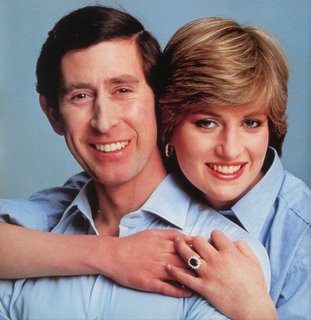 Before it all went awry. I'm sure no one laughed at them when this picture came out but where did Charles end and Diana begin? Was this the first sign of trouble?
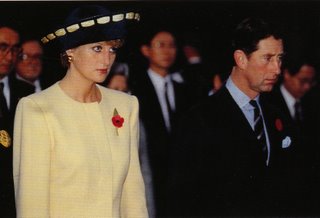 Sometimes they even do matching pained expressions, proving that if a couple is together long enough they will start to look like each other or their pets.
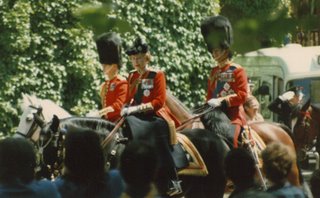
When they work together they wear matching uniforms. Quick, count who has more medals!
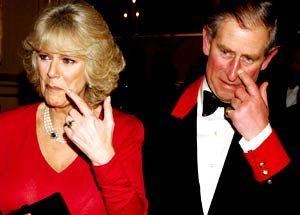 And if they don't dress alike, they're mannerisms are curiously...curious...
© Marilyn Braun 2006
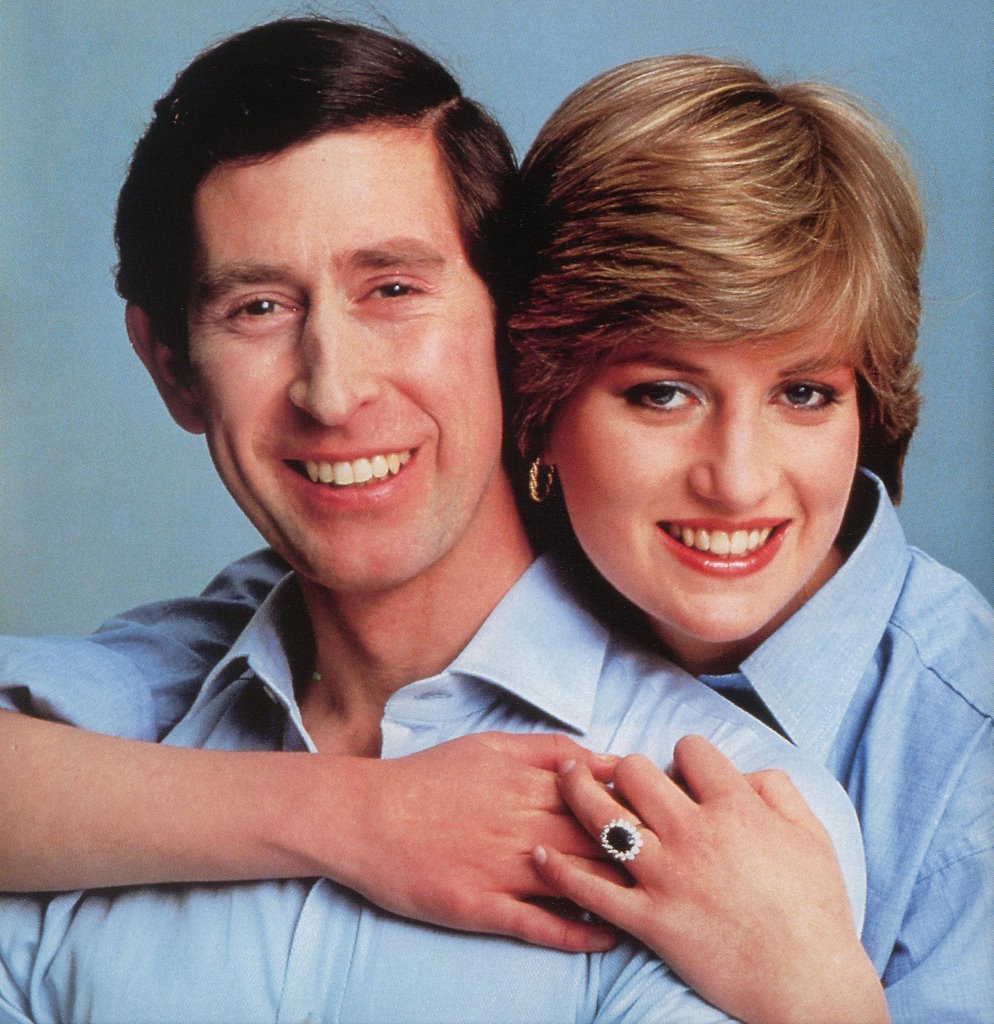 Before it all went awry. I'm sure no one laughed at them when this picture came out but where did Charles end and Diana begin? Was this the first sign of trouble?
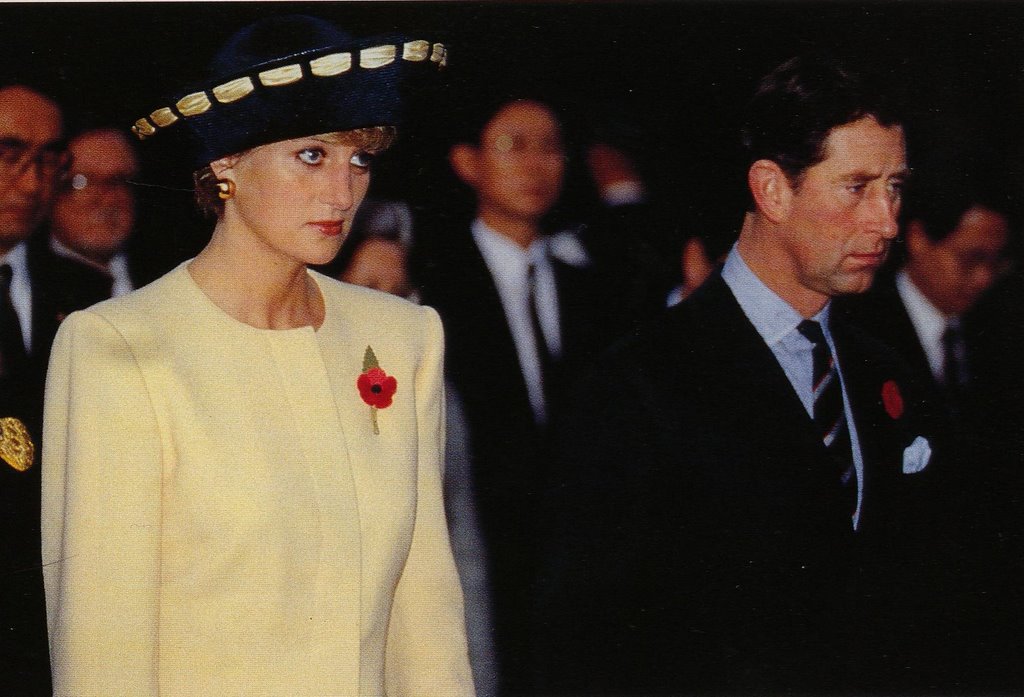 Sometimes they even do matching pained expressions, proving that if a couple is together long enough they will start to look like each other or their pets.
When they work together they wear matching uniforms. Quick, count who has more medals!
 And if they don't dress alike, they're mannerisms are curiously...curious...
© Marilyn Braun 2006
Wednesday, September 27, 2006
Royal Baby Boom
It has just been announced that Princess Letizia of Spain and Princess Maxima of the Netherlands are expecting new arrivals in Spring 2007. This will be the second child for Letizia and the third for Maxima.
In 2005 we had a royal baby boom when it was announced within a week of each other, that Crown Princess Mary of Denmark, and Letizia were expecting new arrivals in October. Also expecting in 2005 were Maxima, Mathilde of Belgium, and Mette-Marit of Norway. The birth of a royal baby is always a joyous event but when these events occur in such quick succession one has to wonder whether there's something in the palace water.
There hasn't been a birth in the British royal family since 2004 when the family welcomed Estella Taylor, the youngest child of Lady Helen Taylor. It seems that they are lagging behind, but in the past they have had their share of baby booms. The first one in 1817 after the death of Princess Charlotte, the daughter of the future King George IV, and her son in childbirth. Surprisingly enough, amongst the 15 children of King George III, once Princess Charlotte died, not a legitimate grandchild existed. A race ensued to produce a legitimate heir to the throne, his middle aged sons forgoing their mistresses and illegitimate offspring to marry suitable brides. Eventually this effort culminated with the birth of Princess Victoria of Kent who as Queen Victoria would become the longest reigning sovereign in British history.
The second baby boom occurred in 1964 when the Queen, Princess Alexandra, Princess Margaret and the Duchess of Kent were all expecting at the same time. Princess Alexandra delivered her son James first, followed by the Queen with Prince Edward, the Duchess of Kent delivered Lady Helen Taylor (nee Windsor), and finally in May, Lady Sarah Armstrong-Jones, daughter of Princess Margaret arrived. It is said that the four ladies made quite a sight waddling together. No succession crisis provoked these arrivals. Maybe there was something in the water?
This year Japan welcomed it's first male heir to the throne in 40 years, and a new baby princess arrived in the Italian royal family. As well, the youngest son of Queen Beatrix had his third child and another princess in the Dutch royal house is expecting a baby in November. I wouldn't be in the least bit surprised if Princess Mary of Denmark announced an impending arrival. She and her husband welcomed Prince Christian in October 2005 and have made no secret of wanting more children.
Regardless, let us hope that these future children arrive safely and are happy and healthy.
© Marilyn Braun 2006
Postscript: It was announced on October 26th that Crown Princess Mary of Denmark is expecting her second child in May. Am I psychic or what? ;)
In 2005 we had a royal baby boom when it was announced within a week of each other, that Crown Princess Mary of Denmark, and Letizia were expecting new arrivals in October. Also expecting in 2005 were Maxima, Mathilde of Belgium, and Mette-Marit of Norway. The birth of a royal baby is always a joyous event but when these events occur in such quick succession one has to wonder whether there's something in the palace water.
There hasn't been a birth in the British royal family since 2004 when the family welcomed Estella Taylor, the youngest child of Lady Helen Taylor. It seems that they are lagging behind, but in the past they have had their share of baby booms. The first one in 1817 after the death of Princess Charlotte, the daughter of the future King George IV, and her son in childbirth. Surprisingly enough, amongst the 15 children of King George III, once Princess Charlotte died, not a legitimate grandchild existed. A race ensued to produce a legitimate heir to the throne, his middle aged sons forgoing their mistresses and illegitimate offspring to marry suitable brides. Eventually this effort culminated with the birth of Princess Victoria of Kent who as Queen Victoria would become the longest reigning sovereign in British history.
The second baby boom occurred in 1964 when the Queen, Princess Alexandra, Princess Margaret and the Duchess of Kent were all expecting at the same time. Princess Alexandra delivered her son James first, followed by the Queen with Prince Edward, the Duchess of Kent delivered Lady Helen Taylor (nee Windsor), and finally in May, Lady Sarah Armstrong-Jones, daughter of Princess Margaret arrived. It is said that the four ladies made quite a sight waddling together. No succession crisis provoked these arrivals. Maybe there was something in the water?
This year Japan welcomed it's first male heir to the throne in 40 years, and a new baby princess arrived in the Italian royal family. As well, the youngest son of Queen Beatrix had his third child and another princess in the Dutch royal house is expecting a baby in November. I wouldn't be in the least bit surprised if Princess Mary of Denmark announced an impending arrival. She and her husband welcomed Prince Christian in October 2005 and have made no secret of wanting more children.
Regardless, let us hope that these future children arrive safely and are happy and healthy.
© Marilyn Braun 2006
Postscript: It was announced on October 26th that Crown Princess Mary of Denmark is expecting her second child in May. Am I psychic or what? ;)
Friday, September 15, 2006
Thursday, September 14, 2006
Tribute to Princess Grace of Monaco
Princess Grace of Monaco died 24 years ago, on September 14, 1982.
Monday, September 11, 2006
The Blogs Royal
Recently it seems that people are searching for royal blogs, blogs on British royalty, or blogs about specific royalty. I originally posted this on my other blog, The Royal Chronicles so I thought it would be relevant to post it again, this time updated with more blogs.
When I started Marilyn’s Royal Blog, I didn’t know whether other royal blogs existed. Blogger didn’t seem to have a very good searching option to find blogs by theme, so I didn’t have a clue where to look for them. Since then I’ve located several blogs which are either devoted to, have sections on royalty, or have a royal theme. In no particular order:
World of Royalty Blog
The Royal Journal & August Annotations
Royal Anecdotes & Aristocracy Anecdotes
Monarchio (In Italian)
The Monarchist
Swedish Royalty Insight
Danish Royal Watchers
Eke’s Royalty Blog
Royal Jewels of the World & Royal Jewels of the World 2 (Interesting sites but these haven't been updated in a while)
Celebrity Baby Blog - Royalty
The Princely Family of Monaco (Mainly in French)
King Nicholas and the Copeman Empire - Blog by ‘Englands other monarch’
If you know of any other royalty blogs, feel free to add them in your comment!
When I started Marilyn’s Royal Blog, I didn’t know whether other royal blogs existed. Blogger didn’t seem to have a very good searching option to find blogs by theme, so I didn’t have a clue where to look for them. Since then I’ve located several blogs which are either devoted to, have sections on royalty, or have a royal theme. In no particular order:
World of Royalty Blog
The Royal Journal & August Annotations
Royal Anecdotes & Aristocracy Anecdotes
Monarchio (In Italian)
The Monarchist
Swedish Royalty Insight
Danish Royal Watchers
Eke’s Royalty Blog
Royal Jewels of the World & Royal Jewels of the World 2 (Interesting sites but these haven't been updated in a while)
Celebrity Baby Blog - Royalty
The Princely Family of Monaco (Mainly in French)
King Nicholas and the Copeman Empire - Blog by ‘Englands other monarch’
If you know of any other royalty blogs, feel free to add them in your comment!
Wednesday, September 06, 2006
Is Princess Aiko's loss Japan's gain?
National rejoicing greeted the birth of a male heir to the Japanese Chrysanthemum throne today. The first male born to the family since 1965. The birth of the unnamed prince effectively ends any move to revise the succession laws to allow Princess Aiko, the only child of the Crown Prince and Princess of Japan to succeed. Of course it is certainly politically correct for politicians to say that the debate will continue, paying lip service to the female population of Japan, who today had further confirmation of the inequality of their sex. However, tradition trumps change and progress.
When Princess Aiko was born in 2001, eight years after the marriage of her parents, it sparked a succession crisis which seemed inevitable until it was announced in February that Princess Kiko, wife of the second son of the Emperor was pregnant with her third child. Princess Aiko as a female could not, according to the present succession laws, succeed to the throne.
Thankfully Aiko, at four years old, is too young to fully realize what she's lost. The opportunity to make a change. To be a symbol of equality to Japanese women. Her parents may be relieved that she doesn't have to shoulder the burden of such a lofty position, but as the first and only child of the Crown Prince and Princess she has been deprived of a birthright otherwise denied to her because of her sex.
Should this new child have been a girl, Aiko might still have had a chance. Now we can only wonder what might have been. The new prince is now third in line to the throne, behind his uncle, the Crown Prince and his father. The status quo has been maintained and traditionalists can breathe a sigh of relief until the next generation. One thing is for certain, we have not heard the last of this issue.
© Marilyn Braun 2006
When Princess Aiko was born in 2001, eight years after the marriage of her parents, it sparked a succession crisis which seemed inevitable until it was announced in February that Princess Kiko, wife of the second son of the Emperor was pregnant with her third child. Princess Aiko as a female could not, according to the present succession laws, succeed to the throne.
Thankfully Aiko, at four years old, is too young to fully realize what she's lost. The opportunity to make a change. To be a symbol of equality to Japanese women. Her parents may be relieved that she doesn't have to shoulder the burden of such a lofty position, but as the first and only child of the Crown Prince and Princess she has been deprived of a birthright otherwise denied to her because of her sex.
Should this new child have been a girl, Aiko might still have had a chance. Now we can only wonder what might have been. The new prince is now third in line to the throne, behind his uncle, the Crown Prince and his father. The status quo has been maintained and traditionalists can breathe a sigh of relief until the next generation. One thing is for certain, we have not heard the last of this issue.
© Marilyn Braun 2006
Thursday, August 31, 2006
Tuesday, August 29, 2006
Royal Profile: Princess Mary, Princess Royal and Countess of Harewood

She was born at York Cottage, on the Sandringham estate, the third child and only daughter of the Duke and Duchess of York, the future King George V and Queen Mary. Her siblings were Prince Edward (later Edward VIII and Duke of Windsor, Albert (later King George VI), Henry, Duke of Gloucester , Prince George, Duke of Kent and Prince John. Her christening took place on June 7, 1897 at St. Mary Magdalene Church on the Sandringham estate. Her godparents included Queen Victoria, King George I of Greece, the Dowager Empress of Russia, the Prince and Princess of Wales, Princess Victoria of Wales, Princess Mary Adelaide, Duchess of Teck and Prince Francis of Teck.

She was extremely shy but she was her father's favourite child. Cooking was a favourite pastime and she enjoyed working the model dairy that her grandmother Queen Alexandra had set up at Sandringham, milking the cows, churning the milk, and making little pats of butter for her father's breakfast. She had her own school room, sharing her lessons with the younger daughters of the Duke of Devonshire. She studied piano and singing and shared drill classes with her brothers. Quick and intelligent, she was an excellent rider, and a good linguist, fluent in French and German.
During the First World War she was active in welfare organizations, particularly involved in projects to provide comfort to troops. This concern led to the creation of the Princess Mary gift box which was sent out to troops in Christmas 1914. These boxes contained one ounce of pipe tobacco, twenty cigarettes, a pipe, a tinder lighter, a Christmas card from the King and Queen and a photograph of Princess Mary. Non-smokers received a box containing a packet of acid tablets, a khaki writing case containing pencil, paper and envelopes together with the Christmas card and photograph. Princess Mary also took a nursing course and in 1918 went to work at the Great Ormond Street Hospital.
 In 1922 she married Henry, Viscount Lascelles, a man 15 years her senior at Wesminster Abbey. At first they made their home at Goldsborough Hall, near Knaresborough. Seven years after their wedding, Lord Lascelles succeeded his father as the sixth Earl of Harewood and they moved into Harewood House. Princess Mary loved Yorkshire and she was known as the 'Yorkshire Princess'. They had two sons, George the present Earl of Harewood, born in 1922 and Gerald born in 1923.
Her public duties reflected a particular concern with nursing, the Women's Services and the Girl Guide movement. She was appointed Commandant in Chief of the British Red Cross Detachments in 1926 and she also became Colonel-in-chief' of a number of regiments. Following the death of her aunt, Louise, Princess Royal and Duchess of Fife, she was created Princess Royal by her father on January 1, 1932.
At the outbreak of World War II, the Princess Royal became chief controller and later controller commandant of the Auxiliary Territorial Service (ATS, renamed the Women's Royal Army Corp in 1949). In that capacity she travelled Britain visiting its units, as well as wartime canteens and other welfare organizations.
After her husband's death in 1947, she continued to live at Harewood house with her son and his family. She became Chancellor of Leeds University in 1951, and continued to carry out many duties at home and abroad, representing the Queen at the independence celebrations of Trinidad in 1962 and Zambia in 1964. During a trip to Canada in 1962 she became the first woman to be installed as an honorary bencher of the Law Society of Upper Canada. Upon receiving this honor she said 'I have not been a great lawyer, but I'm fast becoming one'. One of her last official engagements was to represent the Queen at the funeral of Queen Louise of Sweden in early March 1965.
She died suddenly of a heart attack on March 28, 1965 while walking in the garden with her eldest son and his family. She is buried on the Harewood estate.
© Marilyn Braun 2006
Wednesday, August 23, 2006
Royal Gastronomy
Royalty have their image on stamps and commemorative items. Some more notable royals have buildings, docks, and streets that bear their names. At one point it was even fashionable to honor royalty, by naming a food dish after them. Although some of the stories behind the names of these items are unsubstantiated, here are some examples I've located:
Many dishes are named for Queen Victoria: Victoria Pea, Victoria Plum, Victoria Apple, including sole, eggs, salad, a garnish, several sauces, a cherry spice cake, a bombe, and small tarts. The Victoria sponge cake (or Victorian Sandwich, Victorian Cake) was so named because the Queen was known to enjoy a slice with her afternoon tea.
Prince Albert: Albert Sauce, Filet of Beef Prince Albert, Prince Albert Pea, Cobourg Loaf and the Prince Albert Apple. The Apple, thought to have originated in Berkhampstead, Herts, raised by Mr Thomas Squire, as a cross between Russet Nonpareil and Dumelow's Seedling and named after Queen Victoria and Prince Albert, who reputedly visited Berkhampstead on the very day that Mr Squire planted his seedling in his garden. He initially named the apple tree Victoria and Albert. However it was renamed Prince Albert some time later when it was grown commercially.
Like his parents, Edward VII had several foods named for him: Poularde Eduoard VII, King Edward VII Potato, and the King Edward VII Apple. Possibly the most famous example is Crepes Suzette. Said to have been created for then-Prince of Wales Edward VII on 31 January, 1896, at the Café de Paris in Monte Carlo. When the prince ordered a special dessert for himself and a young female companion, Henri Charpentier, produced the flaming crepe dish. Edward reportedly asked that the dessert be named after his companion Suzette (reportedly the daughter of a friend) rather than himself.
Battenburg Cake: Supposedly named in honor of the marriage of Queen Victoria's granddaughter, Princess Victoria of Hesse-Darmstadt to Prince Louis of Battenberg in 1884. A two colored, chequered sponge cake, four quarters of sponge honour the four Battenberg princes, Louis, Alexander, Henry and Francis. During the war with Germany the family decided it should anglicize its name in the face of anti-German feeling and the Battenberg family name was changed to Mountbatten, thankfully the cake kept its original Battenberg name.
Pizza Margherita: This pizza is dedicated to Queen Margherita of Savoy. She was interested in the popular dish that her French chefs could not prepare so the famous "pizzaiolo" Raffaele Esposito was invited to court and suggested three pizzas, this one reflecting the colours of the Italian Sabauda flag, the Marinara and a white cheese pizza. Garlic, considered improper for the delicate palate of the Queen was avoided. So on the 11th June 1889 Pizza became a dish fit for Royalty.
Queen Elizabeth, The Queen Mother: Queen Mother's Cake. The story is that Jan Smeterlin, the eminent Polish pianist, loved to cook. And he collected recipes. This is one that was given to him on a concert tour in Austria.When the Queen Mother was invited to tea at the home of the Smeterlins, the hostess baked the cake according to Smeterlin's recipe. The Queen Mother loved it and asked for the recipe. Then--as the story goes--she served it often at her royal parties. Including the time she invited the Smeterlins to her home.
Some other examples of food named for royalty:
Queen Alexandra: Gâteau Alexandra, consommé Alexandra, soup, sole, chicken quail
Consommé Princess Alice: Named for Princess Alice, Countess of Athlone, one of Queen Victoria's granddaughters.
Christian IX (of Denmark) cheese: also called Danbo. Named after the "Grandfather of Europe"
Queen Charlotte (wife of George III): Apple Charlotte, named in her honor because she was a supporter of apple growers.
Queen of Sheba Cake (or Reine de Saba)
Consommé Marie Stuart: Named after Mary, Queen of Scots
Queen Mary (consort of King George V): Twinings Queen Mary tea
Prince of Wales Twinings tea
© Marilyn Braun 2006
Many dishes are named for Queen Victoria: Victoria Pea, Victoria Plum, Victoria Apple, including sole, eggs, salad, a garnish, several sauces, a cherry spice cake, a bombe, and small tarts. The Victoria sponge cake (or Victorian Sandwich, Victorian Cake) was so named because the Queen was known to enjoy a slice with her afternoon tea.
Prince Albert: Albert Sauce, Filet of Beef Prince Albert, Prince Albert Pea, Cobourg Loaf and the Prince Albert Apple. The Apple, thought to have originated in Berkhampstead, Herts, raised by Mr Thomas Squire, as a cross between Russet Nonpareil and Dumelow's Seedling and named after Queen Victoria and Prince Albert, who reputedly visited Berkhampstead on the very day that Mr Squire planted his seedling in his garden. He initially named the apple tree Victoria and Albert. However it was renamed Prince Albert some time later when it was grown commercially.
Like his parents, Edward VII had several foods named for him: Poularde Eduoard VII, King Edward VII Potato, and the King Edward VII Apple. Possibly the most famous example is Crepes Suzette. Said to have been created for then-Prince of Wales Edward VII on 31 January, 1896, at the Café de Paris in Monte Carlo. When the prince ordered a special dessert for himself and a young female companion, Henri Charpentier, produced the flaming crepe dish. Edward reportedly asked that the dessert be named after his companion Suzette (reportedly the daughter of a friend) rather than himself.
Battenburg Cake: Supposedly named in honor of the marriage of Queen Victoria's granddaughter, Princess Victoria of Hesse-Darmstadt to Prince Louis of Battenberg in 1884. A two colored, chequered sponge cake, four quarters of sponge honour the four Battenberg princes, Louis, Alexander, Henry and Francis. During the war with Germany the family decided it should anglicize its name in the face of anti-German feeling and the Battenberg family name was changed to Mountbatten, thankfully the cake kept its original Battenberg name.
Pizza Margherita: This pizza is dedicated to Queen Margherita of Savoy. She was interested in the popular dish that her French chefs could not prepare so the famous "pizzaiolo" Raffaele Esposito was invited to court and suggested three pizzas, this one reflecting the colours of the Italian Sabauda flag, the Marinara and a white cheese pizza. Garlic, considered improper for the delicate palate of the Queen was avoided. So on the 11th June 1889 Pizza became a dish fit for Royalty.
Queen Elizabeth, The Queen Mother: Queen Mother's Cake. The story is that Jan Smeterlin, the eminent Polish pianist, loved to cook. And he collected recipes. This is one that was given to him on a concert tour in Austria.When the Queen Mother was invited to tea at the home of the Smeterlins, the hostess baked the cake according to Smeterlin's recipe. The Queen Mother loved it and asked for the recipe. Then--as the story goes--she served it often at her royal parties. Including the time she invited the Smeterlins to her home.
Some other examples of food named for royalty:
Queen Alexandra: Gâteau Alexandra, consommé Alexandra, soup, sole, chicken quail
Consommé Princess Alice: Named for Princess Alice, Countess of Athlone, one of Queen Victoria's granddaughters.
Christian IX (of Denmark) cheese: also called Danbo. Named after the "Grandfather of Europe"
Queen Charlotte (wife of George III): Apple Charlotte, named in her honor because she was a supporter of apple growers.
Queen of Sheba Cake (or Reine de Saba)
Consommé Marie Stuart: Named after Mary, Queen of Scots
Queen Mary (consort of King George V): Twinings Queen Mary tea
Prince of Wales Twinings tea
© Marilyn Braun 2006
Popular Posts
-
Definition: A queen regnant is a female ruler who reigns in her own right. Unlike a queen consort who is the spouse of the reigning king, wi...
-
An occupational hazard of marrying into the royal family is receiving thousands of bouquets throughout your royal career. While these flower...
-
Royalty have their image on stamps and commemorative items. Some more notable royals have buildings, docks, and streets that bear their name...
-
View image | gettyimages.com When Lady Diana Spencer married Prince Charles in 1981, the Spencer's - one of England's preeminent ...
-
 Since the reign of King George IV, most sovereigns have created a form of royal family order for members of the royal family, usually female...
 -
On the last episode of The Royal & The Clueless, Prince William, Kate and Jecca Craig were left in a precarious position when their ski ...
-
"Diamonds are a girl's best friend", and so the song goes. But royal engagement rings are somewhat different. Despite some fab...
-
 She was born on April 25, 1897 in Queen Victoria's Diamond Jubilee year. Queen Victoria called her "My dear little Jubilee baby...


