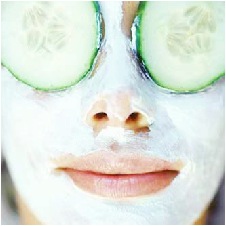
Queen Victoria had many granddaughters named after her, but few stand out more than Princess Victoria Melita, who was to create a scandal in the royal courts of Europe with her divorce and remarriage.
Princess Victoria Melita was born on November 25, 1876 in the San Antonio Palace in Malta, where her father, an officer in the British Royal navy, had been temporarily stationed. She was the third child of Alfred, Duke of Edinburgh, and son of Queen Victoria, and Grand Duchess Marie Alexandrovna, daughter of Tsar Alexander II of Russia. She was named Victoria after her grandmother and Melita after her birthplace, but to her family she was known as “Ducky”. She had four siblings: Alfred, Marie (later Queen of Romania), Alexandra, and Beatrice. Her early years were spent in England, where the family lived at Clarence House in London. When she was nine, her father was stationed in Malta, where the family was to remain for three years. While there Victoria learnt to ride and horse riding would become a passion she shared with her sister Marie.
When her father became heir to the Duchy of Saxe-Coburg, the family moved to Coburg, Germany in 1889. She was confirmed on May 15th 1891 in the village church of Oeslau, near Scholl Roseau. On a trip to Russia later that year, Victoria Melita met Grand Duke Kyril Vladimirovich, a cousin on her mother’s side. Although there was a mutual attraction, the Russian Orthodox Church disallowed marriage between first cousins. Instead Queen Victoria steered Victoria Melita towards her cousin, Prince Ernst Ludwig (Ernie), Grand Duke of Hesse (brother of Victoria, Marchioness of Milford Haven). Other than the same birthday, the cousins shared little in common and were incompatible. Despite this the couple bowed to pressure from Queen Victoria and the family and was married on April 9, 1894 at Schloss Ehrenburg, in Coburg. The marriage produced two children, Elisabeth born in 1895, and a stillborn son in 1900. Their daughter was to die of typhoid at the age of eight in 1903.
With Prince Ernst Ludwig rumored to be bisexual, and Victoria Melita in love with another man, the marriage became increasingly untenable. They made attempts to make it work for the sake of appearances, but the marriage was finally dissolved on December 21, 1901 by the Supreme Court of Hesse on the grounds of “invincible mutual antipathy”.
After her divorce, Victoria Melita went to live with her mother. Victoria Melita resumed her relationship with Kyril, something which caused a scandal in the Russian courts as Empress Alexandra was the sister of Prince Ernst Ludwig. In 1902 Kyril was exiled to the Far East by Nicholas II. In 1904, Kyril returned to Moscow and the Tsar gave him permission to leave Russia to be with Victoria Melita. They were married in secret on October 8, 1905 in Tegernsee. As a result of their marriage, the Tsar stripped Kyril of his rank, decorations and privileges and the couple went into exile in Paris. The couple would have three children, Maria (born 1907), Kira (born 1909), and Vladimir (born 1917).
After several deaths in the Russian royal family made Kyril third in line to the throne, Nicholas II allowed the couple to return to Russia in 1909 and granted Victoria Melita the title of Grand Duchess.
In 1917, during the Russian revolution, the couple and their children fled to Finland. They spent some time in Coburg, Germany before eventually settling in France.
Victoria Melita died in Amobach on March 1 1936 and is buried in the family mausoleum in Germany.
© Marilyn Braun

Wednesday, June 28, 2006


Tuesday, May 30, 2006
Royal Profile: The Earl of Snowdon
The announcement that Antony Armstrong-Jones would marry Princess Margaret took people by surprise. Although people were happy for the Princess, especially after the Peter Townsend affair, many felt a "bohemian" photographer, who worked for a living, had no place in the royal family.
Antony Charles Robert Armstrong-Jones was born on March 7th 1930 in Eaton Terrace, London. He was the only son, and second child of Ronald Owen Lloyd Armstrong-Jones and his first wife Anne Messel, who later became the Countess of Rosse. His parents divorced in 1934 and as a result of his parent's subsequent marriages, he has three half-brothers.
He was educated at Sandroyd preparatory school then he went on to Eton. An attack of polio left him in a wheel-chair for a year, severely interrupting his education, and would leave him with one leg slightly shorter than the other. He eventually attended Jesus College Cambridge, first studying natural sciences and then switching to architecture. Neither subject stimulated his interest so he decided to pursue photography, a hobby he'd had since boyhood. His first shots appeared in an undergraduate newspaper and he then progressed to taking photos for various society magazines, which brought him professional status. While at Cambridge he coxed the college rowing team, and in 1950 he led the Cambridge Eight to victory. Having failed the architecture exams, he left Cambridge without a degree and joined the studio of the photographer Baron, who had taken the wedding photographs of the Queen and Prince Philip. After six months he set up his own studio and soon established himself as one of London's most successful photographers in the fields of fashion, design and theatre.
His career as a royal portraitist began in 1956 when he was comissioned to photograph the young Duke of Kent. The following year he photographed the Queen's children, Prince Charles and Princess Anne, and then the Queen and the Duke of Edinburgh themselves. He has continued to photograph the royal family, taking the engagement photos of Charles and Diana, the first official photos of the infant Prince's William and Harry and more recently, a portrait of the Queen for her 80th birthday.
He met Princess Margaret at a dinner party on February 20, 1958. Their relationship was kept from the public eye and when their engagement was announced on February 26, 1960, it took many by surprise. They were married on May 6, 1960 in Westminster Abbey. The couple were very popular in the 1960's, regarded as the epitome of glamour and modernity. They moved in showbiz, artistic, and fashion circles befriending the Beatles and Peter Sellers.
With the announcement that the Princess was pregnant with her first child, Antony was created the 1st Earl of Snowdon, Viscount Linley of Nymans, a title with centuries old royal associations and an acknowledgement of his Welsh ancestry. It was thought that this child, as the grandchild of a sovereign, should not go without a title. Their son, David Armstrong-Jones, Viscount Linley was born on November 3, 1961. A daughter, Lady Sarah Armstrong-Jones was born on May 1st 1964.
Following his marriage to Princess Margaret, Lord Snowdon continued his work as a photographer and as a design consultant. His work included designing an aviary at London Zoo in 1965 and in his role as Constable of Caernarvon Castle, he played a significant part in the design preparations for the investiture ceremony for the Prince of Wales in 1969. He has done a great deal of work for disabled people. In 1972 he designed the Chairmobile, a motorised platform intended to give greater mobility to those suffering from physical handicaps. As the reknowned photographer 'Snowdon', he had had several international exhibitions, and his work has appeared in over a dozen books. He has also made several television films, which have earned him international awards, including two Emmy's.
Princess Margaret and Lord Snowdon announced their separation in March 1976 and the marriage ended on May 24 1978. On December 15 1978 Lord Showdon married Lucy Mary Lindsay-Hogg and their daughter, Lady Frances, was born on July 17, 1979. They divorced two decades later when it was revealed that Snowdon was having an affair with another woman, Melanie Cable-Alexander, with whom he fathered an out-of-wedlock child, Jasper William Oliver Cable-Alexander, born on April 30, 1998.
He was awarded the Knight Grand Cross of the Victorian order in 1969 and in 1999 he was created Baron Armstrong-Jones.
© Marilyn Braun 2006
Antony Charles Robert Armstrong-Jones was born on March 7th 1930 in Eaton Terrace, London. He was the only son, and second child of Ronald Owen Lloyd Armstrong-Jones and his first wife Anne Messel, who later became the Countess of Rosse. His parents divorced in 1934 and as a result of his parent's subsequent marriages, he has three half-brothers.
He was educated at Sandroyd preparatory school then he went on to Eton. An attack of polio left him in a wheel-chair for a year, severely interrupting his education, and would leave him with one leg slightly shorter than the other. He eventually attended Jesus College Cambridge, first studying natural sciences and then switching to architecture. Neither subject stimulated his interest so he decided to pursue photography, a hobby he'd had since boyhood. His first shots appeared in an undergraduate newspaper and he then progressed to taking photos for various society magazines, which brought him professional status. While at Cambridge he coxed the college rowing team, and in 1950 he led the Cambridge Eight to victory. Having failed the architecture exams, he left Cambridge without a degree and joined the studio of the photographer Baron, who had taken the wedding photographs of the Queen and Prince Philip. After six months he set up his own studio and soon established himself as one of London's most successful photographers in the fields of fashion, design and theatre.
His career as a royal portraitist began in 1956 when he was comissioned to photograph the young Duke of Kent. The following year he photographed the Queen's children, Prince Charles and Princess Anne, and then the Queen and the Duke of Edinburgh themselves. He has continued to photograph the royal family, taking the engagement photos of Charles and Diana, the first official photos of the infant Prince's William and Harry and more recently, a portrait of the Queen for her 80th birthday.
He met Princess Margaret at a dinner party on February 20, 1958. Their relationship was kept from the public eye and when their engagement was announced on February 26, 1960, it took many by surprise. They were married on May 6, 1960 in Westminster Abbey. The couple were very popular in the 1960's, regarded as the epitome of glamour and modernity. They moved in showbiz, artistic, and fashion circles befriending the Beatles and Peter Sellers.
With the announcement that the Princess was pregnant with her first child, Antony was created the 1st Earl of Snowdon, Viscount Linley of Nymans, a title with centuries old royal associations and an acknowledgement of his Welsh ancestry. It was thought that this child, as the grandchild of a sovereign, should not go without a title. Their son, David Armstrong-Jones, Viscount Linley was born on November 3, 1961. A daughter, Lady Sarah Armstrong-Jones was born on May 1st 1964.
Following his marriage to Princess Margaret, Lord Snowdon continued his work as a photographer and as a design consultant. His work included designing an aviary at London Zoo in 1965 and in his role as Constable of Caernarvon Castle, he played a significant part in the design preparations for the investiture ceremony for the Prince of Wales in 1969. He has done a great deal of work for disabled people. In 1972 he designed the Chairmobile, a motorised platform intended to give greater mobility to those suffering from physical handicaps. As the reknowned photographer 'Snowdon', he had had several international exhibitions, and his work has appeared in over a dozen books. He has also made several television films, which have earned him international awards, including two Emmy's.
Princess Margaret and Lord Snowdon announced their separation in March 1976 and the marriage ended on May 24 1978. On December 15 1978 Lord Showdon married Lucy Mary Lindsay-Hogg and their daughter, Lady Frances, was born on July 17, 1979. They divorced two decades later when it was revealed that Snowdon was having an affair with another woman, Melanie Cable-Alexander, with whom he fathered an out-of-wedlock child, Jasper William Oliver Cable-Alexander, born on April 30, 1998.
He was awarded the Knight Grand Cross of the Victorian order in 1969 and in 1999 he was created Baron Armstrong-Jones.
© Marilyn Braun 2006
Tuesday, May 09, 2006
Royal Trivia
Did you know...
- Buckingham Palace does not have air conditioning
- King Edward VIII, while Prince of Wales, was the first member of the royal family to make a public broadcast on October 7, 1922.
- The Queen does not vote
- The Queen does not require a drivers licence
- The Duke of Edinburgh is currently the oldest member of the royal family.
- The Queen received 20,000 birthday cards and 17,000 emails on her recent 80th birthday.
© Marilyn Braun 2006
Wednesday, May 03, 2006
Royal Profile: Frances Shand Kydd
Two significant events occurred on the Sandringham estate in Norfolk on January 20, 1936. King George V died and The Honorable Frances Ruth Burke Roche was born. The Fermoys had long been friends of King George V and Queen Mary and it is said that Queen Mary was able to tell the King the news of her birth before he died. Frances was the younger daughter of Edmund Maurice Burke Roche, 4th Lord Fermoy, and Ruth Silvia Gill, an accomplished concert pianist and later lady in waiting to Queen Elizabeth, the Queen Mother. Frances had an elder sister, Cynthia (or Mary), and a younger brother, Edmund.
She was educated at home in the schoolroom of Park House under a governess by the name of Miss Gertrude Allen, who would later teach Frances' own children. When Frances and her sister graduated from the schoolroom they went to Downham, in Hertfordshire. Frances did exceptionally well, leaving at the age of sixteen as head girl and captain of cricket, netball, lacrosse and tennis. She became a good tennis player and qualified for a national school's tournament, however appendicitis sidelined her chance to play at Wimbledon.
When she left school in 1952 to met John 'Johnny' Spencer, Viscount Althorp (later the 8th Earl Spencer). Like the Fermoy's, the Spencer's had long associations with the royal family and Johnny was equerry to King George VI and Queen Elizabeth II. On June 1, 1954 she married Johnny at Westminster Abbey. This wedding was touted as the society wedding of the year, attended by the queen, Prince Philip, the Queen Mother and Princess Margaret. Frances at eighteen, was the youngest royal bride to be married in the Abbey in the 20th century. Like her daughter Diana, she married a man 12 years her senior.
The Althorps began their married life in Gloucestershire where Johnny was a student in a farming course at the Royal Agricultural College. They would have five children: Sarah (b 1955), Jane (b 1957), John (born 1960, and died within 10 hours of his birth), and Diana (born 1961). After the death of their son and the birth of Diana, the marriage was increasingly marred by pressure to produce a male heir to continue the Spencer title. Frances was sent to various doctors to evaluate her failure to produce a boy. In 1964, their son Charles, the 9th Earl Spencer was born.
Increasingly unhappy in her marriage, Frances caused a scandal by having an affair with a married, wealthy businessman, Peter Shand Kydd. Lord and Lady Althorp separated in 1967 and divorced in April 1969. As a result of her affair, and having been named as 'the other woman' in the Shand Kydd's divorce, Frances lost custody of her children. One month later, Frances married Peter on May 2, 1969 in a quiet register office ceremony. In 1972 the Shand Kydd's bought a 1,000 acre farm on the isle of Seil, south of Oban in Argyllshire.
The Shand Kydd's led a quiet life until Diana married into the royal family and the media turned their attention on the family. Peter and Frances separated in June 1988 after he had an affair with a younger woman. She continued to live on the island, and she was respected and known for taking long walks and for her love of fishing. She converted to Catholicism and was well known for her charity work. She died on June 3, 2004, in her home after a long illness at the age of 68.
© Marilyn Braun 2006
She was educated at home in the schoolroom of Park House under a governess by the name of Miss Gertrude Allen, who would later teach Frances' own children. When Frances and her sister graduated from the schoolroom they went to Downham, in Hertfordshire. Frances did exceptionally well, leaving at the age of sixteen as head girl and captain of cricket, netball, lacrosse and tennis. She became a good tennis player and qualified for a national school's tournament, however appendicitis sidelined her chance to play at Wimbledon.
When she left school in 1952 to met John 'Johnny' Spencer, Viscount Althorp (later the 8th Earl Spencer). Like the Fermoy's, the Spencer's had long associations with the royal family and Johnny was equerry to King George VI and Queen Elizabeth II. On June 1, 1954 she married Johnny at Westminster Abbey. This wedding was touted as the society wedding of the year, attended by the queen, Prince Philip, the Queen Mother and Princess Margaret. Frances at eighteen, was the youngest royal bride to be married in the Abbey in the 20th century. Like her daughter Diana, she married a man 12 years her senior.
The Althorps began their married life in Gloucestershire where Johnny was a student in a farming course at the Royal Agricultural College. They would have five children: Sarah (b 1955), Jane (b 1957), John (born 1960, and died within 10 hours of his birth), and Diana (born 1961). After the death of their son and the birth of Diana, the marriage was increasingly marred by pressure to produce a male heir to continue the Spencer title. Frances was sent to various doctors to evaluate her failure to produce a boy. In 1964, their son Charles, the 9th Earl Spencer was born.
Increasingly unhappy in her marriage, Frances caused a scandal by having an affair with a married, wealthy businessman, Peter Shand Kydd. Lord and Lady Althorp separated in 1967 and divorced in April 1969. As a result of her affair, and having been named as 'the other woman' in the Shand Kydd's divorce, Frances lost custody of her children. One month later, Frances married Peter on May 2, 1969 in a quiet register office ceremony. In 1972 the Shand Kydd's bought a 1,000 acre farm on the isle of Seil, south of Oban in Argyllshire.
The Shand Kydd's led a quiet life until Diana married into the royal family and the media turned their attention on the family. Peter and Frances separated in June 1988 after he had an affair with a younger woman. She continued to live on the island, and she was respected and known for taking long walks and for her love of fishing. She converted to Catholicism and was well known for her charity work. She died on June 3, 2004, in her home after a long illness at the age of 68.
© Marilyn Braun 2006
Wednesday, April 26, 2006
Royal Profile: Queen Louise of Sweden
Louise Alexandra Marie Irene was born on July 13, 1889 at the Heiligenberg in Darmstadt. Her parents were Victoria, Marchioness of Milford Haven, and Prince Louis of Battenberg, son of Princess Battenberg.
She was the second of four children: Alice (mother of the present Duke of Edinburgh), George Milford Haven, and Louis (Earl Mountbatten of Burma). She was born prematurely and in her memoirs, her mother described her as 'a rather miserable little object, and the nickname "shrimp" which Louis then gave her remained attached to her during her childhood.' As a result of her premature birth she would suffer frail health for most of her life. She was christened at the Heiliegenberg on August 9, 1889 and confirmed on May 16, 1905.
Like her sister, Louise became a nurse during the Balkan War in Nevers, France. While there she met a Scottish artist named Alexander Stuart-Hill, who Louise's family nickhamed Shakespeare because of a resemblance. She was briefly engaged to him but the plans came to nothing when it was discovered that he was homosexual. With the end of this engagement, Louise, at twenty-five, resigned herself to a life of spinsterhood.
On July 14, 1917, her parents renounced their German titles and Louise became Lady Louise Mountbatten. In 1923, at the age of thirty-four, Louise became engaged to the widowed Crown Prince Gustaf Adolf of Sweden who had five children. They were married in the Chapel Royal in London on November 3, 1923. The couple had one child, a stillborn daughter born on May 30th 1925. Despite this tragedy, their marriage was a happy one.
She became Queen of Sweden on October 29 1950. She took to this role with modesty, 'I just can't get over people calling me your majesty.' At the funeral of King George VI, the Queen of Sweden's car was announced and Louise did not recognize it was for her. When she went shopping in London, in case she was run over and nobody knew who she was, she placed a card in her purse announcing: 'I am the Queen of Sweden.'
In December 1964 she suffered a heart attack, recovered but died on March 7th 1965 after an operation to remove a blot clot in the main artery of her heart. She is buried in the Royal graveyard at Haga.
© Marilyn Braun 2006
She was the second of four children: Alice (mother of the present Duke of Edinburgh), George Milford Haven, and Louis (Earl Mountbatten of Burma). She was born prematurely and in her memoirs, her mother described her as 'a rather miserable little object, and the nickname "shrimp" which Louis then gave her remained attached to her during her childhood.' As a result of her premature birth she would suffer frail health for most of her life. She was christened at the Heiliegenberg on August 9, 1889 and confirmed on May 16, 1905.
Like her sister, Louise became a nurse during the Balkan War in Nevers, France. While there she met a Scottish artist named Alexander Stuart-Hill, who Louise's family nickhamed Shakespeare because of a resemblance. She was briefly engaged to him but the plans came to nothing when it was discovered that he was homosexual. With the end of this engagement, Louise, at twenty-five, resigned herself to a life of spinsterhood.
On July 14, 1917, her parents renounced their German titles and Louise became Lady Louise Mountbatten. In 1923, at the age of thirty-four, Louise became engaged to the widowed Crown Prince Gustaf Adolf of Sweden who had five children. They were married in the Chapel Royal in London on November 3, 1923. The couple had one child, a stillborn daughter born on May 30th 1925. Despite this tragedy, their marriage was a happy one.
She became Queen of Sweden on October 29 1950. She took to this role with modesty, 'I just can't get over people calling me your majesty.' At the funeral of King George VI, the Queen of Sweden's car was announced and Louise did not recognize it was for her. When she went shopping in London, in case she was run over and nobody knew who she was, she placed a card in her purse announcing: 'I am the Queen of Sweden.'
In December 1964 she suffered a heart attack, recovered but died on March 7th 1965 after an operation to remove a blot clot in the main artery of her heart. She is buried in the Royal graveyard at Haga.
© Marilyn Braun 2006
Wednesday, April 19, 2006
Royal Review: Official Royal Websites
Most people may get their royalty news from tabloids, legitimate media or unofficial royal sites, but one of the best sources for information are the official sites. The details may not be juicy but they're a fantastic resource. Nearly all royal families realize the value of having a website for announcements, and general information. Over time, some of the sites have added multi-media features such as virtual tours, music, audio and occassional videos. Although there are many official sites out there, I've decided to review just a few of them. Note, links to these sites are available on the sidebar to the left.
The Official Site of the British Monarchy. One of the best sites out there, comprehensive, it can answer almost any question that you have regarding the family, its traditions, and ceremonies. It has a monthly on-line news magazine, with some of the questions rumoured to be answered by the Duke of York himself. Not to mention access to the Royal Collection with an impressive e-gallery. Has a children's section. Updated frequently it is always up to the minute in terms of the information offered.
The Greek Royal family Site: Greek and English. This site seems to be under construction and some of the information is disappointing. An improvement from its previous incarnation, but it still has a ways to go. For one there is a complete lack of history of the Greek royal family and the site seems to be more of a press release for ex-King Constantine regarding his legal issues.
The Danish Monarchy: English and Danish. Clean and stylish, this site is proof that you don't need multi-media to make a site interesting.The bio's are very informative, but it has limited information regarding the activities of the family. It would be nice if there was more information on previous Danish sovereigns other than a chronological list. Also, some of the information has yet to be updated, such as the bios of the Crown Prince and Princess, which say nothing about the birth of their son Prince Christian.
The Official Site of the Prince's Palace of Monaco: English and French. At one point this site was practically non-existent in terms of information about the current royal family. It has since been redesigned, however it doesn't seem to have much history regarding the Grimaldi family. Information for the Sovereign Prince reads like a resume but otherwise the bio's for the current family are fairly comprehensive. Although the site is bilingual, if you select press releases they will come up in French. I'm not certain whether this is a glitch or not but I've found this frustrating on more than one occassion.
The Dutch Royal House: English and Dutch. This site has been redesigned so it's much easier to use and navigate. One of the few sites to have a children's section, which includes some charming letters and drawings. A photo section allows downloading for personal use. Some of the photos are very casual, a welcome departure from some of the more formal poses released by other royal families. Unlike other royal sites, reading the biographies in the 'Who's Who" section, and especially seeing the photos, one gets a sense of family as opposed to a Royal House. Public engagements, news, photos of current activities and important announcements are only available on the Dutch version of this site. If an important event occurs, such as the birth of the Crown Prince and Princess's younger daughter, the visitor is left to decipher the announcement. Offers 'virtual tours' of the palaces, but some of the tours are slow to load. The history section is not nearly as comprehensive as the British site.
The Belgian Monarchy: English, Dutch, French and German. The only sections that are not available in English are the recent royal births, engagements and archives of individual members. Informative and easy to navigate, the site has some nice sections, the birth Princess Elisabeth is a sweet example, with video of the newborn Princess with her parents.
The Royal House of Norway: Norwegian and English. Some nice biographies of the members of the royal house. A more detailed history of previous monarchs would be nice. Some of the announcements are rather limited and brief, and I've found that some important updates are not in English. Photos are available in the Norwegian section of the site. Has a family tree, showing the relationship between the royal houses of Britain, Sweden, Norway and Denmark. if you click on various people will come up with short biographies of the person. In comparison to some of the other royal sites, this appears a bit basic. I could not locate a site map or any contact information in English.
The Swedish Royal Court: Swedish and English. This site has also been recent redesigned and it's much easier to navigate. Second only to the British site in terms of being comprehensive, it has the option to listen to the site. Unlike the Monagasque site, the language feature is consistent - if you select English, the entire site appears in English. In reviewing, I found a discrepancy in Princess Victoria's birthdate and when I contacted the webmaster I was given an unexpected personalized response.
The Imperial Household Agency Homepage (Japanese Royalty): Japanese and English. Overall I think this is one of the worst sites, aesthetically outdated and difficult to navigate. Has a wealth of information but it's not presented in a very impressive fashion. Unlike other sites, it has some interviews with members of the royal family. Awkwardly laid out, some of the characters in the personal histories don't translate properly. Contact information is limited to an email address.
The Royal Household of His Majesty the King (The Royal House of Spain): Spanish and English. Recently redesigned but still being worked on. It's an improvement on its previous incarnation, which you can see if you click on the link to it. Despite selecting English, some of the sections still come up in Spanish. I didn't find this site particularly easy to navigate. If there is a history of the monarchy I couldn't find it. Has information on the various palaces, including virtual tours.
King Abdullah II of Jordan's website: Arabic and English. One of the few sites to have music! For some reason the King and Queen have separate websites. The Queen's site is actually wonderful, focusing on her initiatives with women and empowerment. Great information about the couple's separate initiatives.
The Princely House of Liechtenstein: German and English. Although I'm not particularly familar with this royalty, should I want to learn more the information is here in this rather sparse site. Has information each reigning Prince since 1608, the history of the Princely House, the Constitution, Titles, Orders and Decorations, and a link to the Princely Collection. Very limited information about the current family aside from names and dates of birth. Also has a link to the LGT group, which provides financial services to the royal family, as well as anyone else who might be interested, which I think is a bit unusual.
Serbian Royalty: Style wise I found this site to be inconsistent and a bit busy, particularly the history page. On the front page, if you mouse over the members of the family it will highlight the person and fade the other members. Has movies , radio interviews, and information about the history, flags, and a nice page about the Royal Palaces.
© Marilyn Braun 2006
The Official Site of the British Monarchy. One of the best sites out there, comprehensive, it can answer almost any question that you have regarding the family, its traditions, and ceremonies. It has a monthly on-line news magazine, with some of the questions rumoured to be answered by the Duke of York himself. Not to mention access to the Royal Collection with an impressive e-gallery. Has a children's section. Updated frequently it is always up to the minute in terms of the information offered.
The Greek Royal family Site: Greek and English. This site seems to be under construction and some of the information is disappointing. An improvement from its previous incarnation, but it still has a ways to go. For one there is a complete lack of history of the Greek royal family and the site seems to be more of a press release for ex-King Constantine regarding his legal issues.
The Danish Monarchy: English and Danish. Clean and stylish, this site is proof that you don't need multi-media to make a site interesting.The bio's are very informative, but it has limited information regarding the activities of the family. It would be nice if there was more information on previous Danish sovereigns other than a chronological list. Also, some of the information has yet to be updated, such as the bios of the Crown Prince and Princess, which say nothing about the birth of their son Prince Christian.
The Official Site of the Prince's Palace of Monaco: English and French. At one point this site was practically non-existent in terms of information about the current royal family. It has since been redesigned, however it doesn't seem to have much history regarding the Grimaldi family. Information for the Sovereign Prince reads like a resume but otherwise the bio's for the current family are fairly comprehensive. Although the site is bilingual, if you select press releases they will come up in French. I'm not certain whether this is a glitch or not but I've found this frustrating on more than one occassion.
The Dutch Royal House: English and Dutch. This site has been redesigned so it's much easier to use and navigate. One of the few sites to have a children's section, which includes some charming letters and drawings. A photo section allows downloading for personal use. Some of the photos are very casual, a welcome departure from some of the more formal poses released by other royal families. Unlike other royal sites, reading the biographies in the 'Who's Who" section, and especially seeing the photos, one gets a sense of family as opposed to a Royal House. Public engagements, news, photos of current activities and important announcements are only available on the Dutch version of this site. If an important event occurs, such as the birth of the Crown Prince and Princess's younger daughter, the visitor is left to decipher the announcement. Offers 'virtual tours' of the palaces, but some of the tours are slow to load. The history section is not nearly as comprehensive as the British site.
The Belgian Monarchy: English, Dutch, French and German. The only sections that are not available in English are the recent royal births, engagements and archives of individual members. Informative and easy to navigate, the site has some nice sections, the birth Princess Elisabeth is a sweet example, with video of the newborn Princess with her parents.
The Royal House of Norway: Norwegian and English. Some nice biographies of the members of the royal house. A more detailed history of previous monarchs would be nice. Some of the announcements are rather limited and brief, and I've found that some important updates are not in English. Photos are available in the Norwegian section of the site. Has a family tree, showing the relationship between the royal houses of Britain, Sweden, Norway and Denmark. if you click on various people will come up with short biographies of the person. In comparison to some of the other royal sites, this appears a bit basic. I could not locate a site map or any contact information in English.
The Swedish Royal Court: Swedish and English. This site has also been recent redesigned and it's much easier to navigate. Second only to the British site in terms of being comprehensive, it has the option to listen to the site. Unlike the Monagasque site, the language feature is consistent - if you select English, the entire site appears in English. In reviewing, I found a discrepancy in Princess Victoria's birthdate and when I contacted the webmaster I was given an unexpected personalized response.
The Imperial Household Agency Homepage (Japanese Royalty): Japanese and English. Overall I think this is one of the worst sites, aesthetically outdated and difficult to navigate. Has a wealth of information but it's not presented in a very impressive fashion. Unlike other sites, it has some interviews with members of the royal family. Awkwardly laid out, some of the characters in the personal histories don't translate properly. Contact information is limited to an email address.
The Royal Household of His Majesty the King (The Royal House of Spain): Spanish and English. Recently redesigned but still being worked on. It's an improvement on its previous incarnation, which you can see if you click on the link to it. Despite selecting English, some of the sections still come up in Spanish. I didn't find this site particularly easy to navigate. If there is a history of the monarchy I couldn't find it. Has information on the various palaces, including virtual tours.
King Abdullah II of Jordan's website: Arabic and English. One of the few sites to have music! For some reason the King and Queen have separate websites. The Queen's site is actually wonderful, focusing on her initiatives with women and empowerment. Great information about the couple's separate initiatives.
The Princely House of Liechtenstein: German and English. Although I'm not particularly familar with this royalty, should I want to learn more the information is here in this rather sparse site. Has information each reigning Prince since 1608, the history of the Princely House, the Constitution, Titles, Orders and Decorations, and a link to the Princely Collection. Very limited information about the current family aside from names and dates of birth. Also has a link to the LGT group, which provides financial services to the royal family, as well as anyone else who might be interested, which I think is a bit unusual.
Serbian Royalty: Style wise I found this site to be inconsistent and a bit busy, particularly the history page. On the front page, if you mouse over the members of the family it will highlight the person and fade the other members. Has movies , radio interviews, and information about the history, flags, and a nice page about the Royal Palaces.
© Marilyn Braun 2006
Monday, April 10, 2006
Royal Focus: The Poltimore Tiara
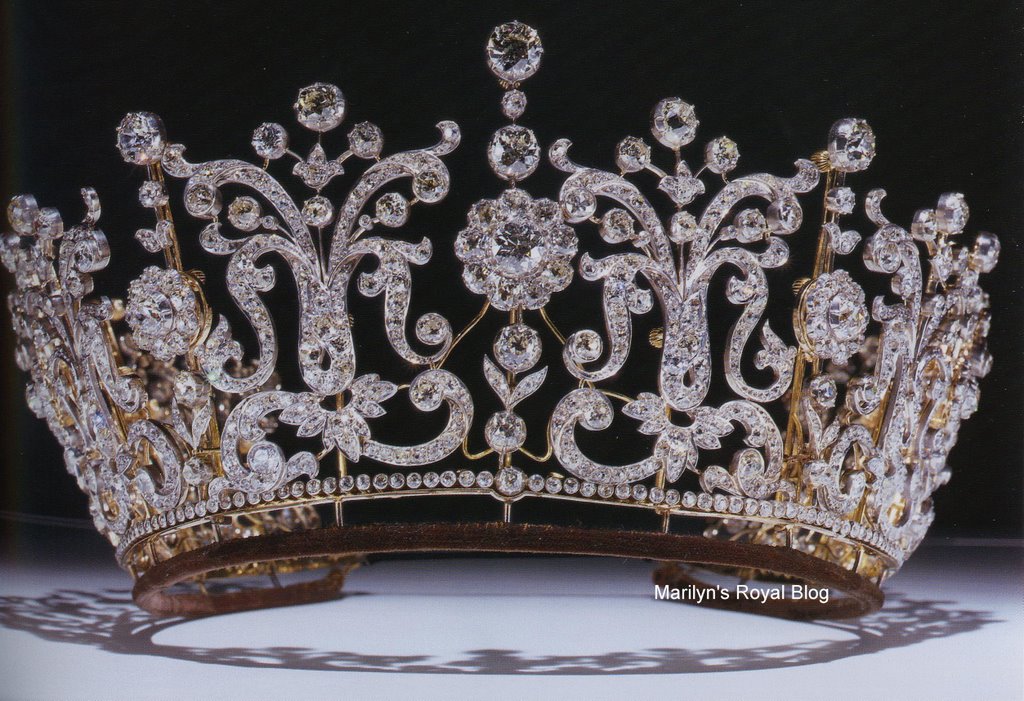 It isn't very often that British royal jewellery goes to auction. The 1987 Sotheby's sale of the Duchess of Windsor's collection could be considered to be the last significant auction. However, in June another sale will be taking place when Christie's International auctions off over 800 items of the late Princess Margaret's jewellery and works of art collection. And if you are the lucky bidder, you could own a memorable piece of royal history.
Amongst the beautiful jewels that Princess Margaret wore in her lifetime, the Poltimore tiara was unquestionably the most striking. She wore it many times throughout her life, but it was most famously worn for her wedding in 1960. The Princess made a stunning bride in her silk organza dress. Unlike other royal wedding dresses it was simple in its design and this simplicity was underlined by the Poltimore tiara.
It is interesting to note that this particular tiara did not come from the royal vaults; but it was acquired specifically for Princess Margaret in 1959. Sold at Sotheby's by the fourth Baron Poltimore's daughter, the Hon. Lady Stucley, it is rumoured to have cost ₤5000.
This neo-classical tiara, was made by Garrard in the 1870's for Florence, the wife of the Second Baron Poltimore, treasurer to Queen Victoria's household. The Diadem features scrolls, leaves and flower clusters and is set on a row of small diamond collets.
The versatile Poltimore can also be worn as a small circlet, necklace and it can be taken apart to form two large corsage brooches. Perfect for those of us who don't have many opportunities to wear tiaras.
© Marilyn Braun 2006
Tuesday, April 04, 2006
Royal Review: Philip and Elizabeth - Portrait of a Royal Marriage by Gyles Brandreth
 I don't normally buy biographies of royal subjects and I rarely read them. Mainly because they tend to have too many sensationalized details already written about in dozens of other books. For the most part it's the same story, different dustjacket. If it does deviate from chronological biography, the books tend to be a forum for the onesided and venemous viewpoints of the author (example: Charles - Victim or Villain by Penny Junor).
Claiming to know his subjects personally and with the promise of no unnamed sources, I decided to read Philip and Elizabeth: Portrait of a Marriage. Ultimately the title 'Portrait of a Marriage' is a bit deceptive, as the book becomes more about Prince Philip than it does on his relationship with the Queen (see list of Prince Philip's Achievements at the end of the book). In this case, it's not much different from Basil Boothroyd's Philip: An Informal Biography. Of course that was 35 years ago, so 'Philip and Elizabeth' continues where Boothroyd left off.
The book begins with the life stories of Prince Philip and the Queen, but none of the information is unique; it can be found in any biography. The story of their romance and courtship comes across as seemingly one-sided. As the Queen does not give interviews, we are left with Philip's unsentimental and pragmatic view of the relationship . Prince Philip is quoted in the book as saying "I suppose one thing led to another, it was sort of fixed up. That's what really happened." Considering that this book is supposed to be a 'Portrait of a Marriage' we are left with little to go on regarding its genesis. We are reminded several times throughout the book that Philip is not inclinded to introspection, nor recollection, which becomes tiresome after a while and makes it frustrating to get an accurate picture.
Any juicy information is prefaced by the author ("Although it's really none of your business..." or "Of course we don't need to know. It's none of our business..."). True but then why write a book in the first place? With only one half co-operating with the author, we are left with friends and relatives of the couple to fill in the blanks. To understand his subject better, the author resorts to some misguided psychoanalysis of Prince Philip, but with no clear insight.
Their relationship with their children has its own chapter, and other than Prince Charles' side of the story in his own book by Johnathan Dimbleby, we are left with the impression that, given the circumstances of their lives, the children had a fairly normal and pleasant upbringing. "We did the best we could" is Prince Philip's reply. Although the media would have us believe that the Queen and Prince Philip are distant and cold parents, they come across as anything but. Understanding and sympathetic, these qualities are particularly evident in their relationship with Diana.
Rumours about their married lives and Philip's affairs are addressed. The author makes a valiant attempt to dispel notions by interviewing friends, relatives, some of the women in question and the Prince himself, with rather unsatisfying results. It's hard to take the conclusions at face value when these women are referred to as Prince Philip's "play-mates".
Despite this, I believe the author has maintained an objective viewpoint of his subject. He does not sensationalize any aspect of their lives. But it is only towards the end of the book that the portrait comes into its own. After almost 60 years of marriage, the Queen and Prince Philip are revealed to be a couple who are different, yet friends. Happy, they respect, understand, and complement each other.
And with their share of ups and downs, following the path towards this conclusion makes this book enjoyable to read.
© Marilyn Braun 2006
Saturday, April 01, 2006
Royal Profile: Marion Crawford
Marion Crawford was the governess of the Queen and Princess Margaret when they were children. But she is more famous for being one of the first insiders to write an intimate account of royal life by publishing The Little Princesses.
She was born on June 5, 1909 in Woodside Cottage near Kilmarnock in Ayrshire. The daughter of a mechanical engineer's clerk, her father died when she was a year old. Her mother remarried when she was six and the family then moved to Dundermline in Scotland.
She trained as a teacher at Moray House Training College in Edinburgh, (now part of Edinburgh University) and she had originally intended to become a child psychologist. While on leave from her studies, she worked as a temporary governess to the children of Lord Elgin and tutored the daughter of Lady Rose Leveson Gower; the sister of Elizabeth, Duchess of York (later the Queen Mother). Two weeks after meeting the Duke and Duchess, she was asked to take on the education of Princesses Elizabeth and Margaret, who were five and two at the time. She joined the royal household in 1933 and stayed for sixteen years. Affectionately named 'Crawfie' by her royal charges, she taught Bible, History Grammar, Arithmetic, Geography, Literature, Poetry, Music, Drawing, Writing and Composition.
She became engaged to George Buthlay, a divorced Major from Aberdeen. Fifteen years her senior, he had served in the Middle East during the war. They were married on September 16, 1947 in Dunfermline Abbey. She retired in 1949 to a grace and favour residence, Nottingham Cottage, at Kensington Palace and was made a Commander of the Victorian Order in January 1949 by King George VI.
At the time royal servants were paid very little and it was thought that serving royalty was its own reward. Convinced by her husband that she was being taken advantage of, she went against Queen Elizabeth (the Queen Mother's) wishes by writing The Little Princesses. As a result, she was shunned by the royal family and their circle. She went on to publish a life of Queen Mary (The Queen Mother) in 1951. In 1952 and 1953, she sold her name to a series of articles: Queen Elizabeth II, Happy and Glorious and Princess Margaret. She also had her own weekly column 'Crawfie's Column' but her career as a royal columnist ended when, on June 16, 1955, Woman's Own published her personal accounts of the Trooping the Colour and Royal Ascot; events which had been cancelled due to the National Rail Strike.
Her husband died in 1977 and she spent her remaining years in seclusion in Aberdeen, making one suicide attempt in old age. She died at Hawkhill House, an Aberdeen nursing home on February 11, 1988. No member of the royal family attended or sent condolences.
© Marilyn Braun 2006
She was born on June 5, 1909 in Woodside Cottage near Kilmarnock in Ayrshire. The daughter of a mechanical engineer's clerk, her father died when she was a year old. Her mother remarried when she was six and the family then moved to Dundermline in Scotland.
She trained as a teacher at Moray House Training College in Edinburgh, (now part of Edinburgh University) and she had originally intended to become a child psychologist. While on leave from her studies, she worked as a temporary governess to the children of Lord Elgin and tutored the daughter of Lady Rose Leveson Gower; the sister of Elizabeth, Duchess of York (later the Queen Mother). Two weeks after meeting the Duke and Duchess, she was asked to take on the education of Princesses Elizabeth and Margaret, who were five and two at the time. She joined the royal household in 1933 and stayed for sixteen years. Affectionately named 'Crawfie' by her royal charges, she taught Bible, History Grammar, Arithmetic, Geography, Literature, Poetry, Music, Drawing, Writing and Composition.
She became engaged to George Buthlay, a divorced Major from Aberdeen. Fifteen years her senior, he had served in the Middle East during the war. They were married on September 16, 1947 in Dunfermline Abbey. She retired in 1949 to a grace and favour residence, Nottingham Cottage, at Kensington Palace and was made a Commander of the Victorian Order in January 1949 by King George VI.
At the time royal servants were paid very little and it was thought that serving royalty was its own reward. Convinced by her husband that she was being taken advantage of, she went against Queen Elizabeth (the Queen Mother's) wishes by writing The Little Princesses. As a result, she was shunned by the royal family and their circle. She went on to publish a life of Queen Mary (The Queen Mother) in 1951. In 1952 and 1953, she sold her name to a series of articles: Queen Elizabeth II, Happy and Glorious and Princess Margaret. She also had her own weekly column 'Crawfie's Column' but her career as a royal columnist ended when, on June 16, 1955, Woman's Own published her personal accounts of the Trooping the Colour and Royal Ascot; events which had been cancelled due to the National Rail Strike.
Her husband died in 1977 and she spent her remaining years in seclusion in Aberdeen, making one suicide attempt in old age. She died at Hawkhill House, an Aberdeen nursing home on February 11, 1988. No member of the royal family attended or sent condolences.
© Marilyn Braun 2006
Monday, March 27, 2006
Here's More Royal Trivia!
Did you know....
- King Edward VIII, as Prince of Wales, was the first member of the royal family to fly. He learned in France during the first World War and later went on to become a skilful pilot. He also founded the King's Flight in 1936 to provide royal air transportation for official duties.
- King George VI, as Prince Albert was the first monarch to be a qualified pilot. He gained his pilot's licence in 1919.
- In 1911, King George V, accompanied by Queen Mary, was the only King-Emperor to visit India and be installed as Emperor at a Delhi-Durbar.
- King George VI was the first British monarch to visit the United States and Canada
- Prince Albert Edward (the future King Edward VII) was heir apparent to the throne longer than anyone else in British history. The son of Queen Victoria, he inherited the throne at the age of 59.
- Queen Elizabeth II has visited countries which no other British monarch has ever visited. She was the first reigning monarch to make State visits to Russia in October 1994, Korea in 1999 and to Brunei and Malaysia in 1998.
- The Queen does not have or need a passport.
© Marilyn Braun 2006
Wednesday, March 22, 2006
Spouse of the Year
Camilla has been granted a new title. No, it's not Princess of Wales, and the verdict is still out on the Queen Camilla thing. Noooo...this is special and one you would least expect. She's been named 'Spouse of the Year' at the Oldie of the Year awards. Considering what she's been called in the past, she would probably welcome this. But what would the award be for such an honor. Yes, it's great that she's been given this honor but shouldn't she have something to show for it? A conversation piece that people can admire? The Oscars have, well, a gold plated man, the Grammy's have a gramaphone, the Razzies, have raspberries, shouldn't Camilla have something to show for being elected the most famous hausfrau in the world? Here are some ideas I've come up with:
 The bane of most spouses, cleaning supplies are a sure symbol of the sacrifice and hard work involved in being a spouse. She can choose between a lifetime supply or a vacuum
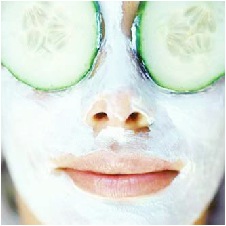 A Spa Day - Yes, truly appreciated but the facial scrub glow and french manicure only lasts for so long. Warning: Do not stare at the photo for too long, it might be disturbing.
 Children - Cute huh? sure you can't gold plate them, but if they make you proud that could be a great, long lasting reward. Choose more than one and it could be an endless (really endless) conversation piece.
Station Wagon - She'll need something to haul the kids around in.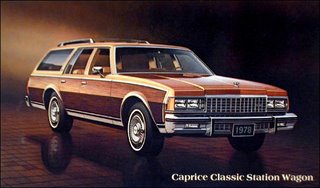
Who needs a mini-van when you can have this? Just don't let them ride in the back - there are laws about that now.
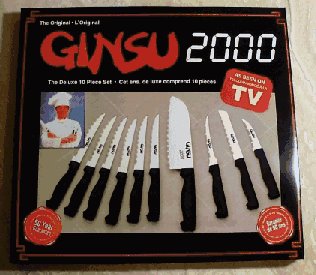 A set of ginsu knives - why settle for anything less. Multi-functional: cut tomatos, shoes and even trees! Choose this option and we'll throw in a free steak knife.
 Appliances - Not just a default wedding gift. Functional, practical and unsentimental, modern appliances are a must have. They can't live on love alone, they've got to eat. She could be the envy of all her neighbors too.
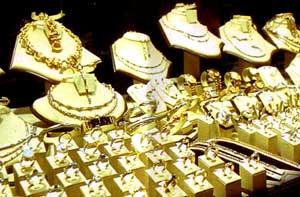 Jewellery - Nothing says "I don't appreciate you enough, but here's something to make up for it" better than a ring or necklace. Besides she can't keep borrowing from her mother in law forever.
© Marilyn Braun 2006
 The bane of most spouses, cleaning supplies are a sure symbol of the sacrifice and hard work involved in being a spouse. She can choose between a lifetime supply or a vacuum
 A Spa Day - Yes, truly appreciated but the facial scrub glow and french manicure only lasts for so long. Warning: Do not stare at the photo for too long, it might be disturbing.
 Children - Cute huh? sure you can't gold plate them, but if they make you proud that could be a great, long lasting reward. Choose more than one and it could be an endless (really endless) conversation piece.
Station Wagon - She'll need something to haul the kids around in.

Who needs a mini-van when you can have this? Just don't let them ride in the back - there are laws about that now.
 A set of ginsu knives - why settle for anything less. Multi-functional: cut tomatos, shoes and even trees! Choose this option and we'll throw in a free steak knife.
 Appliances - Not just a default wedding gift. Functional, practical and unsentimental, modern appliances are a must have. They can't live on love alone, they've got to eat. She could be the envy of all her neighbors too.
 Jewellery - Nothing says "I don't appreciate you enough, but here's something to make up for it" better than a ring or necklace. Besides she can't keep borrowing from her mother in law forever.
© Marilyn Braun 2006
Tuesday, March 21, 2006
Camilla's Humanity
Charles and Camilla recently toured a Sikh temple where they watched a traditional martial arts sword demonstration. During part of this display, Camilla covered her eyes when a blindfolded swordsman sliced a watermelon in half on another man's stomach. No doubt a fairly routine engagement for the world-weary Prince, but for the Duchess it was a new experience.
With ancestors who led troops into bloody battles, it's not surprising to see Prince Charles unfazed. He's not alone: the Queen, Prince Philip, Princess Anne, are practiced in the art of the 'stiff upper lip' whatever the occassion. When Diana died, the royal family experienced some grief over this lack of emotion. So it's a wonder that Camilla, covering her eyes and instinctively flinching, is the focus of attention for..well..being human.
Unfortunately, this quality will go by the wayside once Camilla becomes more royal. She will learn how not to betray her feelings, even in the most dire of circumstances: Queen Victoria survived several assasination attempts, Princess Anne was brave during a kidnapping attempt in 1974. In 1981 the present Queen, most famously during the Trooping the Color when six blank shots were fired at her. In 1982, when Michael Fagan broke into the palace and found the Queen in her bedroom, we were told that the Queen was calm until help arrived. In these instances, the royal family has been lauded for their bravery. How could Camilla recoil from a mere sword?
With headlines that included 'Camilla's hide and Sikh', 'Scaredy-Cat Camilla Covers Her Eyes', 'Duchess of Cornwall Shook by Sikh Swordsman', and 'Charles and Camilla make hair-raising visit to Sikh temple', she paid for it the next day. Well, she can be forgiven for still being on the learning curve. But eventually Camilla will learn to sit impassively through these types of demonstrations, politely applauding afterwards. She will be capable of making small talk with terminally ill patients and in the same day look suitably concerned while visiting the aftermath of devastation and tragedy.
So, trembling with nerves on her wedding day, nervously waving to the crowds and press during the US tour, recoiling from swords....
Enjoy it while it lasts.
© Marilyn Braun 2006
With ancestors who led troops into bloody battles, it's not surprising to see Prince Charles unfazed. He's not alone: the Queen, Prince Philip, Princess Anne, are practiced in the art of the 'stiff upper lip' whatever the occassion. When Diana died, the royal family experienced some grief over this lack of emotion. So it's a wonder that Camilla, covering her eyes and instinctively flinching, is the focus of attention for..well..being human.
Unfortunately, this quality will go by the wayside once Camilla becomes more royal. She will learn how not to betray her feelings, even in the most dire of circumstances: Queen Victoria survived several assasination attempts, Princess Anne was brave during a kidnapping attempt in 1974. In 1981 the present Queen, most famously during the Trooping the Color when six blank shots were fired at her. In 1982, when Michael Fagan broke into the palace and found the Queen in her bedroom, we were told that the Queen was calm until help arrived. In these instances, the royal family has been lauded for their bravery. How could Camilla recoil from a mere sword?
With headlines that included 'Camilla's hide and Sikh', 'Scaredy-Cat Camilla Covers Her Eyes', 'Duchess of Cornwall Shook by Sikh Swordsman', and 'Charles and Camilla make hair-raising visit to Sikh temple', she paid for it the next day. Well, she can be forgiven for still being on the learning curve. But eventually Camilla will learn to sit impassively through these types of demonstrations, politely applauding afterwards. She will be capable of making small talk with terminally ill patients and in the same day look suitably concerned while visiting the aftermath of devastation and tragedy.
So, trembling with nerves on her wedding day, nervously waving to the crowds and press during the US tour, recoiling from swords....
Enjoy it while it lasts.
© Marilyn Braun 2006
Tuesday, March 14, 2006
Meeting Royalty and Nobility
Some people may wonder, what should I do if I meet a member of the royal family? Unless you’re in England, it’s unlikely to happen, but what if? You really don't want to resort to "Hi there" or "Do I know you?" Of course you could say absolutely nothing, a polite handshake and then afterwards wonder who you've just met. But why not be prepared? These instructions are so easy you can even write them on your hand. Just make sure your palms aren't sweaty otherwise you'll get ink all over the Queen's glove.
In comparison to meeting nobility it's far more straightforward than you may think. Note that when you meet royalty, it is optional to bow or curtsey, although some traditionalists still hold to this form of deference. When in doubt, err on the side of formality.
For future reference, I’ve included ways to address them all so that you need not worry about making a faux pas:
The Queen: Your Majesty and thereafter: Ma’am (rhymes with lamb)
The Duke of Edinburgh: Your Royal Highness, and thereafter: Sir
The Duke of York and the Earl of Wessex: Your Royal Highness, and thereafter: Sir
Prince William and Prince Harry: Your Royal Highness, and thereafter: Sir
The Princess Royal: Your Royal Highness, and thereafter: Ma'am
Princess Beatrice, Princess Eugenie, Princess Michael, Princess Alexandra, the Duchess of Kent, the Duchess of Gloucester: Your Royal Highness, and thereafter: Ma’am
Fairly straightforward, wouldn’t you agree?
Now, onto nobility. Here it becomes a bit more complicated. A veritable mine-field of potential offence. After all, what exactly are you supposed to do? Royalty is fairly recognizable, and you may know Earl Spencer (Diana, Princess of Wales' brother) but would you be able to pick out the Duke of Wesminster in a crowd? Once again, when in doubt, err on the side of caution. Especially if no one is wearing a name tag.
There are five forms of Peerage: Duke, Marquess, Earl, Viscount, Baron.
Duke: Your/His Grace
Marquess: My Lord
Earl: My Lord
Viscount: My Lord
Baron: My Lord
There you go! Now, when meeting royalty and nobility, you no longer have to worry about any embarrassing situations.
However, if you happen to run into them, tell Lilibet and Phil I said 'Hi!'
© Marilyn Braun 2006
In comparison to meeting nobility it's far more straightforward than you may think. Note that when you meet royalty, it is optional to bow or curtsey, although some traditionalists still hold to this form of deference. When in doubt, err on the side of formality.
For future reference, I’ve included ways to address them all so that you need not worry about making a faux pas:
The Queen: Your Majesty and thereafter: Ma’am (rhymes with lamb)
The Duke of Edinburgh: Your Royal Highness, and thereafter: Sir
The Duke of York and the Earl of Wessex: Your Royal Highness, and thereafter: Sir
Prince William and Prince Harry: Your Royal Highness, and thereafter: Sir
The Princess Royal: Your Royal Highness, and thereafter: Ma'am
Princess Beatrice, Princess Eugenie, Princess Michael, Princess Alexandra, the Duchess of Kent, the Duchess of Gloucester: Your Royal Highness, and thereafter: Ma’am
Fairly straightforward, wouldn’t you agree?
Now, onto nobility. Here it becomes a bit more complicated. A veritable mine-field of potential offence. After all, what exactly are you supposed to do? Royalty is fairly recognizable, and you may know Earl Spencer (Diana, Princess of Wales' brother) but would you be able to pick out the Duke of Wesminster in a crowd? Once again, when in doubt, err on the side of caution. Especially if no one is wearing a name tag.
There are five forms of Peerage: Duke, Marquess, Earl, Viscount, Baron.
Duke: Your/His Grace
Marquess: My Lord
Earl: My Lord
Viscount: My Lord
Baron: My Lord
There you go! Now, when meeting royalty and nobility, you no longer have to worry about any embarrassing situations.
However, if you happen to run into them, tell Lilibet and Phil I said 'Hi!'
© Marilyn Braun 2006
Friday, March 10, 2006
Camilla The Good
In the best tradition of women in the British monarchy, Camilla is a class act.
You may dispute that but it's true.
Putting aside all that has happened in the past relating to Diana, Camilla is an asset to the monarchy, just as much as the Queen and the Queen Mother.
Why?
Because she knows how to keep her mouth shut.
Unlike Diana, Camilla has maintained a respectful silence. In 30 years she's had more than enough provocation to defend herself, yet she never has. What little we do know of her is from Diana's point of view. We don't know the other side of the story, and maybe we never will.
You may argue, but the evidence suggests that royal class is equated with silence, with going about duty without complaint, earning their keep. The Duchess of Gloucester, the Duchess of Kent, Princess Alexandra, we can't help but see dedication there. No comment can be made when no information is given. We can speculate all we like. Queen Alexandra, Queen Mary and even Queen Elizabeth, the Queen Mother, all class acts, who did not complain about their lot. Who understood duty. Of course we looked at royals with far more deference then, there wasn't the same amout of media interest, no papparazzi to invade their privacy. If they had lived in today's day and age, would there be the same respect?
Princess Michael, although stylish and elegant, is not regarded as a class act. Why? because she talks to the media, writes books and in general sells her wares. It also doesn't help that she makes honest and occassionally unkind remarks about other royals. We don't seem to like royals who have opinions, just look at Prince Charles and his diaries. However, you just can't help but get the feeling that Princess Michael, unrepentant, enjoys all of the attention.
The Queen is respected, mainly because she personifies duty, never having put a foot wrong in all of the years on the throne. Sure, she didn't respond to Diana's death the way we would have liked her to, but she was only doing what she had been trained to do. In 80 years, how much do we really know about the Queen? How much should we know? The Queen does not owe us a public confession. Neither does Camilla.
It's interesting to note that the Queen, her father, grandfather, grandmother and so on, never gave an interview. The Queen Mother was an exception. In 1923, just after her engagement, she gave a brief interview to a newspaper. King George V, her future father-in-law, disapproved and she never made the mistake again. Charles and Diana, Andrew and Sarah, and Edward and Sophie, may have given engagement and pre-wedding interviews, but not Charles and Camilla. Maybe Charles was trying to avoid saying something that would haunt him later. Smart move on Charles' part.
Nowadays we expect our public figures to give us sound bites. After all, we can't live on official photos alone. And slow on the uptake, the royal family is becoming increasingly media savvy. But as Camilla seems to have observed, sometimes it's sensible to keep things to oneself. She may have learnt, to quote part of an old proverb, 'Speech is silver and silence is golden'.
© Marilyn Braun 2006
You may dispute that but it's true.
Putting aside all that has happened in the past relating to Diana, Camilla is an asset to the monarchy, just as much as the Queen and the Queen Mother.
Why?
Because she knows how to keep her mouth shut.
Unlike Diana, Camilla has maintained a respectful silence. In 30 years she's had more than enough provocation to defend herself, yet she never has. What little we do know of her is from Diana's point of view. We don't know the other side of the story, and maybe we never will.
You may argue, but the evidence suggests that royal class is equated with silence, with going about duty without complaint, earning their keep. The Duchess of Gloucester, the Duchess of Kent, Princess Alexandra, we can't help but see dedication there. No comment can be made when no information is given. We can speculate all we like. Queen Alexandra, Queen Mary and even Queen Elizabeth, the Queen Mother, all class acts, who did not complain about their lot. Who understood duty. Of course we looked at royals with far more deference then, there wasn't the same amout of media interest, no papparazzi to invade their privacy. If they had lived in today's day and age, would there be the same respect?
Princess Michael, although stylish and elegant, is not regarded as a class act. Why? because she talks to the media, writes books and in general sells her wares. It also doesn't help that she makes honest and occassionally unkind remarks about other royals. We don't seem to like royals who have opinions, just look at Prince Charles and his diaries. However, you just can't help but get the feeling that Princess Michael, unrepentant, enjoys all of the attention.
The Queen is respected, mainly because she personifies duty, never having put a foot wrong in all of the years on the throne. Sure, she didn't respond to Diana's death the way we would have liked her to, but she was only doing what she had been trained to do. In 80 years, how much do we really know about the Queen? How much should we know? The Queen does not owe us a public confession. Neither does Camilla.
It's interesting to note that the Queen, her father, grandfather, grandmother and so on, never gave an interview. The Queen Mother was an exception. In 1923, just after her engagement, she gave a brief interview to a newspaper. King George V, her future father-in-law, disapproved and she never made the mistake again. Charles and Diana, Andrew and Sarah, and Edward and Sophie, may have given engagement and pre-wedding interviews, but not Charles and Camilla. Maybe Charles was trying to avoid saying something that would haunt him later. Smart move on Charles' part.
Nowadays we expect our public figures to give us sound bites. After all, we can't live on official photos alone. And slow on the uptake, the royal family is becoming increasingly media savvy. But as Camilla seems to have observed, sometimes it's sensible to keep things to oneself. She may have learnt, to quote part of an old proverb, 'Speech is silver and silence is golden'.
© Marilyn Braun 2006
Thursday, March 09, 2006
The Diana Investigation: Is it really over?
Although this hasn't been posted on the official inquest site, it has been announced that Diana's death has been ruled an accident. Two days before this news I became inspired to write about all of the unanswered questions surrounding Diana's death. I can't really do that now can I? Couldn't everyone have waited until I could post a timely article? I guess I thought I had more time, you know how these things tend to drag out. Too bad, it was going to be a thought provoking yet satirical article if I'd gotten around to writing it.
Personally if the inquest is truly over, I'm glad. Not that I was paying much attention to begin with. I admit to being somewhat intrigued by the grisly details, and the possible pregnancy rumors, but the Prince Philip and Prince Charles conspiracy theories are ridiculous. Then: Prince Charles was way too busy wooing Camilla and making copies of his infamous Chinese diaries. Now: Married to Camilla, he's too busy trying to prevent their publication. Then: Prince Philip was too busy telling Charles off about something to worry about Diana and her lover. Now: he's too busy telling Prince Charles off about his diaries to care about the results.
So here's as far as I'd gotten with my draft, where I ask questions which are now quite redundant. Other than spending a lot of money and wringing every last drop out of Diana's memory, what did all of this really accomplish? Okay, maybe that's the only real thought provoking question I wanted to ask. But I did have other filler questions: Does this honor the memory of the victims? Will Mohammed Al Fayed take down his tacky statue of Dodi and the semi-clad Diana? Will someone please ask him to? Will people stop writing tell-all books, magazine articles, and making made-for-TV movies? The answer to most of these questions is No.
Despite the findings, I'm certain that people will continue to think that her death was more than an accident. After all, she was supposed to grow old gracefully and continue her charity work. Diana would have been proud at William's wedding and holding her first grandchild. She would have looked glamorous and regal at his Coronation. Later on, revered as unofficial Queen Mother, she would have died of extreme old age in luxurious surroundings. How could a drunk driver and not wearing a seat-belt kill her?
Like the Kennedy assassination, there will always be speculation; the Warren Commission findings did not end the questions. The Diana investigation will not end the questions either. Was Henri Paul drunk? Was he part of the French Secret Service? Were his blood samples switched? Was Diana murdered?.....
With misinformation and conflicting reports, we'll never know.
© Marilyn Braun 2006
Personally if the inquest is truly over, I'm glad. Not that I was paying much attention to begin with. I admit to being somewhat intrigued by the grisly details, and the possible pregnancy rumors, but the Prince Philip and Prince Charles conspiracy theories are ridiculous. Then: Prince Charles was way too busy wooing Camilla and making copies of his infamous Chinese diaries. Now: Married to Camilla, he's too busy trying to prevent their publication. Then: Prince Philip was too busy telling Charles off about something to worry about Diana and her lover. Now: he's too busy telling Prince Charles off about his diaries to care about the results.
So here's as far as I'd gotten with my draft, where I ask questions which are now quite redundant. Other than spending a lot of money and wringing every last drop out of Diana's memory, what did all of this really accomplish? Okay, maybe that's the only real thought provoking question I wanted to ask. But I did have other filler questions: Does this honor the memory of the victims? Will Mohammed Al Fayed take down his tacky statue of Dodi and the semi-clad Diana? Will someone please ask him to? Will people stop writing tell-all books, magazine articles, and making made-for-TV movies? The answer to most of these questions is No.
Despite the findings, I'm certain that people will continue to think that her death was more than an accident. After all, she was supposed to grow old gracefully and continue her charity work. Diana would have been proud at William's wedding and holding her first grandchild. She would have looked glamorous and regal at his Coronation. Later on, revered as unofficial Queen Mother, she would have died of extreme old age in luxurious surroundings. How could a drunk driver and not wearing a seat-belt kill her?
Like the Kennedy assassination, there will always be speculation; the Warren Commission findings did not end the questions. The Diana investigation will not end the questions either. Was Henri Paul drunk? Was he part of the French Secret Service? Were his blood samples switched? Was Diana murdered?.....
With misinformation and conflicting reports, we'll never know.
© Marilyn Braun 2006
Monday, March 06, 2006
When a kiss isn't just a kiss
Sometimes a kiss just isn't a kiss. The royals are rather circumspect in their displays of affection, so when they do touch each other it becomes incredibly significant. Not only that, it's seen as a barometer of the status of royal relationships. Of course we've seen the polo match kisses, which is nothing more than a chivalrous brushing of the Queen's gloved hand. We would expect to see the queen greeting her Danish, Norwegian and Spanish cousins warmly. However there are other more memorable moments. So, a brief history of royal kisses and physical contact:
1953: Princess Margaret lighly brushes some lint from Peter Townsend's uniform and a firestorm of controversy ensues. Read: He should have used a lint brush.
1957: After months of being away, and amid rumours of marital problems, Prince Philip returns from his solo tour and reunites with the Queen. We don't know whether they actually kissed each other, but Prince Andrew was seen as a 'happy by-product' of their reunion. Read: Let's assume they did.
1981: Casting protocol aside, and with Mummy's permission, Charles and Diana historically lock lips on the balcony of Buckingham Palace on their wedding day, in front of millions of people. Seemingly the first time anyone had kissed on the balcony. Read: if you're going to break precedent go all the way.
1986: Not to be outdone, Andrew and Fergie kiss on the balcony after their wedding. Not as big a deal but it's been the last public royal wedding kiss. Read: What do you think that means?
1992: The infamous kiss-off in Pakistan. Charles went to kiss Diana and she moved her head away. Read: Extreme marital problems
2001: Charles and Camilla made their first public appearance in 1999, but we had to wait two years to see their first public kiss. Read: True confirmation that they're a couple.
2005: William and Harry kiss Camilla after a polo match. Read: Confirmation that they like their step-mother
2006: Now the Queen kisses Camilla and it's seen as a sure sign that Camilla has finally gained acceptance! Forget the wedding, the tiara, the coat of arms, and now the regiment. Read: The Queen tolerates Camilla
© Marilyn Braun 2006
1953: Princess Margaret lighly brushes some lint from Peter Townsend's uniform and a firestorm of controversy ensues. Read: He should have used a lint brush.
1957: After months of being away, and amid rumours of marital problems, Prince Philip returns from his solo tour and reunites with the Queen. We don't know whether they actually kissed each other, but Prince Andrew was seen as a 'happy by-product' of their reunion. Read: Let's assume they did.
1981: Casting protocol aside, and with Mummy's permission, Charles and Diana historically lock lips on the balcony of Buckingham Palace on their wedding day, in front of millions of people. Seemingly the first time anyone had kissed on the balcony. Read: if you're going to break precedent go all the way.
1986: Not to be outdone, Andrew and Fergie kiss on the balcony after their wedding. Not as big a deal but it's been the last public royal wedding kiss. Read: What do you think that means?
1992: The infamous kiss-off in Pakistan. Charles went to kiss Diana and she moved her head away. Read: Extreme marital problems
2001: Charles and Camilla made their first public appearance in 1999, but we had to wait two years to see their first public kiss. Read: True confirmation that they're a couple.
2005: William and Harry kiss Camilla after a polo match. Read: Confirmation that they like their step-mother
2006: Now the Queen kisses Camilla and it's seen as a sure sign that Camilla has finally gained acceptance! Forget the wedding, the tiara, the coat of arms, and now the regiment. Read: The Queen tolerates Camilla
© Marilyn Braun 2006
Friday, March 03, 2006
The Masako Problem
It has been reported in the Japanese media, normally so deferential to the royal family, that Crown Princess Masako wants to divorce Crown Prince Naruhito. Whether this turns out to be true or not, I take exception to the last sentence in the article:
"Her withdrawal from the imperial family would certainly solve a lot of problems."
By way of background: Crown Princess Masako married into the Japanese royal family 13 years ago. Educated, and accomplished, she gave up a promising career as a diplomat in order to do so. Since then she has been stifled and under pressure to produce a male heir to the Chrysanthemum throne. After eight years of marriage, and one miscarriage, she did have a child. Instead of it being the much wanted male, it was a girl. Somewhat disappointing as females cannot inherit the throne and no male has been born into the royal family in 40 years.
It should have been a happy event, the birth of a healthy baby, but it just put more pressure on Masako. As a result, she suffered what has been referred to as an 'adjustment disorder' and she has rarely been seen in public. It is highly unlikely that the Crown couple will have another child, and therefore a succession crisis has ensued, debating whether the laws should be changed to allow their only child, Princess Aiko, to inherit the throne.
Now, unless things have changed, the last time I checked, it was the male who determines the sex of the child. Females have nothing to do with it. Feel free to correct me on this. Do we see the Crown Prince being blamed for the lack of a male heir? Nope! Even though it could be said that he is more to 'blame' than she is. So why would it 'her departure solve a lot of problems'?
Marrying into the royal family might have been more than she anticipated, and departing might be best for her. Note that I said for her. Not for the royal family, not for the public. For her. Using Diana and Fergie as examples, it's difficult to marry into a royal family, especially the British royal family. But looking at the recent commoners who have married into the royal houses of Denmark Norway, the Netherlands, and Spain, some make the transition better than others. Why is this? These royal courts are far less restrictive than the Japanese one, the desire for a male child is not as crucial, and having the support of a loving husband seems to help. If nothing else, Masako seems to have the support of her spouse, but this might not be enough.
Should she divorce, Masako would become persona non grata in the Japanese court. Literally. Late last year, when her sister in law, Princess Sayako married a commoner, she gave up her royal status and her family. Masako was not born royal, but she too would effectively cease to exist, and there would be no going back. It's very likely that she would lose her child as well. Would that solve a lot of problems?
In light of the recent announcement that Princess Kiko, wife of the Emperor's second son, is expecting, this may take some of the pressure off Masako. Or it may not. Some may even think of it as a disappointment - 'Masako failed in her duty.' If this child is a boy, the traditionalists will be pleased and everyone will breathe a sigh of relief. Let future generations deal with succession issues! Should this child be a girl, the debate would only be postponed by nine months.
Will that be Masako's problem? We'll have to wait until September to find out.
© Marilyn Braun 2006
"Her withdrawal from the imperial family would certainly solve a lot of problems."
By way of background: Crown Princess Masako married into the Japanese royal family 13 years ago. Educated, and accomplished, she gave up a promising career as a diplomat in order to do so. Since then she has been stifled and under pressure to produce a male heir to the Chrysanthemum throne. After eight years of marriage, and one miscarriage, she did have a child. Instead of it being the much wanted male, it was a girl. Somewhat disappointing as females cannot inherit the throne and no male has been born into the royal family in 40 years.
It should have been a happy event, the birth of a healthy baby, but it just put more pressure on Masako. As a result, she suffered what has been referred to as an 'adjustment disorder' and she has rarely been seen in public. It is highly unlikely that the Crown couple will have another child, and therefore a succession crisis has ensued, debating whether the laws should be changed to allow their only child, Princess Aiko, to inherit the throne.
Now, unless things have changed, the last time I checked, it was the male who determines the sex of the child. Females have nothing to do with it. Feel free to correct me on this. Do we see the Crown Prince being blamed for the lack of a male heir? Nope! Even though it could be said that he is more to 'blame' than she is. So why would it 'her departure solve a lot of problems'?
Marrying into the royal family might have been more than she anticipated, and departing might be best for her. Note that I said for her. Not for the royal family, not for the public. For her. Using Diana and Fergie as examples, it's difficult to marry into a royal family, especially the British royal family. But looking at the recent commoners who have married into the royal houses of Denmark Norway, the Netherlands, and Spain, some make the transition better than others. Why is this? These royal courts are far less restrictive than the Japanese one, the desire for a male child is not as crucial, and having the support of a loving husband seems to help. If nothing else, Masako seems to have the support of her spouse, but this might not be enough.
Should she divorce, Masako would become persona non grata in the Japanese court. Literally. Late last year, when her sister in law, Princess Sayako married a commoner, she gave up her royal status and her family. Masako was not born royal, but she too would effectively cease to exist, and there would be no going back. It's very likely that she would lose her child as well. Would that solve a lot of problems?
In light of the recent announcement that Princess Kiko, wife of the Emperor's second son, is expecting, this may take some of the pressure off Masako. Or it may not. Some may even think of it as a disappointment - 'Masako failed in her duty.' If this child is a boy, the traditionalists will be pleased and everyone will breathe a sigh of relief. Let future generations deal with succession issues! Should this child be a girl, the debate would only be postponed by nine months.
Will that be Masako's problem? We'll have to wait until September to find out.
© Marilyn Braun 2006
Thursday, March 02, 2006
Royal Profile: Prince Albert Victor, Duke of Clarence and Avondale
 Invariably labeled 'slow', 'backward' and a 'lunatic', his memory is destined to be clouded by mystery. Considered unsuitable for the throne, his death has even been regarded as a stroke of luck for the royal family. To this day there are rumours that he was a drug addict, homosexual, had fathered an illegitimate child, and, although never a formal suspect, the notorious Jack the Ripper.
Prince Albert Victor Christian Edward, was born on January 8, 1864 at Frogmore House. Due in March, he was originally supposed to be born at Marlborough House but his mother, Princess Alexandra, went into labour while watching her husband, the future King Edward VII, play ice hockey. Instead, he was born prematurely at Frogmore House, weighing less than 4 pounds. Against the wishes of his parents, Queen Victoria chose the names Albert Victor, after her late husband and herself. He was informally known to his family as 'Eddy' but due to the circumstances of his birth, society had a different name for him: "All-but on the ice".
 | |
| As an infant with his mother |
Unlike his brother, Eddy showed no aptitude or interest in the Navy. His father then decided a formal education might be more beneficial and in 1883 he entered Trinity College, Cambridge. He did not excel academically but he was eventually granted an honorary degree in 1888. In 1885 he joined the Army, and was commissioned into the 10th Hussars Calvalry Regiment. In 1889-90 he made his first solo tour to India and upon his return, Queen Victoria granted him the dukedoms of Clarence and Avondale, and the title Earl of Athlone.
As a potential King, his parents and Queen Victoria became concerned with Prince Albert Victor's increasingly desolute lifestyle. Rumoured to be frequenting homosexual brothels, it was thought that a good marriage would set him straight and Queen Victoria set about finding a bride for him. The Prince had a habit of falling in love easily with unsuitable women. At one point he was secretly engaged to the unsuitably Catholic Princess Hélène of Orléans, daughter of the pretender to the French throne. His parents and the Queen eventually chose the suitable and sensible Princess May of Teck, the future Queen Mary. It was not a love match but Prince Albert Victor duly proposed to her in December 1891 and their wedding was set for February 27, 1892.
One month before their marriage, while at Sandringham, he fell ill with influenza. Within days he developed pneumonia and died on January 14. He is buried in St. George's Chapel, Windsor.
© Marilyn Braun 2006
Thursday, February 23, 2006
In Royal Fashion
In 1863, shortly after her marriage to the Prince of Wales, Queen Victoria warned her daughter-in-law Princess Alexandra against 'too much dressing or smartness'. This statement accurately sums up the royal family's attitude towards fashion. This is not to say that fashion isn't important, on the contrary, there have been many fashionable royals; some setting their own trends. The same Princess Alexandra set a trend for choker necklaces, because she was trying to cover a scar on her neck. When rheumatic fever left her with a permanent limp, it briefly became fashionable amongst society to do the ‘Alexandra limp’. Later, Princess Marina, Duchess of Kent's fondness for blue, became known as: Marina Blue. More recently, the term 'Camilla chic' has been coined to describe Camilla, Duchess of Cornwall's growing sense of style.
In Queen Victoria’s day, the preference was for British designers, in support of the British fashion industry, to dress royal ladies. Queen Victoria did her part in helping the lagging lace industry by choosing Honiton lace for her wedding dress and the heirloom-christening gown. Patronizing British designers is still encouraged but occasionally, during a royal tour, a compliment will be paid to a designer from the host country; as in the case of Diana, Princess of Wales when she arrived for a tour of France dressed head to toe in Chanel.
When a tour takes place, care is taken not to offend by ensuring that hemlines as well as outfit colors respect the customs of the host country. For public events, bright colors are chosen so that the royal lady stands out and hemlines are weighted to protect royal dignity. Black is rarely worn as it is considered a mourning color. In 1938, just before a tour of France, Queen Elizabeth's mother died and instead of wearing black, she choose to wear white; an alternate mourning color. This choice was a resounding success and is referred to as the White Wardrobe.
Accessories are just as important. Lately, hats have become a focal point, with some imaginative choices made by guests at the wedding of Charles and Camilla. Shortly after her marriage, Diana's choice of wearing hats revitalized the British milinery industry. Diana and Sarah, Duchess of York were lauded for their use of costume jewellry and it would be extremely rare to see the Queen without gloves, pearls, a priceless brooch and a handbag. It has been reported that she uses her handbags to send signals to her staff, by switching from one arm to another, when someone is taking up too much of her time!
Despite the emphasis on practicality and function, and long after trends have moved on, some royal ladies adopt a personal sartorial style. Queen Mary never strayed from wearing turban style hats and dresses that did not go above the ankle; Vogue magazine described her distinctive style as ‘magnificence that transcended fashion’. In her later years, the Queen Mother was famous for wearing pastel colours, white shoes, and upturned hats with feathers; almost identical as the years went by. Over the years the Queen has remained consistent in her appearance. Despite the occasional nod towards fashion with sleeve and skirt length, the Queen is not a fashion plate, nor has she ever set out to be.
The royal family is one of the best examples of flying the flag for the British fashion industry. Along the way they have set trends, and highlighted unknown designers. And, although some members of the royal family may regard fashion as part of the job, it cannot be denied that it plays an important role in maintaining public interest.
© Marilyn Braun 2006
In Queen Victoria’s day, the preference was for British designers, in support of the British fashion industry, to dress royal ladies. Queen Victoria did her part in helping the lagging lace industry by choosing Honiton lace for her wedding dress and the heirloom-christening gown. Patronizing British designers is still encouraged but occasionally, during a royal tour, a compliment will be paid to a designer from the host country; as in the case of Diana, Princess of Wales when she arrived for a tour of France dressed head to toe in Chanel.
When a tour takes place, care is taken not to offend by ensuring that hemlines as well as outfit colors respect the customs of the host country. For public events, bright colors are chosen so that the royal lady stands out and hemlines are weighted to protect royal dignity. Black is rarely worn as it is considered a mourning color. In 1938, just before a tour of France, Queen Elizabeth's mother died and instead of wearing black, she choose to wear white; an alternate mourning color. This choice was a resounding success and is referred to as the White Wardrobe.
Accessories are just as important. Lately, hats have become a focal point, with some imaginative choices made by guests at the wedding of Charles and Camilla. Shortly after her marriage, Diana's choice of wearing hats revitalized the British milinery industry. Diana and Sarah, Duchess of York were lauded for their use of costume jewellry and it would be extremely rare to see the Queen without gloves, pearls, a priceless brooch and a handbag. It has been reported that she uses her handbags to send signals to her staff, by switching from one arm to another, when someone is taking up too much of her time!
Despite the emphasis on practicality and function, and long after trends have moved on, some royal ladies adopt a personal sartorial style. Queen Mary never strayed from wearing turban style hats and dresses that did not go above the ankle; Vogue magazine described her distinctive style as ‘magnificence that transcended fashion’. In her later years, the Queen Mother was famous for wearing pastel colours, white shoes, and upturned hats with feathers; almost identical as the years went by. Over the years the Queen has remained consistent in her appearance. Despite the occasional nod towards fashion with sleeve and skirt length, the Queen is not a fashion plate, nor has she ever set out to be.
The royal family is one of the best examples of flying the flag for the British fashion industry. Along the way they have set trends, and highlighted unknown designers. And, although some members of the royal family may regard fashion as part of the job, it cannot be denied that it plays an important role in maintaining public interest.
© Marilyn Braun 2006
Monday, February 20, 2006
638th in line for the British throne
Whenever I hear people complaining about the monarchy, its cost, the antics of the various royals, I can't help but feel indignant, and most people don't understand why I take their comments so personally. When I tell them that I'm in line for the throne they chuckle - commoners!
But despite this, I must say that I'm proud of my lineage and provence. I can't claim Dukes, Earls or a few Viscounts in my family tree, however I'm still related. A few generations ago, somewhere along the way, a royal higher up, interbred with someone from a morganatic marriage who then had an affair, fathered an illegitimate daughter, who married and had several children, who then married back into the royal family, had children and voila, here I am today. I confess that I've always harbored a dream that one day I would become Queen of England. I've have the the royal wave down pat (it's all in the wrist), and I've practiced the art of meeting heads of state and appearing riveted at the same time. It's true that as I'm so far down the line of succession that it's an unlikely occurence, but it's still a possibility. Most people don't believe me when I tell them about it, but I still hold on to my royal dignity in the face of it all. I don't have a title per se; Uncle George V limited the use of Prince or Princess. So it's not obvious that I have family connections.
I don't abuse my royal position, maybe the free beer here and there, but I'm not a leech, not like that cousin-in-law 'Freebie Fergie', I would never lower myself. No one asks me about being royal, the burden of it, but if they did I would say that I'm a regular person, I put my pants on one leg at a time like everyone else except that I'm a few pegs higher than them. I do have to work for a living - shocking isn't it? Of course it's not in the family business; my most recent altruitic deed was to donate a can of soup to the local food bank. But I still feel as though I'm making my contribution to the world and making it a better place. It might get more attention if the media were to watch me doing so, highlight the plight of those slightly less fortunate but my calls are ignored. Obviously they're too busy watching Tom Cruise jumping on sofas, otherwise they'd be at my doorstep.
Should I be called to duty I'm ready and willing to accept the sacrifices, the responsibility, constant attention. I might take a couple more coffee breaks and play solitare here and there, but I would take the job with the utmost seriousness. However, I would still expect benefits and three weeks vacation, not to mention time in lieu for all of the overtime I would incessantly complain about. Family is important to me so I would make sure that my assistants kept them at bay - there's always someone trying to do a power play for position or favour with the monarch. Just look at Princess Michael of Kent, practically in the Queen's back pocket.
Understandably I wouldn't wish misfortune on anyone but sometime I wonder what it would take to bring me closer. Every time a baby is born I move further and further down the line. I'm used to it but I would think that Margarita Armstrong-Jones will mind once she's old enough to understand. So, what can I do? I can't very well prevent everyone from siring and interbreeding now can I? Even if the immediate royals were to go over a cliff in a tour bus heading to Buffalo, it might bring me closer, but not by much. There would have to be some sort of family reunion, where most of them meet in the same place, then maybe an unfortunate tornado then hits and that takes care of another 100. If they have room on their ships, an alien invasion takes another 50. Ah, who am I kidding! Maybe more people could follow Prince Michael of Kent or the Earl of St. Andrews' example and marry Catholics to remove themselves from the line of succession. I could possibly marry up but now that Prince Charles is off the market my options are limited. Prince Andrew is only fourth in line and his chances of becoming King are about as likely as mine. However, if Prince William and Harry are into older women...hmmm, I think my husband would have something to say about that.
I don't know what it is about being Queen that appeals to me. Is it the power? the deference? having my image on stamps, coins, china, and portaits in municipal buildings? It's probably all of that and more. But what does it really mean to be a member of the royal family? If we use Diana and Fergie as examples it doesn't seem to be all that it's cracked up to be. Poor Camilla and Sophie! I've heard that the Queen works long hours and she only gets Easter and Christmas day off. It seems that there's no retirement either and that one must have an excellent sense of dedication to keep the job going. I like my weekends off so maybe I should stick with my present position as a minor royal. Apparently there's some talk of paring down the monarchy so unlike those closer to the throne, at least I'm safe. Who would want the constant worry of having to lose their job? Especially one that doesn't pay very well. I think that I would make a boring royal too, wearing the same outfits over and over and preferring to stay below the radar while carrying out my requisite load of duties. Earning my keep doesn't have to entail controversy does it?
I think I'll keep my day job.
© Marilyn Braun 2006
But despite this, I must say that I'm proud of my lineage and provence. I can't claim Dukes, Earls or a few Viscounts in my family tree, however I'm still related. A few generations ago, somewhere along the way, a royal higher up, interbred with someone from a morganatic marriage who then had an affair, fathered an illegitimate daughter, who married and had several children, who then married back into the royal family, had children and voila, here I am today. I confess that I've always harbored a dream that one day I would become Queen of England. I've have the the royal wave down pat (it's all in the wrist), and I've practiced the art of meeting heads of state and appearing riveted at the same time. It's true that as I'm so far down the line of succession that it's an unlikely occurence, but it's still a possibility. Most people don't believe me when I tell them about it, but I still hold on to my royal dignity in the face of it all. I don't have a title per se; Uncle George V limited the use of Prince or Princess. So it's not obvious that I have family connections.
I don't abuse my royal position, maybe the free beer here and there, but I'm not a leech, not like that cousin-in-law 'Freebie Fergie', I would never lower myself. No one asks me about being royal, the burden of it, but if they did I would say that I'm a regular person, I put my pants on one leg at a time like everyone else except that I'm a few pegs higher than them. I do have to work for a living - shocking isn't it? Of course it's not in the family business; my most recent altruitic deed was to donate a can of soup to the local food bank. But I still feel as though I'm making my contribution to the world and making it a better place. It might get more attention if the media were to watch me doing so, highlight the plight of those slightly less fortunate but my calls are ignored. Obviously they're too busy watching Tom Cruise jumping on sofas, otherwise they'd be at my doorstep.
Should I be called to duty I'm ready and willing to accept the sacrifices, the responsibility, constant attention. I might take a couple more coffee breaks and play solitare here and there, but I would take the job with the utmost seriousness. However, I would still expect benefits and three weeks vacation, not to mention time in lieu for all of the overtime I would incessantly complain about. Family is important to me so I would make sure that my assistants kept them at bay - there's always someone trying to do a power play for position or favour with the monarch. Just look at Princess Michael of Kent, practically in the Queen's back pocket.
Understandably I wouldn't wish misfortune on anyone but sometime I wonder what it would take to bring me closer. Every time a baby is born I move further and further down the line. I'm used to it but I would think that Margarita Armstrong-Jones will mind once she's old enough to understand. So, what can I do? I can't very well prevent everyone from siring and interbreeding now can I? Even if the immediate royals were to go over a cliff in a tour bus heading to Buffalo, it might bring me closer, but not by much. There would have to be some sort of family reunion, where most of them meet in the same place, then maybe an unfortunate tornado then hits and that takes care of another 100. If they have room on their ships, an alien invasion takes another 50. Ah, who am I kidding! Maybe more people could follow Prince Michael of Kent or the Earl of St. Andrews' example and marry Catholics to remove themselves from the line of succession. I could possibly marry up but now that Prince Charles is off the market my options are limited. Prince Andrew is only fourth in line and his chances of becoming King are about as likely as mine. However, if Prince William and Harry are into older women...hmmm, I think my husband would have something to say about that.
I don't know what it is about being Queen that appeals to me. Is it the power? the deference? having my image on stamps, coins, china, and portaits in municipal buildings? It's probably all of that and more. But what does it really mean to be a member of the royal family? If we use Diana and Fergie as examples it doesn't seem to be all that it's cracked up to be. Poor Camilla and Sophie! I've heard that the Queen works long hours and she only gets Easter and Christmas day off. It seems that there's no retirement either and that one must have an excellent sense of dedication to keep the job going. I like my weekends off so maybe I should stick with my present position as a minor royal. Apparently there's some talk of paring down the monarchy so unlike those closer to the throne, at least I'm safe. Who would want the constant worry of having to lose their job? Especially one that doesn't pay very well. I think that I would make a boring royal too, wearing the same outfits over and over and preferring to stay below the radar while carrying out my requisite load of duties. Earning my keep doesn't have to entail controversy does it?
I think I'll keep my day job.
© Marilyn Braun 2006
Popular Posts
-
Definition: A queen regnant is a female ruler who reigns in her own right. Unlike a queen consort who is the spouse of the reigning king, wi...
-
Embed from Getty Images In my quest to track down Diana's auctioned dresses to the current owners, I've started running into detai...
-
64/500 Royal Service: My Twelve Years As Valet to Prince Charles Published 1983 246 Pages In the canon of royal tell-alls written...
-
 Y'know, I don't have a problem with artwork. As a matter of fact, I go to the museum at least a couple of times a year to make mysel...
 -
Diana, Princess of Wales has recently been named on Time Europe magazine's issue 60 Years of Heroes. Personally I was quite surprised at...
-
Periodically you will see a variation of this question in media articles, usually when there's no news to report. However, by asking thi...
-
 Based on the title it would be easy to dismiss this book as yet another attempt to reincarnate Diana. Other books have tried and, in my opin...
 -
It seems like a week cannot go by without someone speculating/betting/predicting/announcing the imminent engagement of Prince William and hi...